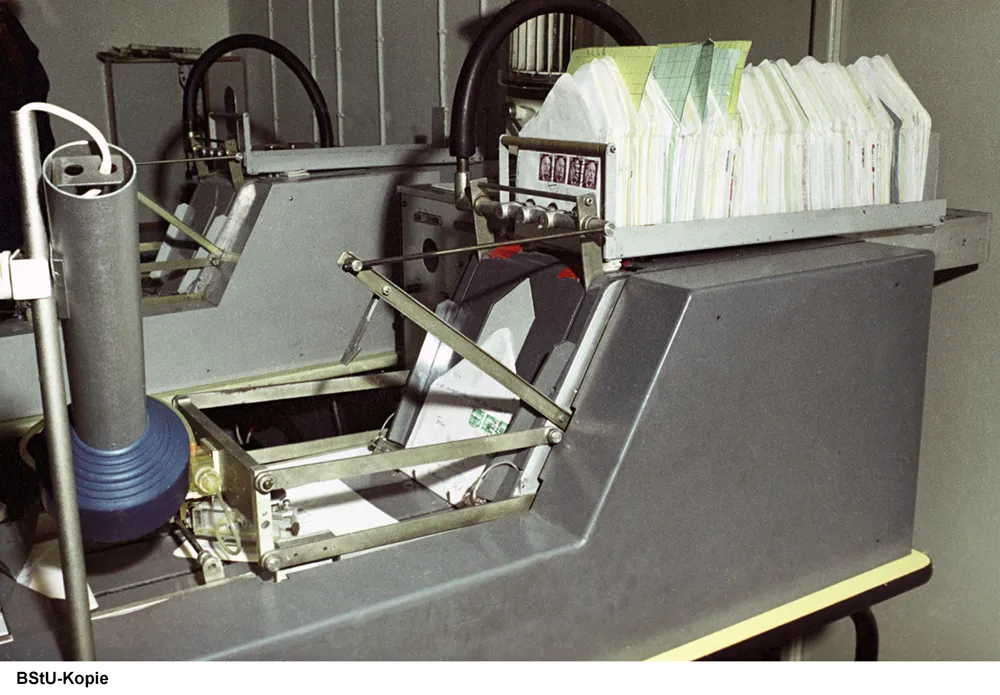
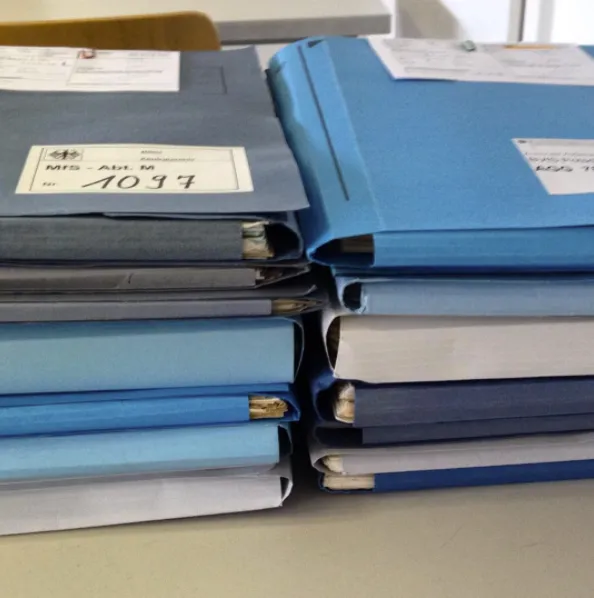
Year: 2017

Stasi / Facebook / Big Data DAAD Day 28 – The Stasi Archive and BStU

After some traveling and conferences and development sprints on other projects I have time this week to come back to the Stasi work. The first post is about the Stasi Records Agency (BStU), whose full name (in English) is the impressive, “Federal Commissioner for the Records of the State Security Service of the former German Democratic Republic”.
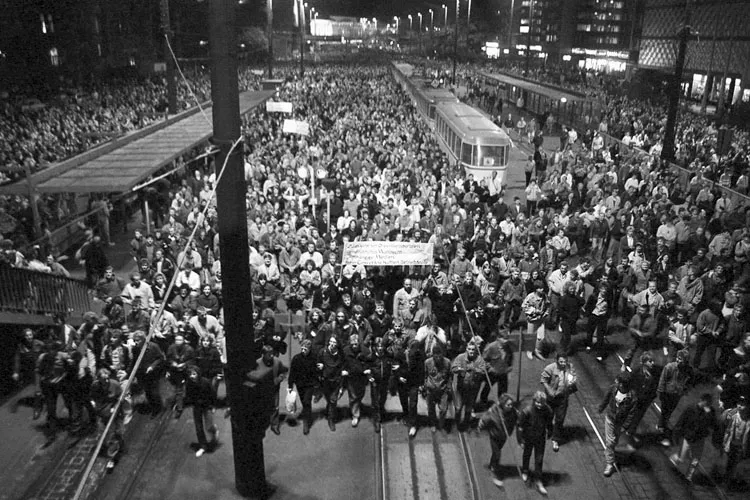

Monday Demonstration in Leipzig on 16 October 1989

At the end of 1989 the Peaceful Revolution spread across the former East Germany. These protests led to the opening of the border via the emotional breaking apart of the Berlin Wall, as well as the end of the reign of the SED government, and with it, the Stasi.

During the transition protesters realized the Stasi agencies were destroying the files that could incriminate them. Groups of citizens occupied Stasi offices across East Germany and sealed the buildings to prevent further destruction of information. On January 15, 1990, citizens gained access and occupied the Berlin headquarters of the Stasi.

After German reunification the BStU was established to preserve the archives and investigate the past of the Stasi. Since January 1992 they have provided a service to allow citizens to view the Stasi files that concern them.

In Berlin the BStU is located at 31 Karl-Liebknecht-Straße, with the files appropriately continuing to be located in the former Stasi headquarters on Frankfurter Allee in Lichtenberg. Here are some photos I took inside the archives in the former Stasi headquarters.
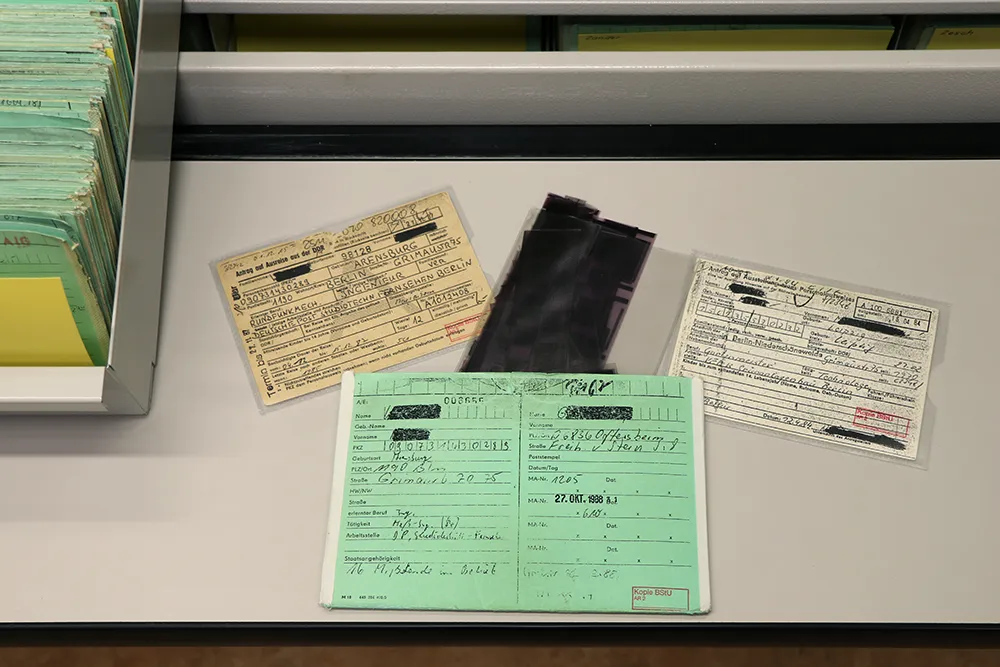

An example card from the Stasi card index now used to locate information for citizens wanting to know what data the Stasi collected, Stasi Records Agency, 2017
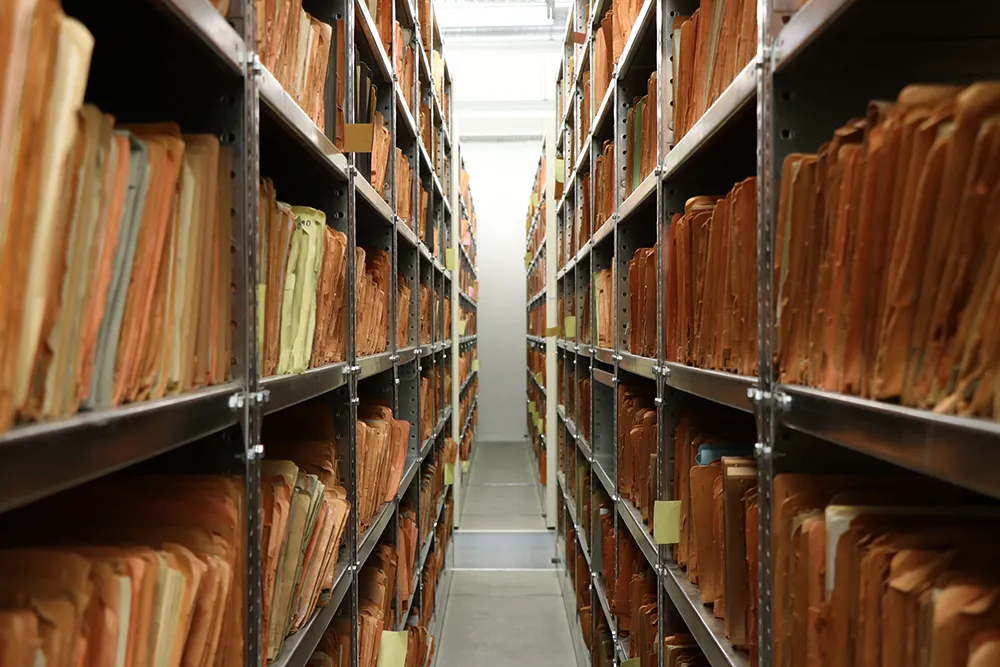

Shelves of citizen files now open to view by the citizens the Stasi surveilled, Stasi Records Agency, 2017
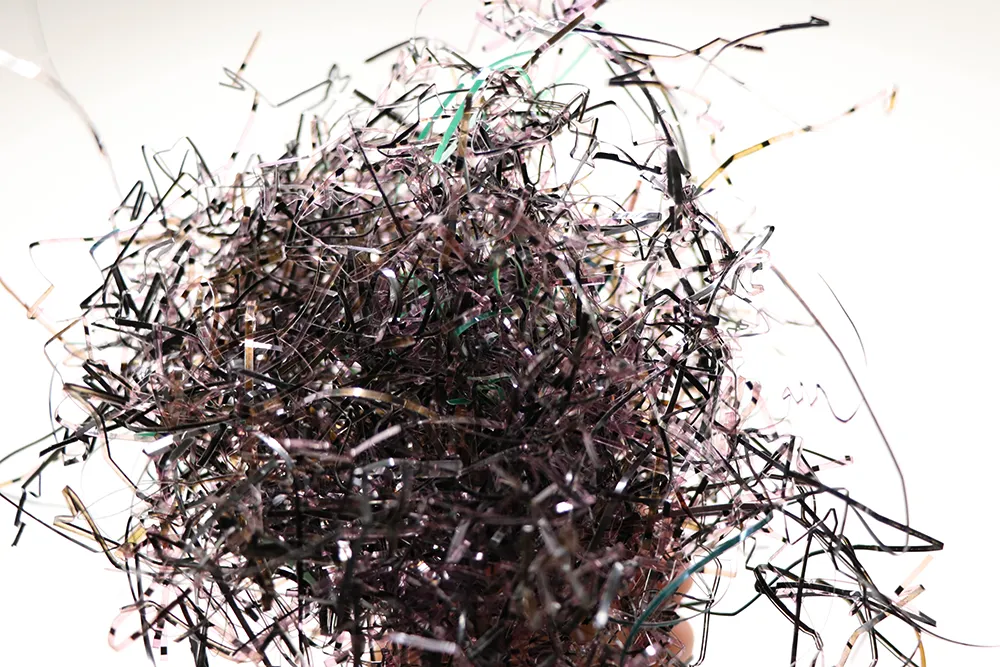

Microfiche shredded by Stasi agents, Stasi Records Agency, 2017
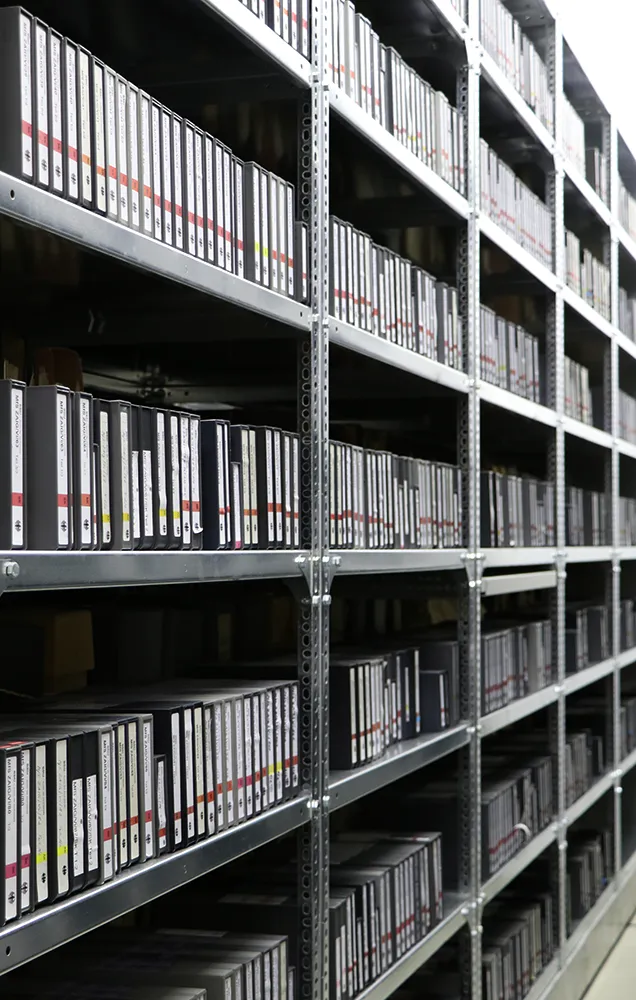

Shelves of surveillance video, Stasi Records Agency, 2017

In addition to providing access to citizen’s files, the BStU assists scholars by allowing viewing of other Stasi documents. In my case, their staff helped me to find and view schematics of postal surveillance machines prepared by the Stasi OTS.
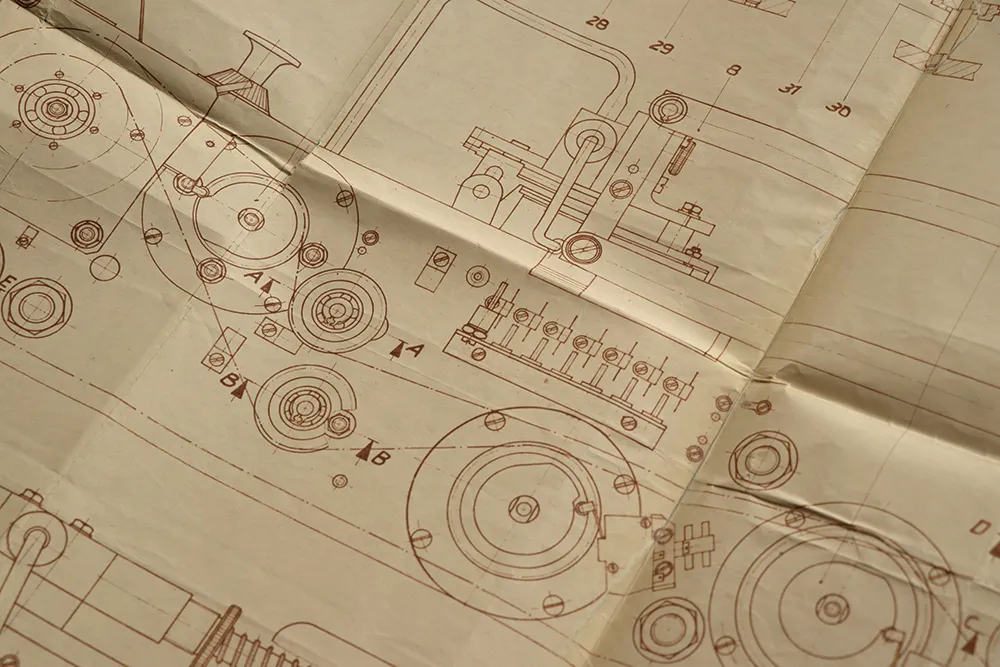

Detail of the Stasi Automatic Letter Closing Machine schematic, Stasi Records Agency, 2017

The BStU also has a thorough library at the Karl-Liebknecht-Straße location. Unlike the Stasi documents, which require one to make an application as a scholar, the library is open to the public.
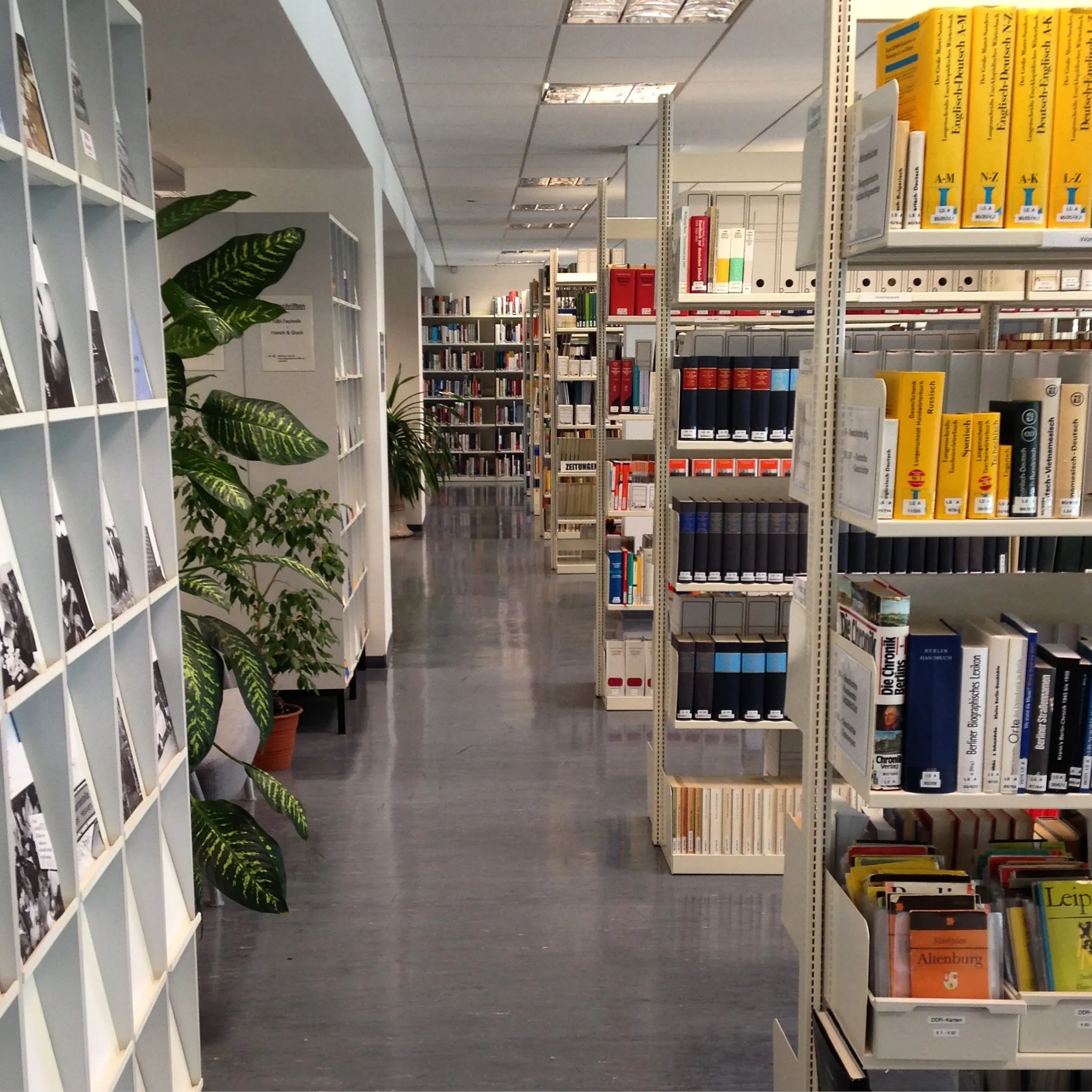

The BStU library, 2017

A Deutsche Welle report on the Stasi archives, 2010

Stasi / Facebook / Big Data DAAD Day 27 – Exhibits on surveillance at Museum für Fotografie

Yesterday I headed to the Museum für Fotografie to see two exhibitions on surveillance.

The Field Has Eyes. Images of the Surveillant Gaze includes 75 prints, books, photographs and examples of optical apparatus to present a visual and cultural history of the controlling gaze from the 16th to the 20th century. I don’t have many images because ironically the museum of photography does not allow photographs.


Daniel Chodowiecki. The Eye of Providence. 1787. Etching, 4 x 5′”

Still, I was able to track down many works online. An example is this one, which focuses on the “all seeing eye” of God as a heavenly entity that watches over everyone like Daniel Chodowiecki’s The Eye of Providence (1787).


Johann Paul Pöhlmann. Gottes Augen schauen auch in die heimlichen Winkel (English: “God’s eyes also look into the secret angles”), Kupferstich: 135 x 165 mm, 1809

This view of God as a watcher later evolved into a sort of big brother figure like in Gottes Augen schauen auch in die heimlichen Winkel (English: “God’s eyes also look into the secret angles”), a copperplate by Johann Paul Pöhlmann from 1809. Here the all seeing eye is essentially a surveillance camera, encouraging potential law breakers to heed the warning that their bad deeds won’t go unpunished. This sort of indoctrination was easily transferred to messages from political bodies wishing to keep the behavior of their citizens inline as nation states emerged.

Watching You, Watching Me. A Photographic Response to Surveillance shows works by 10 contemporary artists using photography to address surveillance. This exhibition was sponsored by the Open Society Foundation.
Stasi / Facebook / Big Data DAAD Day 27 – Exhibits on surveillance at Museum für Fotografie


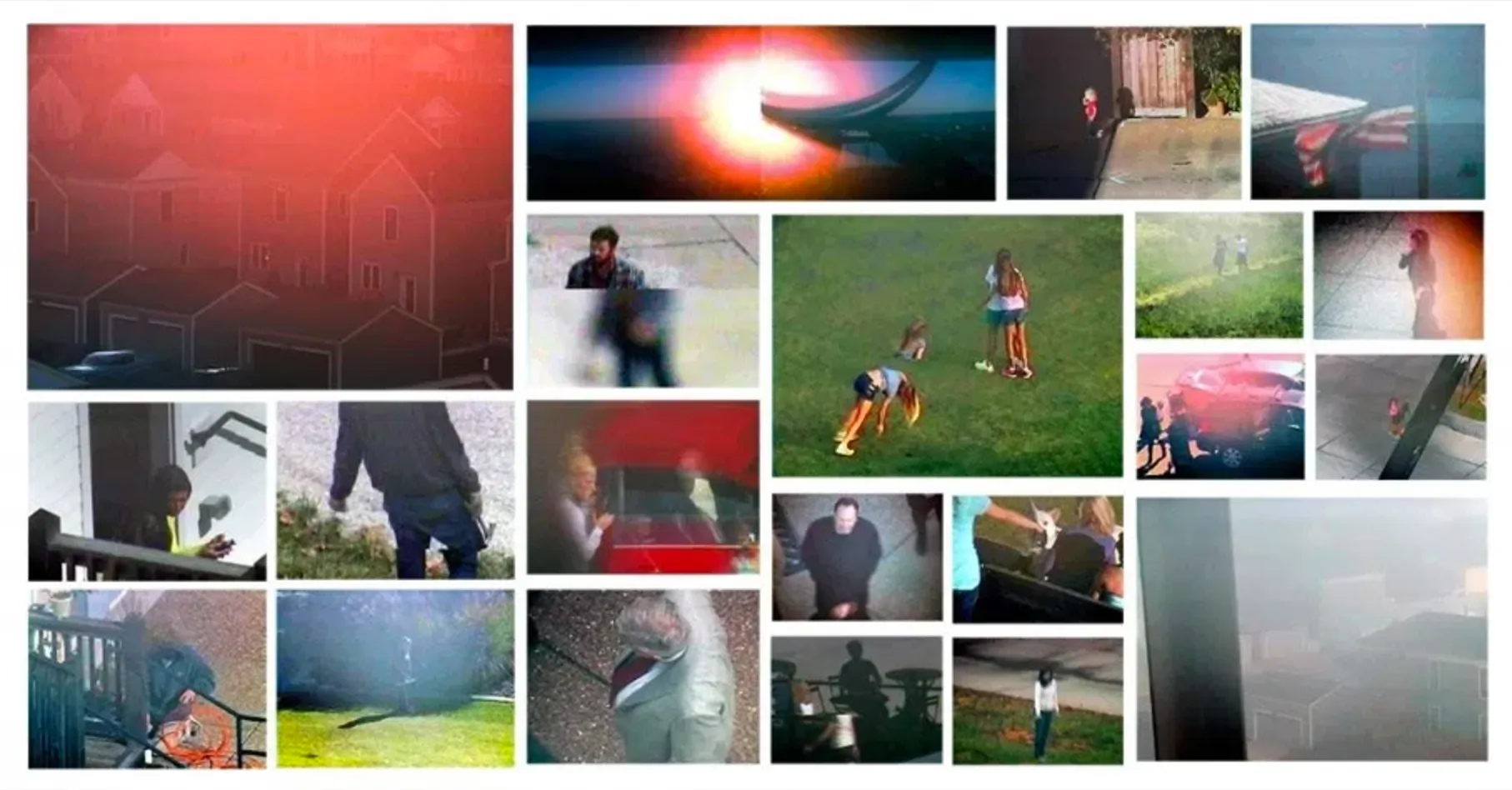
Andrew Hammerand. The New Town. 2013.

In Andrew Hammerand’s The new town (2013), the artist captured surveillance images from a camera placed in the center of an idealized planned community in the American Midwest. These are haunting and beautiful reminders of the gaze of the all seeing eye, and the inability to escape from it in even the most ideal locations.


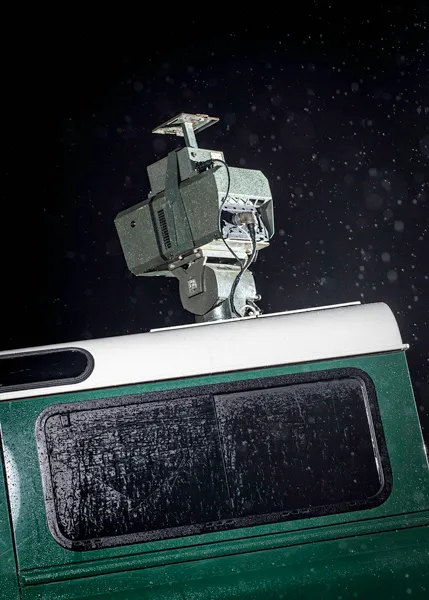
Julian Roeder. Thermal Imaging Camera, Northern Greece, 2012, Archival Pigment Print, 152 x 109 cm


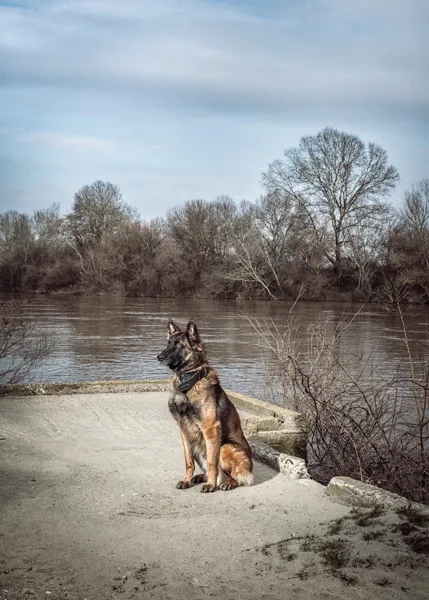
Julian Roeder. Tracking Dog, Northern Greece, 2012, Archival Pigment Print, 152 x 109 cm

Julian Roeder’s Mission and Task (2012) consists of images of the technology and people working in contemporary surveillance at the border of the Schengen zone.

Stasi / Facebook / Big Data DAAD Day 27 – Exhibits on surveillance at Museum für Fotografie


Mari Bastashevski & Privacy International. Private Interests. 2014

Mari Bastashevski & Privacy International presented photographs and evidence of Central Asian governments use of electronic surveillance technologies to spy on activists and journalists, domestically and abroad, in order to clamp down on dissent and to reinforce their political
control. This installation included the stories of several Uzbekistan journalists and lawyers who were surveilled, intimidated, and threatened with prison for their work. This project is covered in detail in this PDF.


Hasan Elahi. Thousand Little Brothers.

In response to questioning by the FBI in suspicious post-9/11 USA, Hasan Elahi created Thousand Little Brothers which includes 32,000 photographs he made during his ongoing project to give the FBI every detail of his life, especially the mundane.
Both exhibitions are up until 2 July, 2017.

Stasi / Facebook / Big Data DAAD Day 26 – Gedenkstätte Berlin-Hohenschönhausen

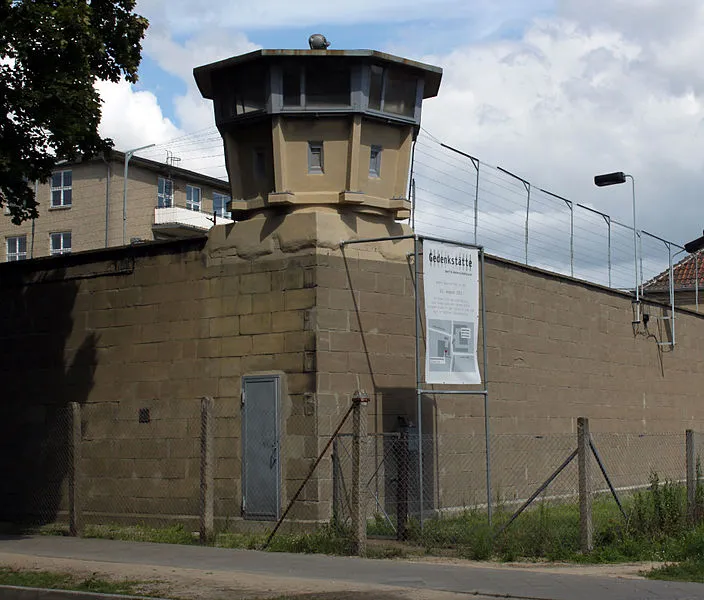
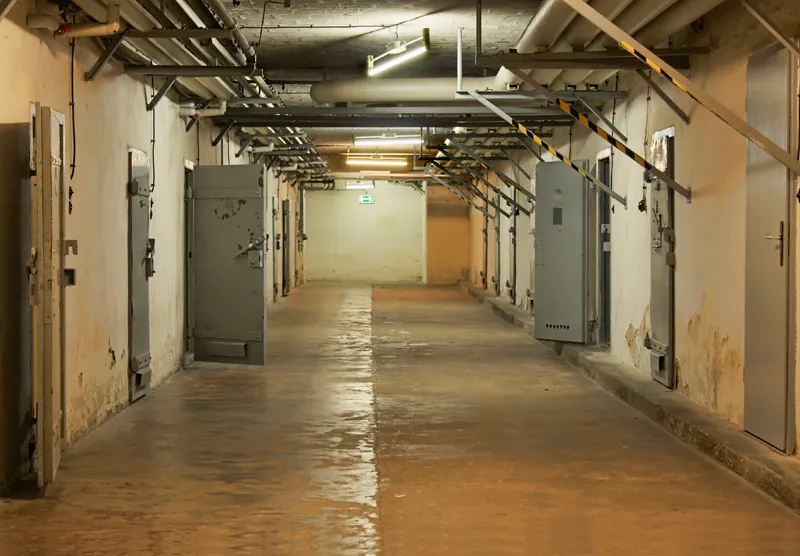
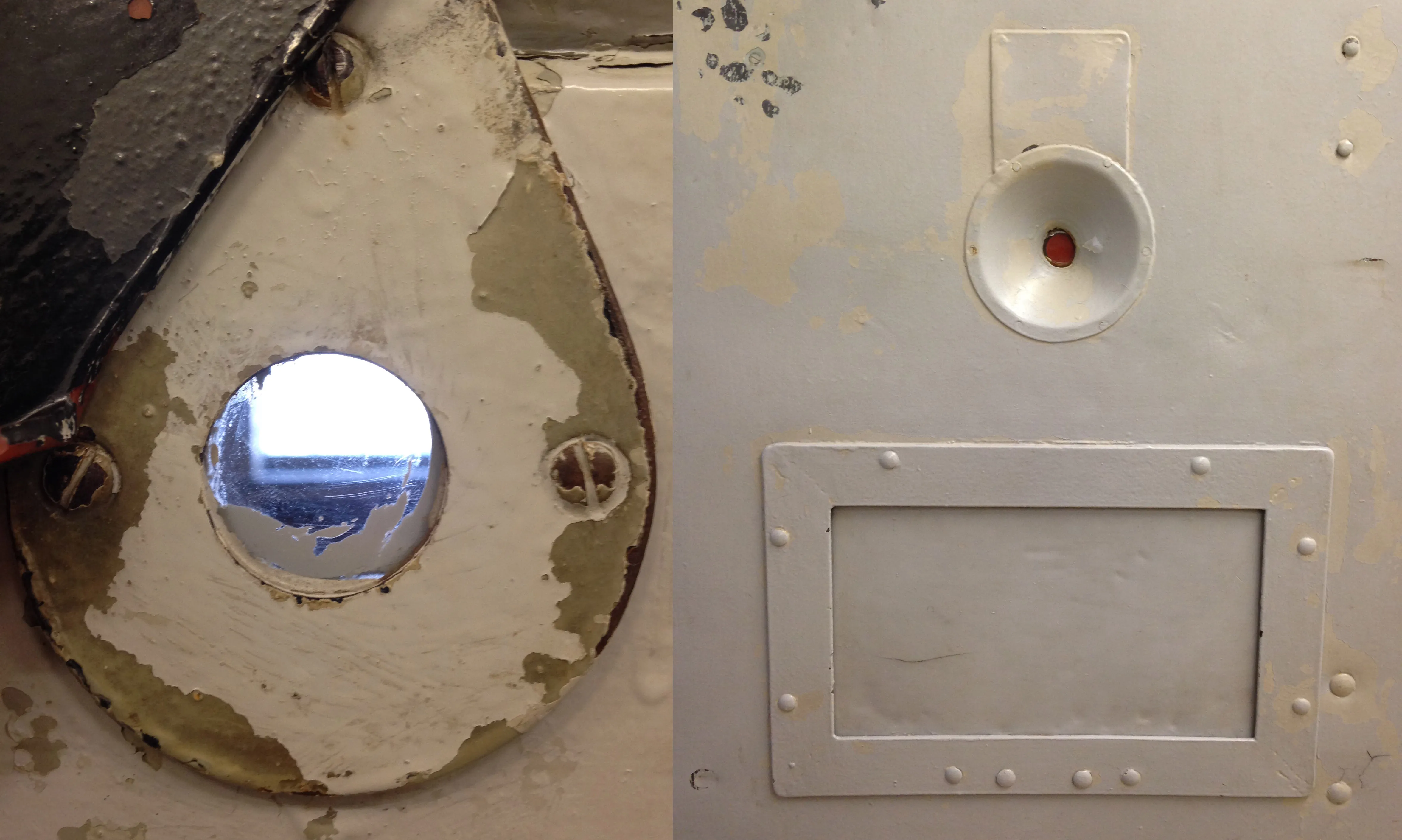
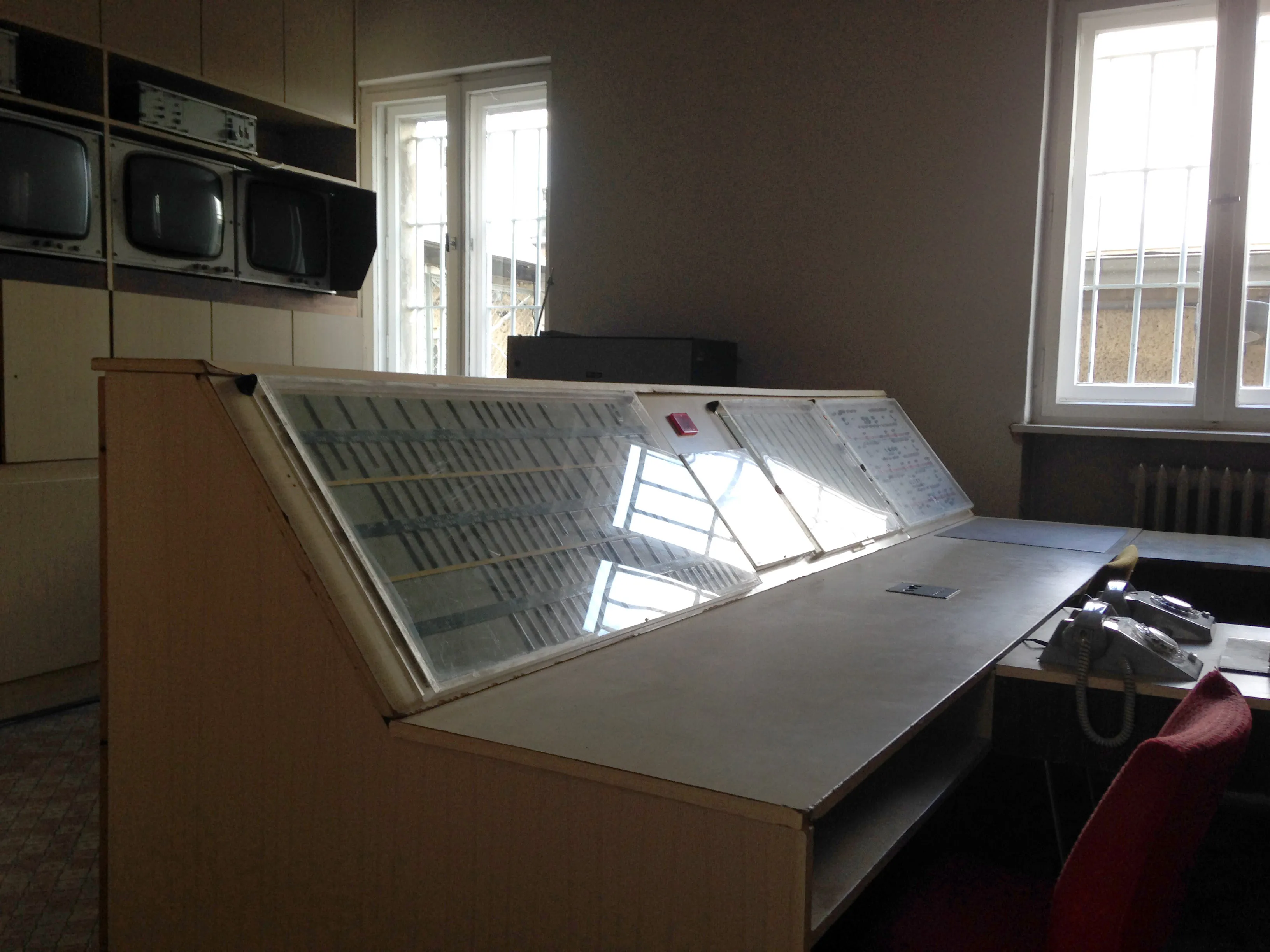
This week has been full of work on this project, including research in the BStU reading room, and making photographs at the archives at the former headquarters and the Stasi Museum. Today, for the first time, I visited The Memorial to Berlin-Hohenschönhausen, a large former prison complex which includes a former Stasi detention and interrogation center. Berlin-Hohenschönhausen began as a Nazi barrack camp for prisoners of war during WWII. After the fall of Nazi Germany it was used by the Soviet NKVD (the secret police) as a camp for interning political prisoners and former Nazis.

The facility was taken over by the GDR Ministry for State Security (MfS) in 1951. For nearly 40 years the MfS used part of it as a secret (it was not located on official city maps) detention and interrogation center. Here, over 10,000 political prisoners were detained and subjected to physical and psychological torture to gain information in preparation for sentencing by the courts.

The MfS staff who worked here were trained at the “Stasi University” (Potsdam) to destabilize and destroy the personality of their prisoners. Their methods included sleep deprivation, isolation, and other harassment that left the prisoners psychologically damaged. They also made references to prisoners’ loved ones, spouses and children, in order to coerce confessions and encourage cooperation.

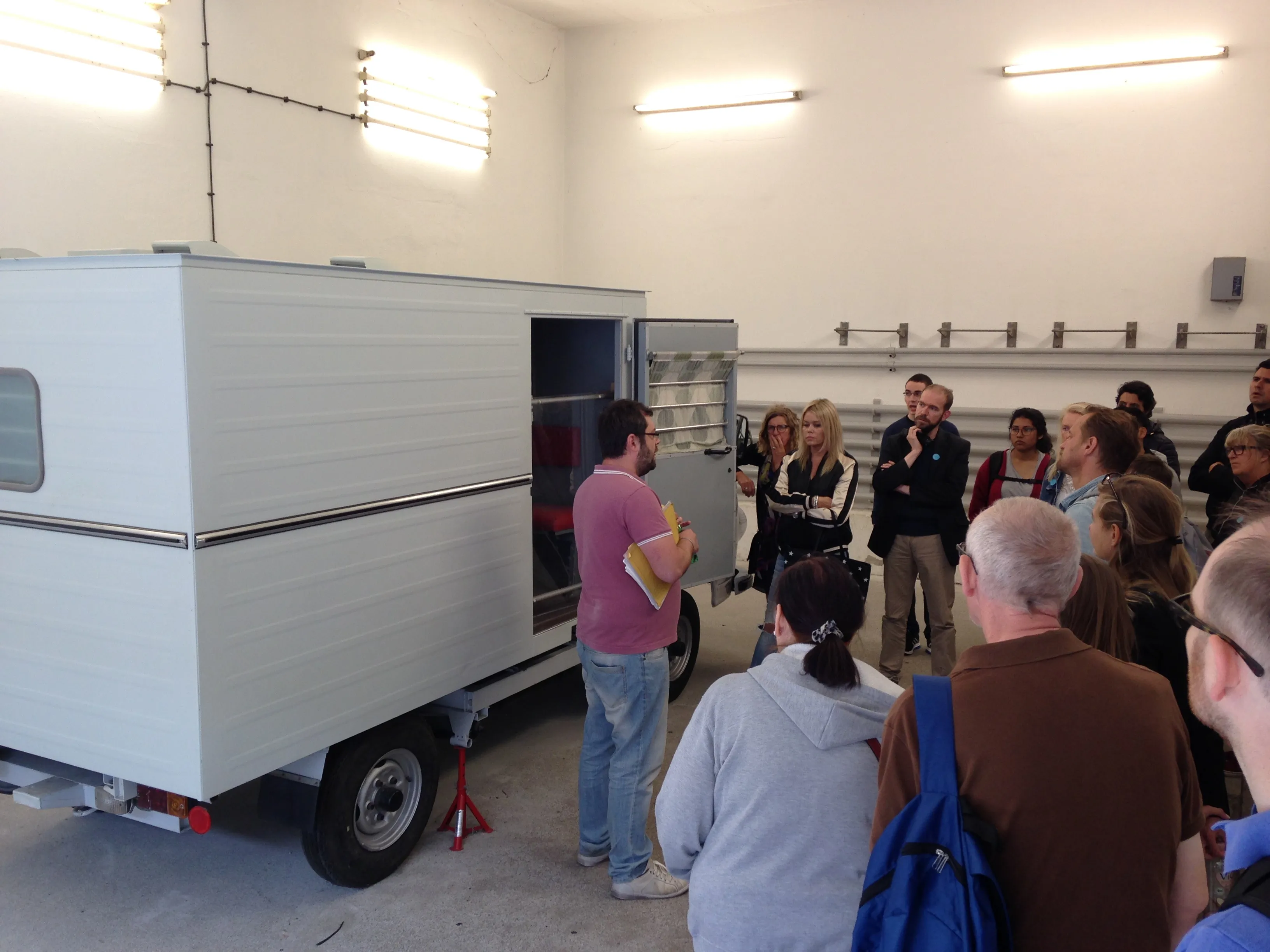
The methods for social isolation were particularly effective. Prisoners were often kidnapped and placed in a cage inside a van disguised as a delivery vehicle. The vehicle would drive around endlessly to disorient the prisoner and then arrive at a special closed-off garage in the detention center.

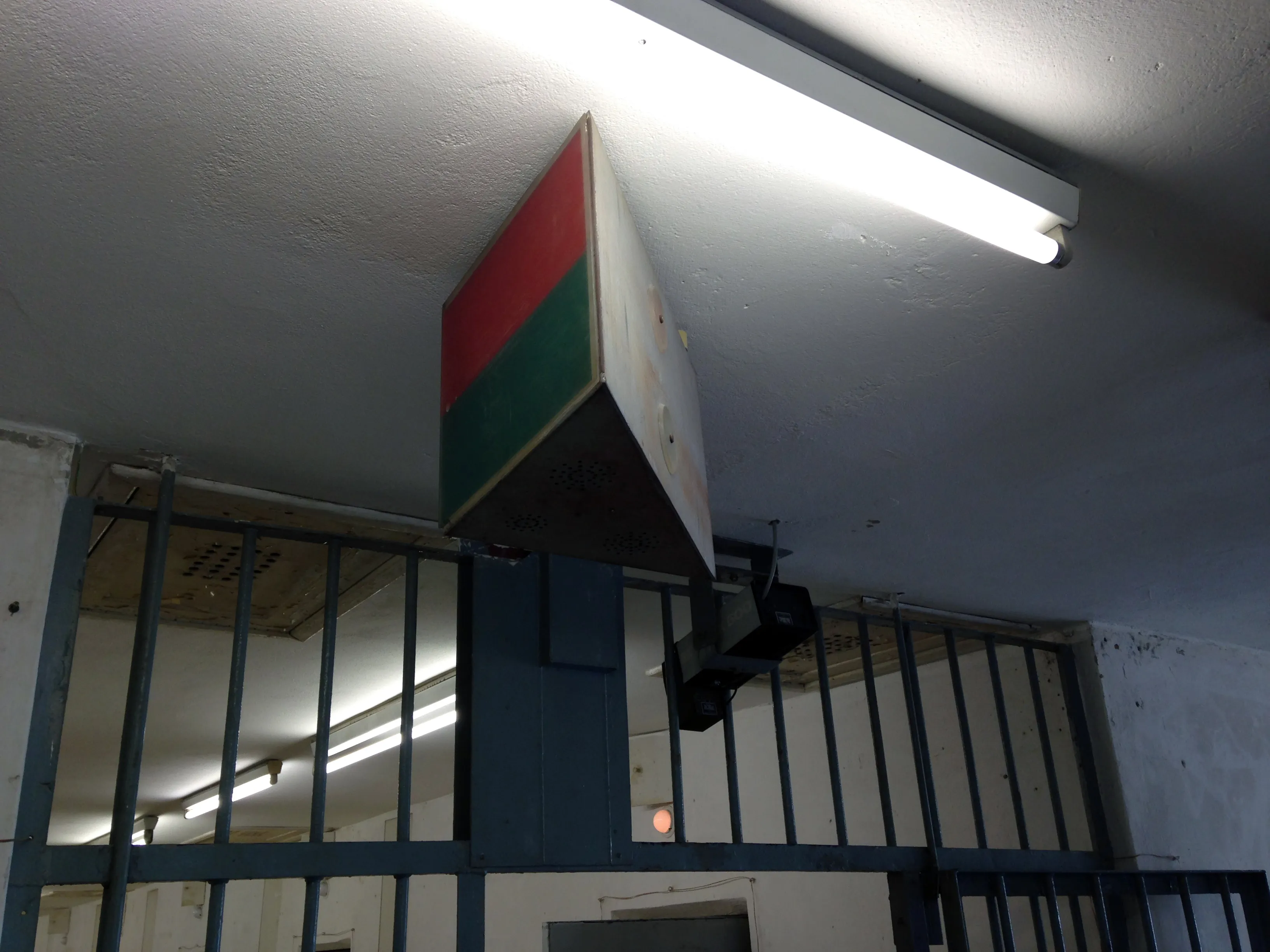
Once inside the buildings an elaborate series of electronic circuits controlled red and green lights in the hallways to direct the flow of prisoners and make certain they would never have the chance to encounter one another.

This last note offers an important comparison to today’s social networks and surveillance capitalism methodologies. In social networks, the organization benefits from the flow of information between participants. They want to stimulate their users to interact and continue generating profit by using the site, producing data, and viewing ads. The Stasi’s torture of political prisoners, on the other hand, intentionally removed all stimulation and human contact. The sensory deprivation and isolation that prisoners experienced in their cells dehumanized, weakened, and prepared them to to give up information the Stasi wanted.

Our information society has transformed the way we think about private information. While we freely give it up in exchange for social capital, companionship, and the serve the impulse to communalize our experiences, it does not mean that the social networks and corporations who deal in that data are not responsible when our information is misused. The recent revelation that the U.K. defense contractor turned data dealer, BAE, sold cyber-surveillance tools to Arab states is proof of this. BAE peddled their sophisticated total surveillance system, with a generic yet telling name, “Evident” (a marketing variation of “criminal evidence”?) to six Middle Eastern countries previously criticised for repressing their citizens. These countries can now use the tool to scour the internet for sites, blogs, and social networks for information on anyone they consider an opponent. A former BAE employee put it like this:

“You’d be able to intercept any internet traffic,” he said. “If you wanted to do a whole country, you could. You could pin-point people’s location based on cellular data. You could follow people around. They were quite far ahead with voice recognition. They were capable of decrypting stuff as well.”

Digital information is inherently insecure. It’s easy to surveill, copy, and duplicate by design. Equally, it is easy to reimplement a surveillance software system that is designed to be sold to do so. The Stasi was a terrible organization, but their work was generally confined to the GDR. There was collaboration across the USSR satellite police organizations, but their work wasn’t on a global market. Looking back at the Stasi provides this evidence; The employees and stockholders of any company that benefits from the sale of such a system to inflict human rights abuses are as guilty as the Stasi employees who worked in the offices and never directly inflicted damage. Surveillance capitalism isn’t just about the profit generated by social network ads, it includes the manufacture and sales of systems like Evident, and all those who derive profit from such decentralized institutions.

Stasi / Facebook / Big Data DAAD Day 25 – Automation in Stasi postal surveillance: Opening letters with sensitive materials using hot air


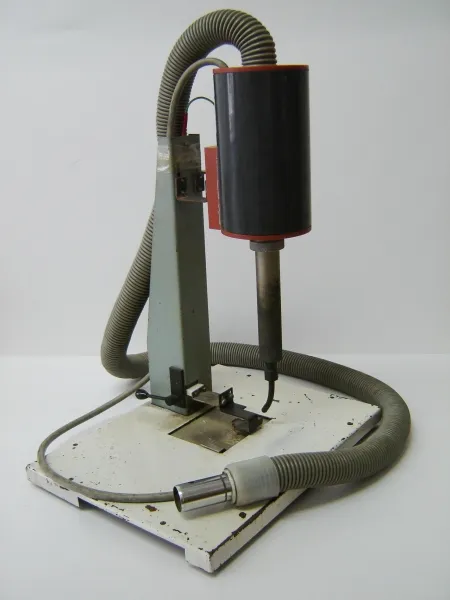
Heißluftgebläse. Credit: Museum in der Runde Ecke

The next artifact in my list is the “Heißluftgebläse”—a hot air blower constructed by the Stasi for opening envelopes and packages sealed with rubberized self-adhesive tape. Unlike the various steam methods the Stasi employed, which only worked on water-based glues and could potentially damage the contents of letters, this machine was used to focus hot, dry air directly to the flap in order to soften and release the adhesive.

Like other “hacked” machines constructed for postal surveillance the Stasi Operative-Technical Sector fashioned this blower using off the shelf, reused, and hand-made parts. In this case, they adopted a commercially-available vacuum cleaner to force air through a heating cartridge and down a steel tube towards a platform where workers laid envelopes. At the end of the tube there is a metal apparatus that could be used to focus the hot air and gently pry the envelope flap open. Impressively, the Runde Ecke index states this method be used to open up to 150 letters per hour.


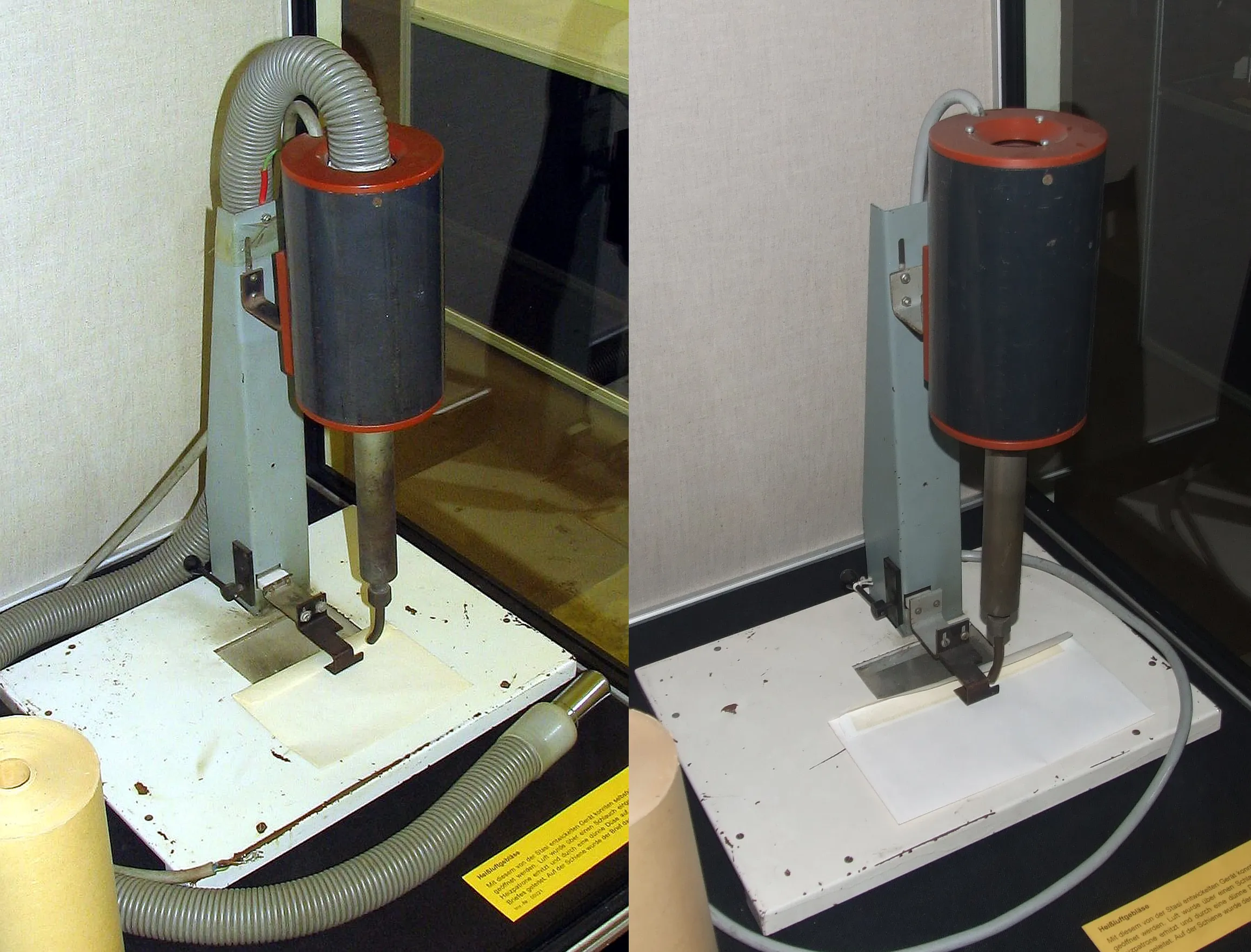
Heißluftgebläse. April and July Credit: Wikepedia user Appaloosa

I’m particularly interested in the different representations of this machine. In these two photographs, both posted by the same Wikipedia user in 2008 just months apart, it appears there were two separate machines on exhibit. This is suggested by comparing the scratches on the base and stand. Yet, while they are clearly different, they are strangely positioned in exactly the same location—an exhibition at the Museum in der Runde Ecke which contains objects found in the Leipziger district administration for state security (BVfS)—with other obvious differences. In the 22 April photo (left) the vacuum cleaner is still attached, showing how the machine was originally used. But in the 27 July image the vacuum and tape have been removed. Was it needed for cleaning in the museum? Where could it have gone? There are additional small differences that point to these being distinct machines, the most noticeable of which is that a different bracket is holding the heating apparatus.

It’s thanks to deviations like this that the telling of the story of Stasi postal surveillance continues to evolve. Aesthetic decisions that seem inconsequential—like a museum staff member replacing the device with the yellowing tape with the one that doesn’t look as disheveled—change how we are able to perceive the past. Here, those moments which make the economic and material constraints the Stasi OTS experienced while hacking and iterating across their analog surveillance devices become less clear. While, thanks to the BTsU we are fortunate to be able to dissect and interpret the methods of the Stasi, it is not possible to collect everything. This unfortunately obscures the parallels with our 21st century hacker culture that, like the Stasi, have grown into immense organizations intent on perfecting and perpetuating their power through surveillance.

  1. Heißluftgebläse zum öffnen von gummierten selbstklebenden Briefen (Inventory no. 00020). Objekt- und Fotodatenbank Online im Museum in der Runden Ecke. Accessed June 13, 2017.
  2. BStU. Die Stasi und das Postgeheimnis. Accessed June 10, 2017.

Stasi / Facebook / Big Data DAAD Day 24 – Automation in Stasi postal surveillance: Opening letters with sensitive materials using cold steam


Credit: BStU

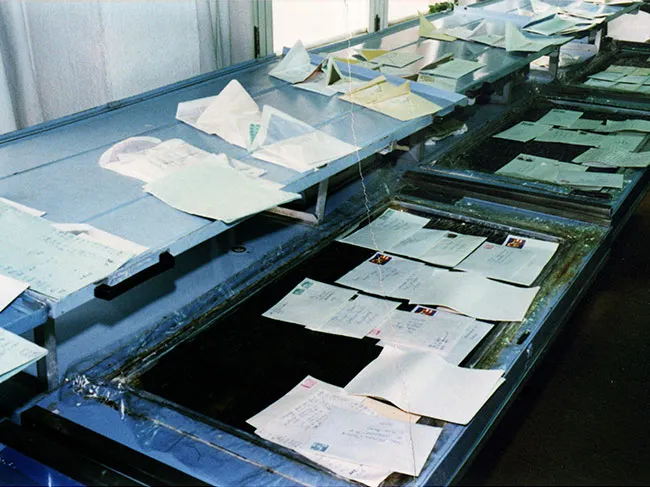
Since hot steam could damage sensitive contents like photographs, the Stasi used the C-83 (“Cellophan 83”) “cold steam” generating device to open those letters. Produced in Hungary, the C-83 used a special film (cellophane) stretched over a tray filled with distilled water. Up to 25 letters could be placed on the film, flaps down, so that when the water in the tray was heated to 50ºC the “cold steam” diffused through the film and dissolved the glue on the envelope flaps.

The procedure was time-consuming because cold steam dissolved the glue at a much slower rate than the hot steam method. Once the glue started to soften, workers had could only lift the letters off the foil for a short time in order to carefully open them using a special spatula.


Credit: BStU

It is unclear if this is an original mass-produced device or is a product modified by the Stasi OTS. It is constructed of painted sheet metal, cast plastic, and other materials that suggest it was primarily constructed in a factory, though it is possible the Stasi made modifications to assist in letter-opening.


Credit: Museum in der Runde Ecke


Credit: Museum in der Runde Ecke


Credit: Museum in der Runde Ecke

  1. Kaltdampf-Öffnungsgerät zum öffnen von Briefen (Zellofanbodengerät) (Inventory no. 00006). Objekt- und Fotodatenbank Online im Museum in der Runden Ecke. Accessed June 13, 2017.
  2. BStU. Die Stasi und das Postgeheimnis. Accessed June 10, 2017.

Stasi / Facebook / Big Data DAAD Day 23 – Automation in Stasi postal surveillance: Work Table for Hot Steam Opening System 532


Credit: Museum in der Runde Ecke

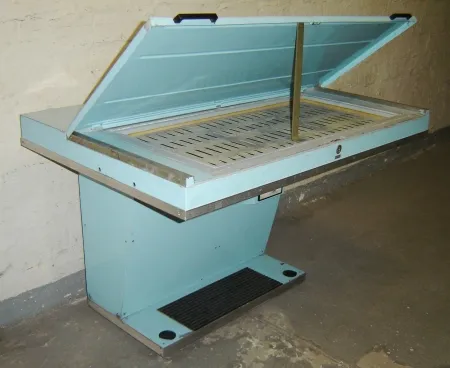
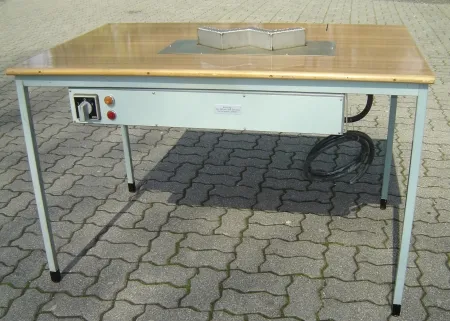
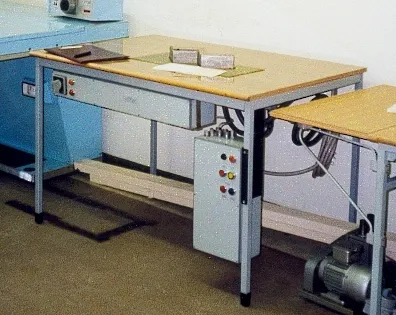
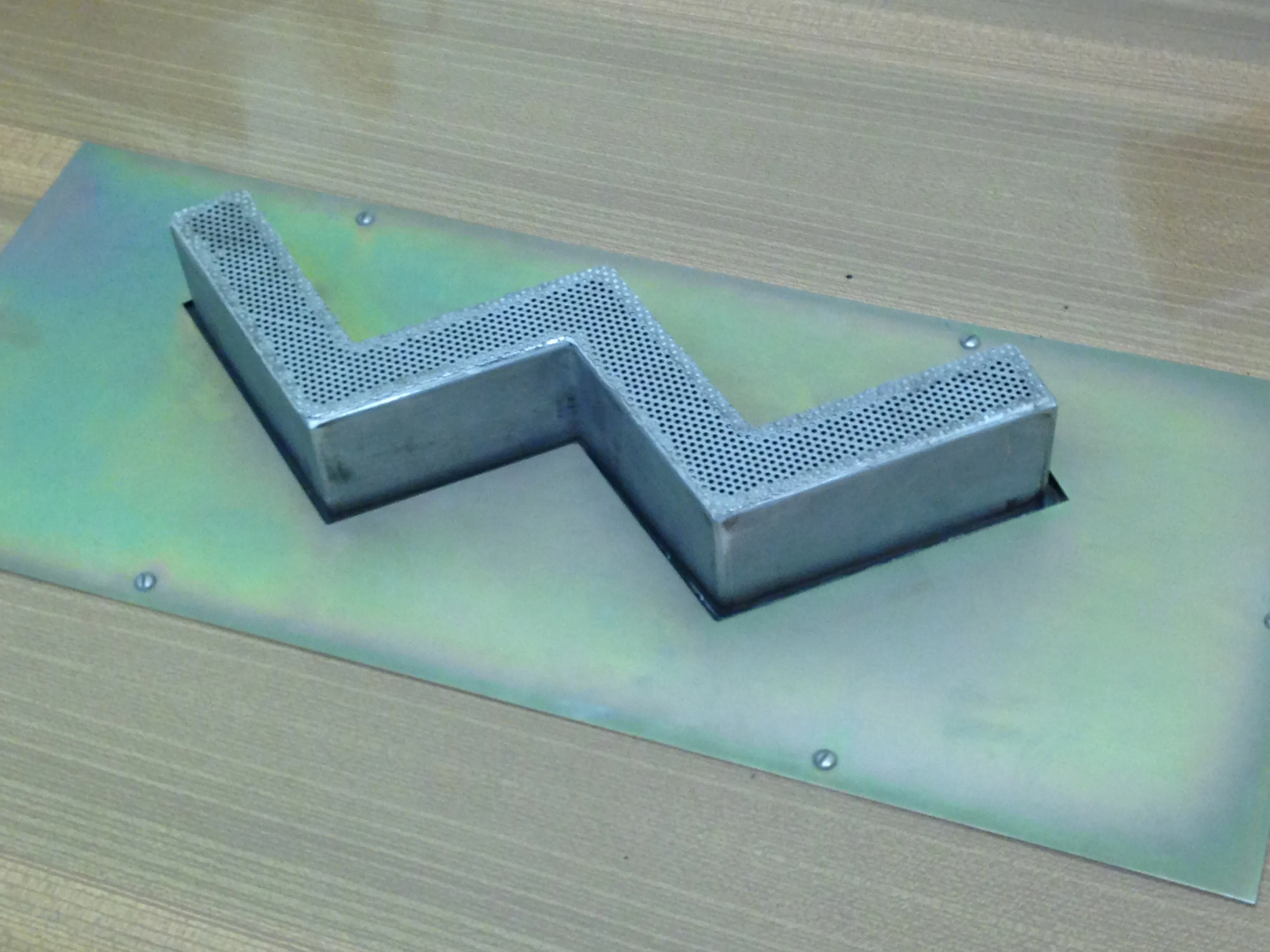
If the “W”-shaped, two-letter steam distribution grid was an “upgrade,” then the ultimate “deluxe” Stasi steam device for manually opening letters with hot water vapor is the “Arbeitstisch der Heißdampf-Öffnungsanlage 532” (English: Work Table for Hot Steam Opening System 532). This modular table was constructed for Department M by the Operational-Technical Sector (OTS) of the MfS in the late 1970’s for manually steaming open envelopes with water-soluble adhesives. The Museum in der Runde Ecke has two of these modified working tables. There is no information on whether “532” is the model number or series number (which would imply there were 531 other models!), and unfortunately I did not record the plate on the front last time in Leipzig, so I cannot confirm its contents until I return.


Credit: Museum in der Runde Ecke

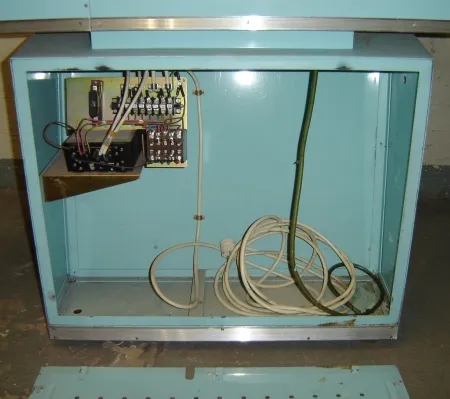
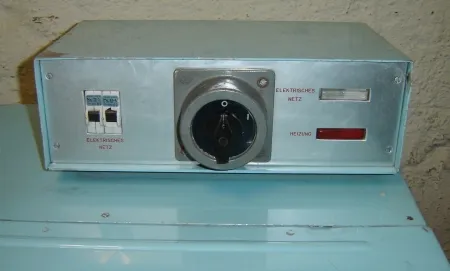
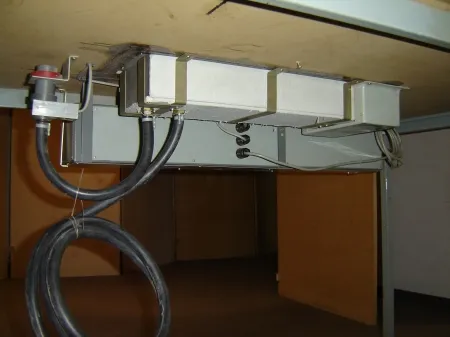
One of the Runde Ecke tables has its own power supply which could be connected to up to three other units to supply power in series (a.k.a. “daisy chaining”). In the center of each table is a “W”-shaped vapor dispersion grid on which two envelopes could be placed. Under the plate is the steam generator, which contained a heater, water storage, and float. While in operation a storage vessel for distilled water was placed underneath. The unit was operated by turning the rotary switch (positions: 0 = “off”, 1 = “pause”, and 2 = “full”) on the attached control panel. Two control lights indicated the operating state of the table, a yellow light which lit when the table was on, and a red light which illuminated when the float inside the steam generator detected that the water was low.


Credit: Museum in der Runde Ecke

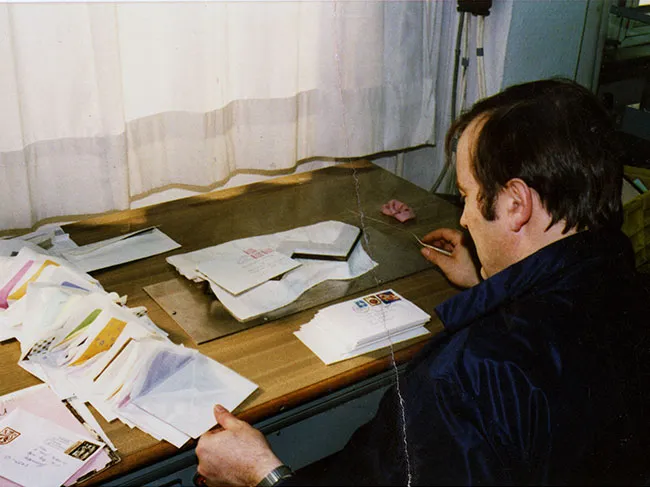
To use the table MfS staff turned the steam generator dial to the “full” position. This activated the heater inside the water receptacle. Once the water reached the correct temperature and began to evaporate the staff placed the flap of the letters on the angles of the W-shaped mesh grids. The vapor, which could reach temperatures of to 100ºC, emerged from the W and dissolved the adhesive. A towel was stretched over the opening to prevent water buildup. Up to 100 letters (between private citizens of the GDR) per hour could be opened on this device.


Stasi staff using the “Work Table for Hot Steam Opening System 532.” Credit: BStU, MfS, Dept. M, Fo 0031, figure 0003

Of the devices I’ve examined so far, this table has little outright evidence that it contains modified parts. Unlike the “hacker aesthetic” of other devices, attention has been given to the various additions to the table to match them to the original. The control panels use commercially-available switches and indicators and are constructed with sheet steel and painted to match the bluish grey steel of the tables. The “W” mesh steam dispersion grid appears to be constructed of aluminum or another treated metal that would not oxidize, and is attached to the table using a plate with measured and symmetrical fasteners. Like the Stasi organization itself, which over time refined their methods according their ideology and what was available, the sharp edges and reused parts on this transformed table are concealed to match the professionalism, efficiency, and attention to detail with which the workers were expected to perform their tasks.


Credit: Owen Mundy

  1. Work Table for Hot Steam Opening System 532 (Inventory no. 00007). Objekt- und Fotodatenbank Online im Museum in der Runden Ecke. Accessed June 10, 2017.
  2. Work Table for Hot Steam Opening System 532 (Inventory no. 00354). Objekt- und Fotodatenbank Online im Museum in der Runden Ecke. Accessed June 10, 2017.
  3. BStU. Die Stasi und das Postgeheimnis. Accessed June 10, 2017.

Stasi / Facebook / Big Data DAAD Day 22 – Automation in Stasi postal surveillance: Aufdampftopf


Credit: Museum in der Runde Ecke

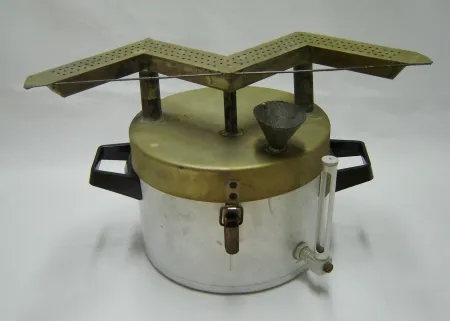
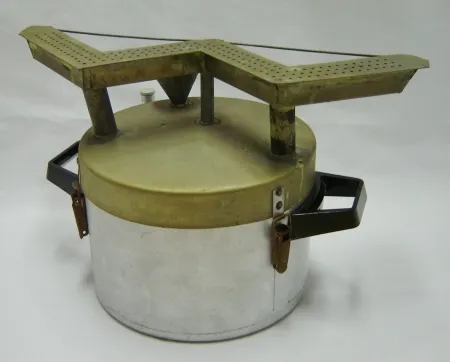
Like other devices constructed in the 1970’s and ‘80s by Department M and the Stasi OTS, this “Aufdampftopf” (“steam pot”) was fashioned using a basic household appliance as a starting point. Starting with a “cooking pot,” as it’s called in the Museum in der Runde Ecke index, the vessel was altered with a tight lid so it could be used to heat water (added via the attached funnel) and generate, collect, and disperse steam for opening letters.

The “W” shape of the vapor dispersing grid on top corresponds to the adhesive edges of, not one, but two envelopes placed end to end on the mesh. Presumably an administrator or other coworker made a human mechanical observation in the spirit of efficiency, suggesting that if the grid was expanded then workers could open two envelopes at once.

Like the Kleindampfentwickler with vapor dispersion grid on its top, the Dampfentwickler made from a steam pot also uses copper tubes and plating in its construction. Likewise, the steam pot additions exhibit a DIY aesthetic that contrasts with the mass produced original object. The copper, again chosen for its malleability and capacity to withstand water, shows signs of use in its darkening patina. It gives the steam pot the appearance of a prop for a dystopian science fiction film, or at least a reference to a real thing, inspiring one to think of a steampunk look popular among cosplayers.


Credit: Museum in der Runde Ecke

The Stasi’s practice of taking bits and pieces from whatever was available might have been based on scarcity given the economic constraints in communist GDR, but their hacked outcomes have a specific “remix aesthetic,” to borrow the term Eduardo Navas uses in his book Remix Theory: The Aesthetics of Sampling. Specifically, the Stasi’s reuse and appropriation of objects and materials towards utilitarian ends expresses itself in the same way the “sampling” of a DJ or musician might. Given the motivations for, uses of, and choices in construction of this device—to secretly open personal communications between individuals and examine their contents (which of course happens on the part of governments and corporations nowadays)—an art historian or anthropologist might term this a classic example of “early hacker”.

  1. Steam generator for opening letters (Inventory no. 00042). Objekt- und Fotodatenbank Online im Museum in der Runden Ecke. Accessed June 10, 2017.

Stasi / Facebook / Big Data DAAD Day 21 – Automation in Stasi postal surveillance: Kleindampfentwickler with nozzle

The Museum in der Runde Ecke in Leipzig has an amazing collection of devices found in the Leipziger district administration office (BVfS) during the dissolution of the Stasi. These are listed online in a thorough index with photos and descriptions. Their images are much better than those I was able to make through the glass of their museum displays, and while I’ve contacted the Citizen’s Committee about making new ones, they hopefully won’t mind if I reproduce some of them here in the meantime.


Credit: Museum in der Runde Ecke

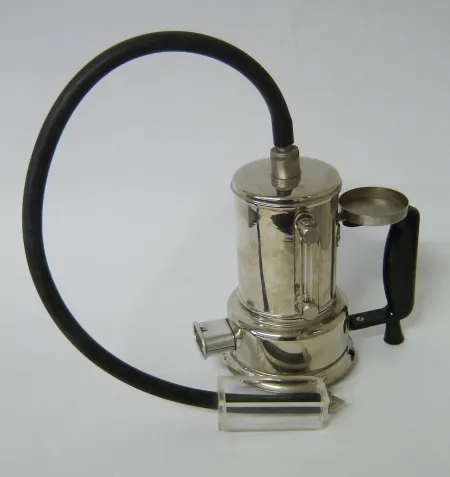
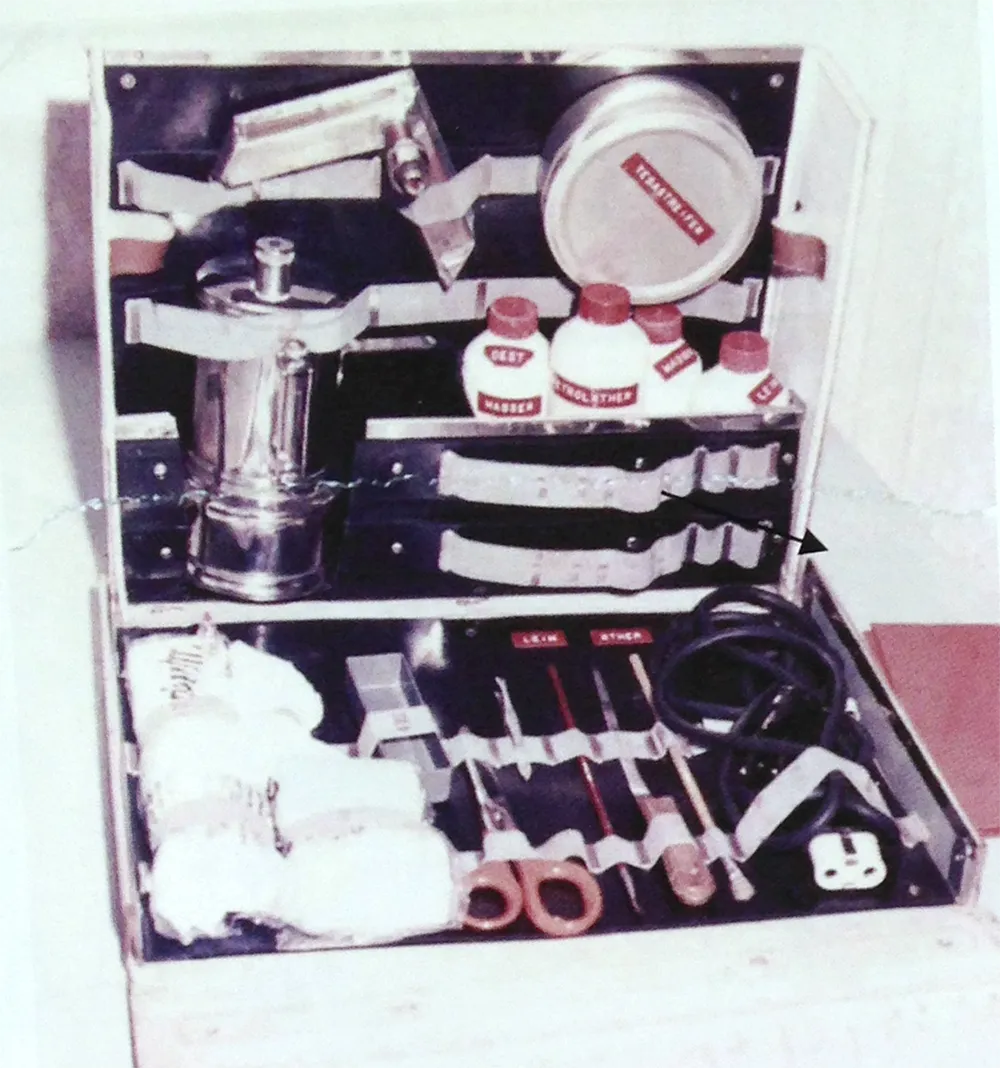
This steam generator was used, like the Kleindampfentwickler in my previous post, for opening “suspicious” letters. The Stasi Department M works directed the steam from the nozzle at the envelope to loosen the water-soluble glue on the flap. Like the Kleindampfentwickler, it was originally a mass-produced device (the Runde Ecke description states it was originally a medical inhaler). It has a glass tube indicating water level, and was stored in a case containing other working materials (which were not preserved) such as “ether, distilled water, glue, knife, scissors, brushes, adhesive strips and cleaning cloths.”

  1. Steam generator for opening letters (Inventory no. 00031). Objekt- und Fotodatenbank Online im Museum in der Runden Ecke. Accessed June 10, 2017.

Stasi / Facebook / Big Data DAAD Day 20 – Automation in Stasi postal surveillance: Kleindampfentwickler

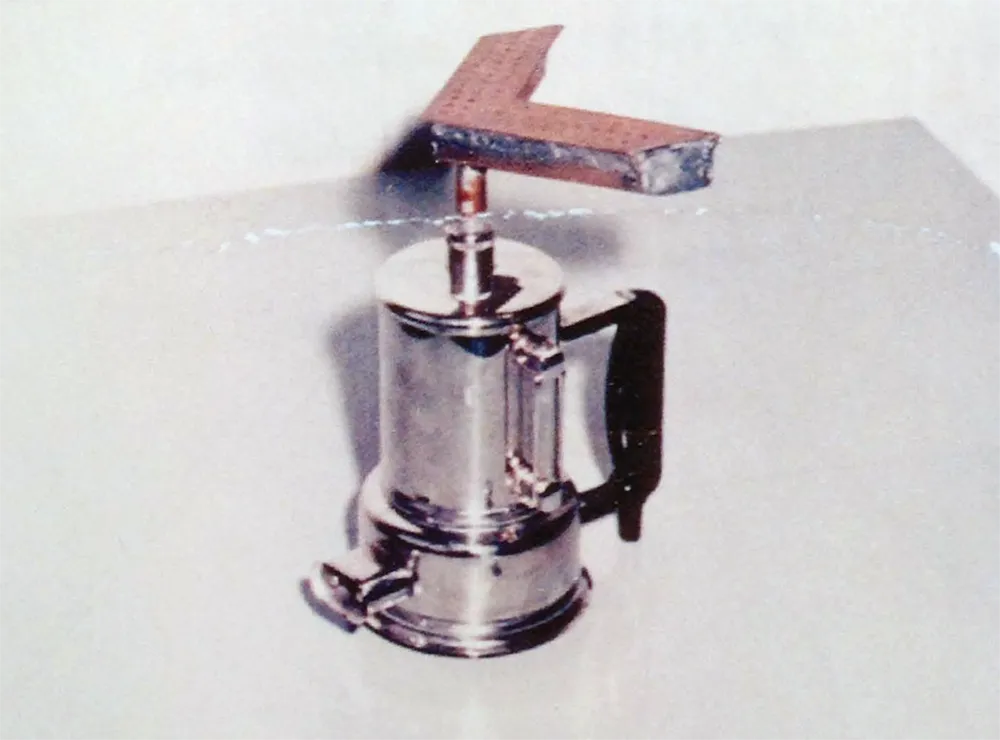
Department M, along with the Stasi OTS (Operativ-Technische Sektor), developed and implemented numerous technical tools, intelligence checks, and operational activities to speed their postal surveillance in the GDR. By the 1970’s, the department was already using various modified household appliances or industrial devices to assist in steaming open and closing letters. One example is this “Kleindampfentwickler”—a “small steam generator,” which appears to be a modified espresso maker or water boiler, with an added, V-shaped steam outlet.


The Kleindampfentwickler (Credit: BStU)

The materials and intentional flat and curved lines in the design of the chrome base and plastic handle suggest it was mass produced. The Stasi probably chose the kettle for the wide base and low placement of the electrical connection which serve to keep the center of gravity low and prevent tipping. They used a V-shape for this and other steam outlets to match the angled shape of envelope flaps. This one is designed to loosen the glue on a single envelope, while other steam outlets could accommodate more.

The crude construction of the modified steam outlet sharply contrasts with the retail-ready kettle. The choice of soldered copper for the material of the pipe leading upwards and steam outlet were probably based on what was available, water resistant, and easy to work with. Copper is used for speciality roofs and gutters, with the seams joined together using heat and solder. The joinery on the Stasi’s addition is not pretty, making it stand out against the base, but it exemplifies the experimental methodologies of the engineers who worked behind closed doors, as well as the belief the aesthetics or secrecy of their work would never be scrutinized.


The Kleindampfentwickler Operational Carrying Case (Credit: BStU)

Stasi / Facebook / Big Data DAAD Day 19 – Automation in Stasi postal surveillance: The PiD Trap

In the beginning of the 1970s most of the work of Department M was performed by hand. This labor included sorting and selecting suspicious mail, manually steaming it open, examining the contents, transcribing, copying or photographing the interior or exterior of the letter, in some cases, examining the letter for conspiratorial or stealth writing, resealing the envelope, and placing the letter back into circulation at Deutsche Post. As the secret operations heightened the suspicions during the Cold War, and with the postal service increasingly relied upon for cross-border communications thanks to the Berlin Wall preventing face to face meetings, Department M received more pressure to increase their efficiency through mechanical means.

One such machine used by the Stasi was referred to as the “PiD Trap.” This electronic device automatically scanned and screened regular letters from printed materials like newspaper excerpts, church letters, and advertisements. Like the organizational systems the Stasi employed, this apparatus made it possible to divide and focus the labor of their workers and expedited the sorting and determination of suspicious mail and “negative” or “hostile” influences from the west in the form of Politisch-ideologische Diversion (PiD). (Labrenz-Weiß, 28)

  1. Hanna Labrenz-Weiß, Abteilung M (MfS Handbuch). Hg. BStU. Berlin 2005.

Stasi / Facebook / Big Data DAAD Day 17 – Stasi networks and Facebook Social Graph

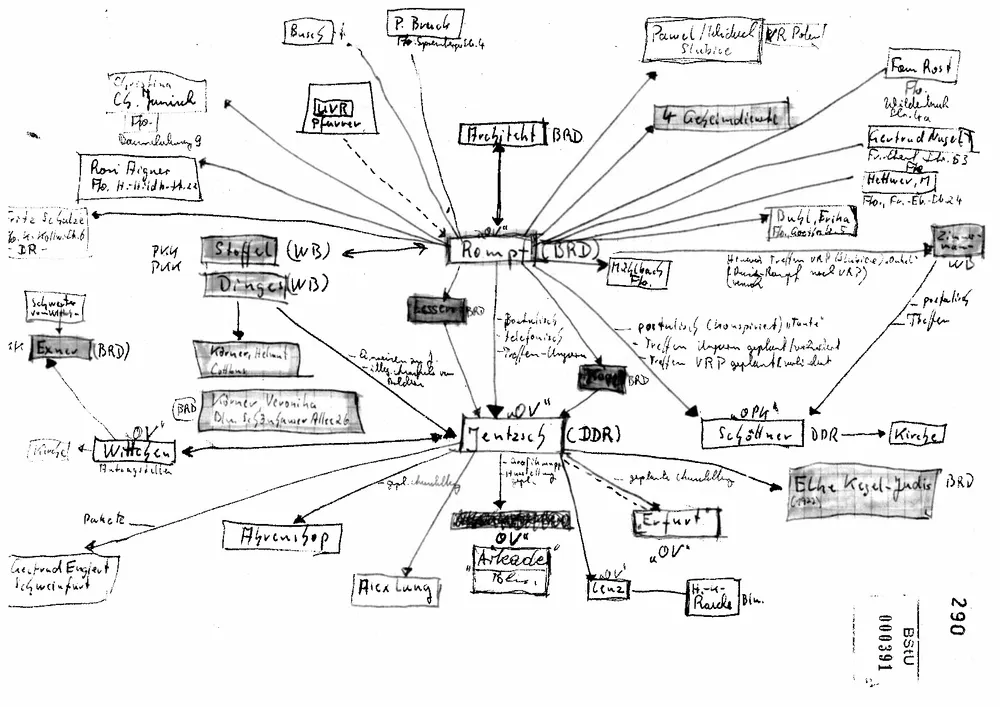
Similar to how Facebook uses a user’s connections to determine information about them, the Stasi considered all information they could gather about a person in their intelligence campaigns. They incorporated not only the contents of a target’s mail, but information about professional and personal relationships, love affairs, and organizations to which they belonged. (Reinicke, 106)


Source: ProPublica/BStU

This attention to not only the contents of a person’s postal communications, but their social connections can be evidenced in this hand-made graphic discovered at the BStU by Julia Angwin. The graphic shows forty-six connections, linking a targeted citizen to other potentially interesting persons (e.g. an aunt), places (e.g. “church”), and meetings (e.g. post, phone). Through whichever means necessary the Stasi made and utilized these connections in order to gain additional insights and institute methods of control.


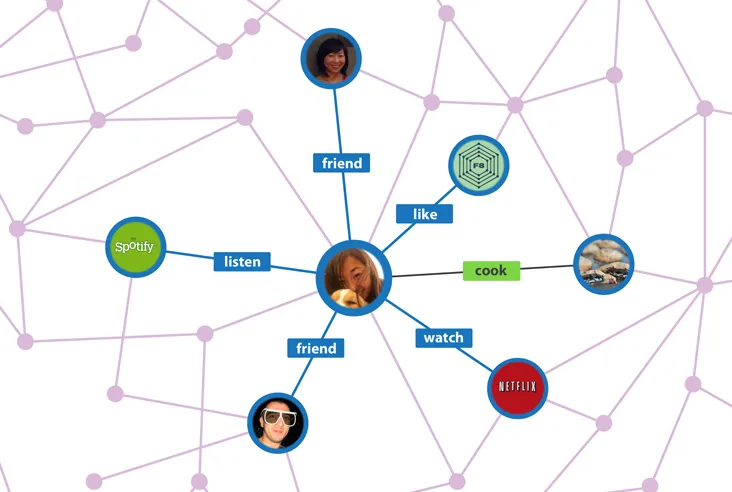
Visual explanation of Facebook Social Graph. Source: Business Insider

This image reinforces the notion that the Stasi’s work was mostly a manual, often experimental, labor. It also tells us their work in surveillance and control, which is seen as a miserable, tyrannical sort, is now standard business practice among the software-automated surveillance capitalist models of the internet used by Facebook, Google, and others. Just as Department M workers like Gerd Reinicke mined the post for intelligence and PiD, the same basic processes the Stasi developed, now used as software by Facebook, are also at work in China, Iran, and other countries to filter and control what people can say and read through elaborate censorship software systems.

  1. Hanna Labrenz-Weiß. Abteilung M (MfS Handbuch). Hg. BStU. Berlin 2005.
  2. Reinicke, Gerd. “Mitlesen für den Klassenkampf: Postkontrolle der Stasi”. In: Heimliche Leser in der DDR: Kontrolle und Verbreitung unerlaubter Literatur (ed. Siegfried Lokatis). Berlin, 2008.
  3. Angwin, J. (2017). You Know Who Else Collected Metadata ? The Stasi. ProPublica, 6–8.

Stasi / Facebook / Big Data DAAD Day 16 – Notes from a former Department M surveillance operator (part2)

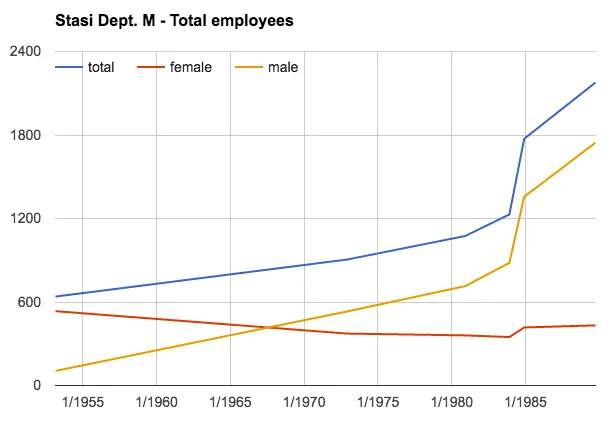
During the seven years Gerd Reinicke worked for Department M the scope of surveillance grew steadily. This is particularly evident in the 1980s, when as the government became more and more concerned of the “class struggle,” they dramatically increased the number of operators in Department M, more than doubling the size from 1980 to 1989.


Stasi Dept. M – Total employees (data from Abteilung M (MfS Handbuch). Hg. BStU. Berlin 2005.)

Reinicke and his coworkers in the “Evaluation and Information” unit constantly tried to increase the “Trefferquote” or “hit rate” of material worthy of confiscation by memorizing large numbers of postal codes, names, and handwriting. Their shift managers carefully sampled the work of individual employees, checking for missed letters, which could result in punishment and disciplinary measures.

Once a citizen or group had been classified as “operationally interesting” then all their mail was withheld for inspection. Citizens of the GDR who sent private messages critical of the government or its leaders through the mail first, had their mail confiscated, and second could be brought to court on charges of “anti-state agitation” according to Section 106 of the Criminal Code of the GDR. (Reinicke, 105)

  1. Reinicke, Gerd. “Mitlesen für den Klassenkampf: Postkontrolle der Stasi”. In: Heimliche Leser in der DDR: Kontrolle und Verbreitung unerlaubter Literatur (ed. Siegfried Lokatis). Berlin, 2008.

Stasi / Facebook / Big Data DAAD Day 15 – Notes from a former Department M surveillance operator

In the essay, “Eavesdropping for the class struggle: Postal control of the Stasi,” from the book, “Secret readers in the GDR: Control and distribution of illicit literature” (ed. Siegfried Lokatis), Gerd Reinicke describes his work in the “evaluation and information” section of the Stasi’s Department M. He explains his job was to assess and classify the contents of mailings, personal letters and printed materials, and in extreme cases, make decisions about confiscation.

This work was not easy. The stream of mail was constant and so he had a limited time frame for his work. He operated in secret, but also had to consider the public perception of his decisions. While technically illegal, the government watched all mail moving within the country, as well as that leaving or arriving in the GDR. As far as the population was concerned it was an “open secret,” because they observed the effect of the government’s policy of opening mail to remove valuable items, as well any writing or media considered to be “Politisch-ideologische Diversion (PiD)” (English: “Political-ideological Diversion”)—a task which was not as clear as it might seem.

Upon his hire was told to collect information on people and facts that might be “operatively interesting” to intelligence services. But he also received instructions to remove “anything unnecessary.” This work reflects the dual role that Department M played for the SED as a surveillance and control mechanism. On one hand, they watched for communications between spies or dissidents, but they were often a censorship apparatus.

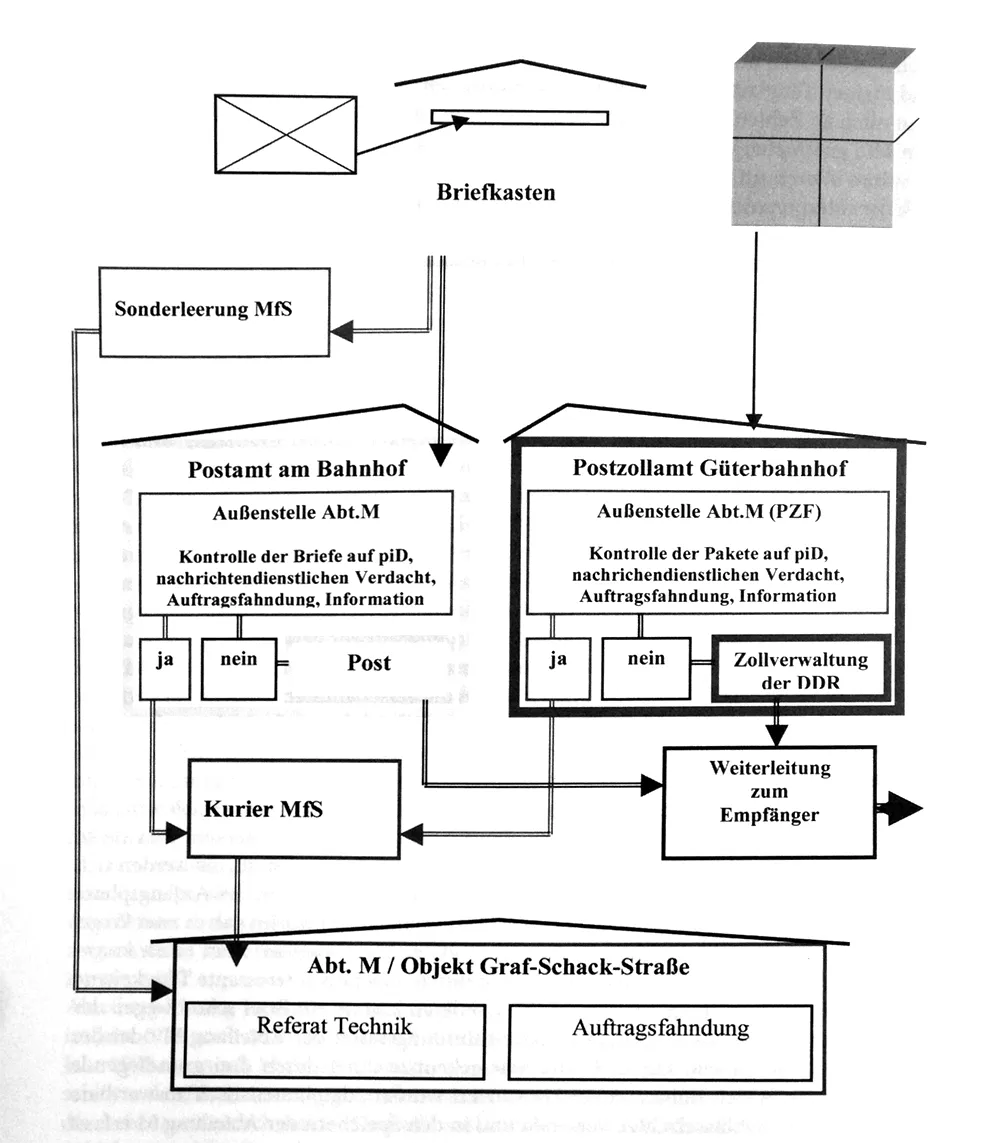
This flowchart shows the three basic categories by which mail was classified, and subclassified, specifically, as “messages suspicious of being intelligence communications,” “messages suspicious of being PiD,” and “messages determined to be ‘interesting content’.” The assignment into of any of these categories determined further routing into the Department M machinery.


Heimliche Leser in der DDR: Kontrolle und Verbreitung unerlaubter Literatur (ed. Siegfried Lokatis)

These broad definitions also underline the ambiguity in how their surveillance and censorship was officially applied. For example, in dealing with Western and dissident literature, these instructions were followed in different ways. Sometimes operators were generous in their interpretation of “class struggle appropriate” materials, while other times he characterizes their subjective interpretation as “petty.”

  • Hanna Labrenz-Weiß. Abteilung M (MfS Handbuch). Hg. BStU. Berlin 2005.
  • Reinicke, Gerd. “Mitlesen für den Klassenkampf: Postkontrolle der Stasi”. In: Heimliche Leser in der DDR: Kontrolle und Verbreitung unerlaubter Literatur (ed. Siegfried Lokatis). Berlin, 2008.
  • Stasi / Facebook / Big Data DAAD Day 14 – Department M OibE groups

    Thanks to the implementation of index cards across the MfS, Department M had access to sender and receiver addresses, contacts, relatives, etc. to inform their surveillance work. By 1970, the department had instituted the following operational steps for examining mail. Numbers 3–6 were considered highly secretive and operations were performed under the codename “Eagle Flight”.

    1. Check if the sender or recipient existed in the police card index
    2. Establish an “Operational Comparison Card” to record information found in the mailing
    3. In the case of a suspicious mailing, carry out a search of the mail box
    4. Create photographic documentation of letterheads
    5. Compare the handwriting or typewriting font, spelling, etc. of the letter head. Identify any stealth writing.
    6. Form a special “OibE” group to check mail boxes.

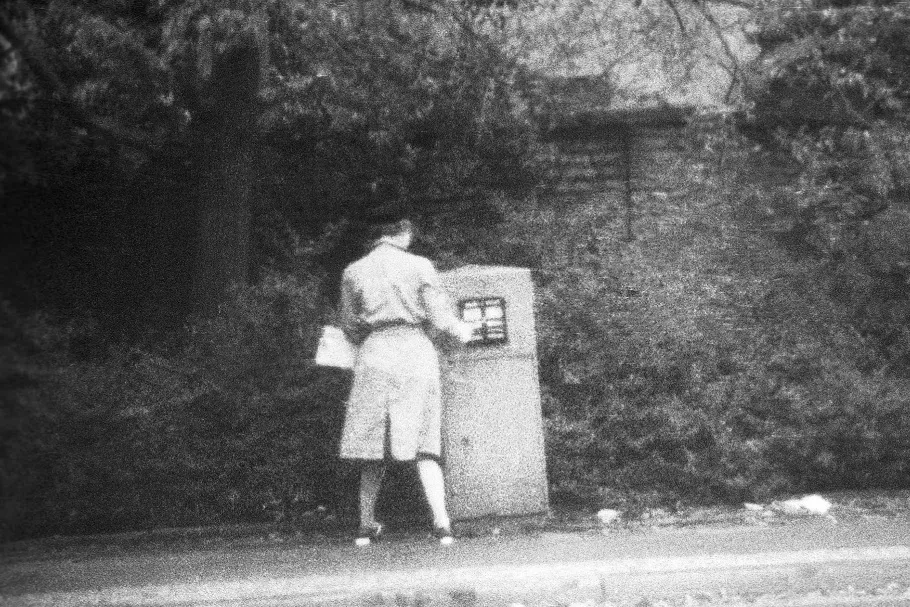
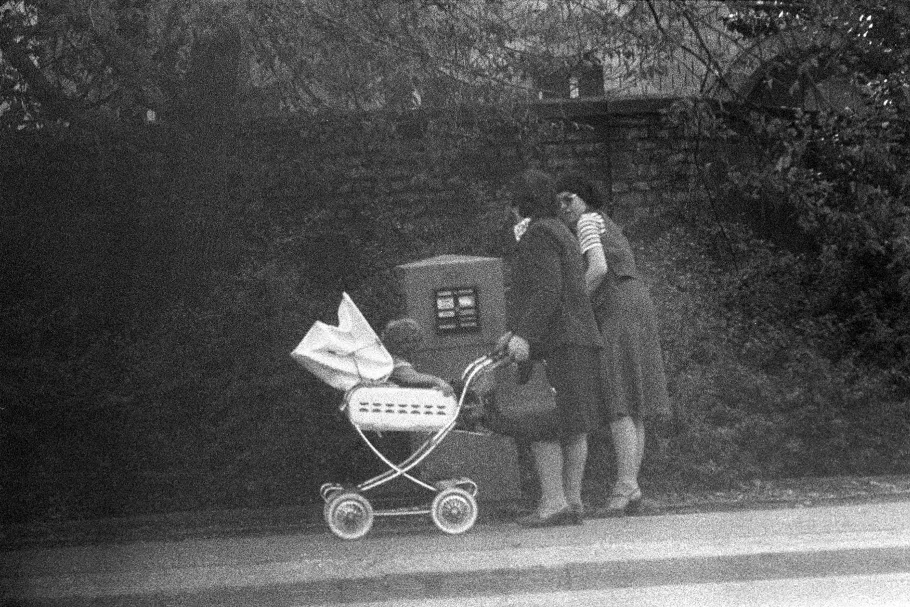
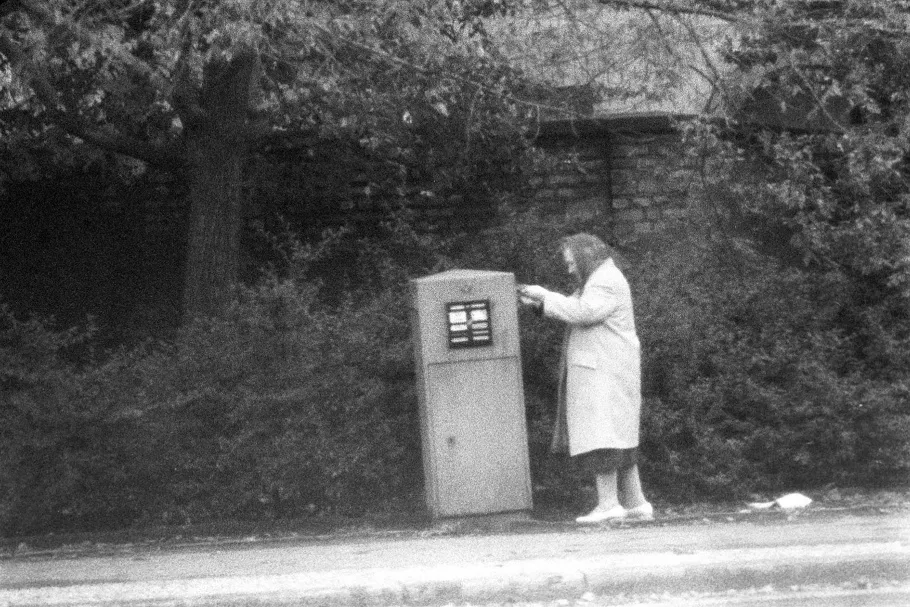
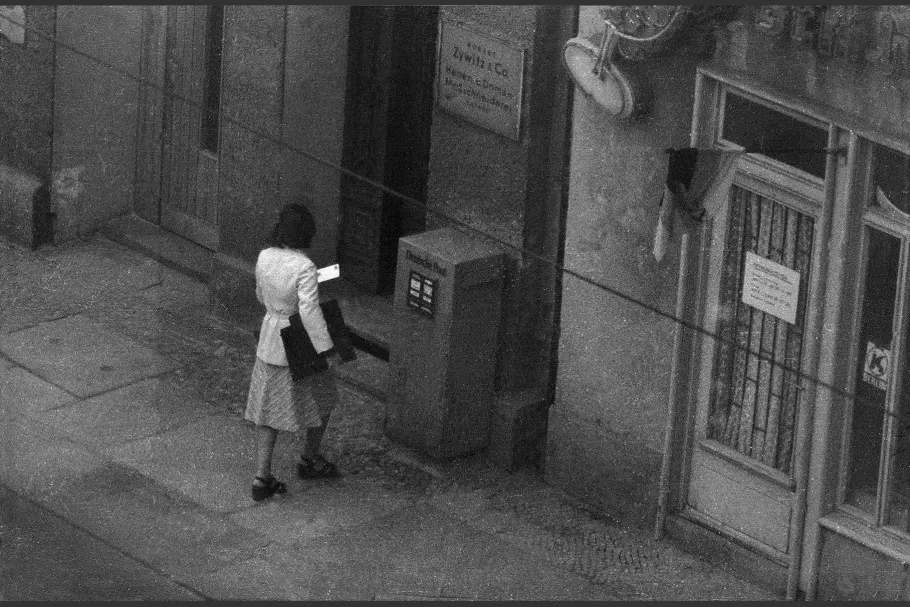
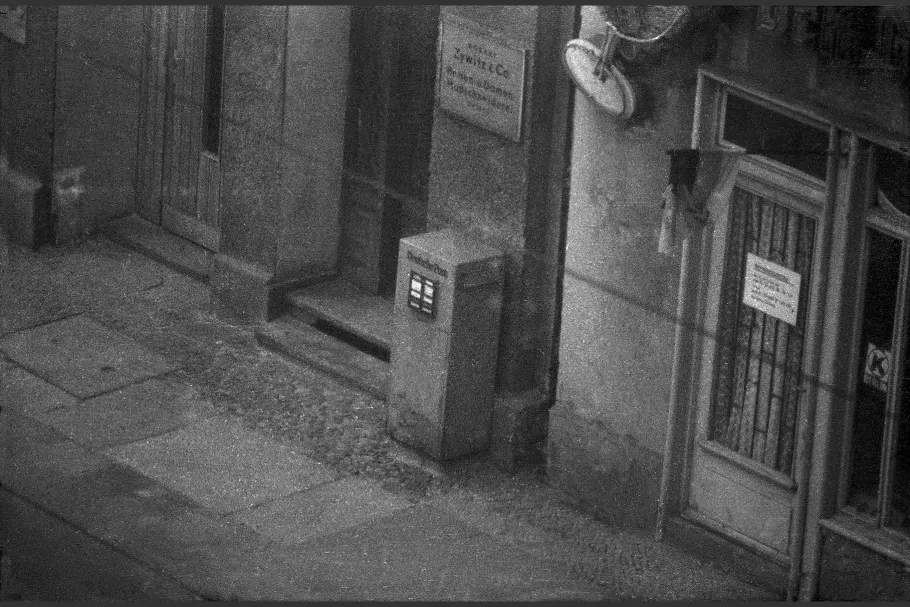
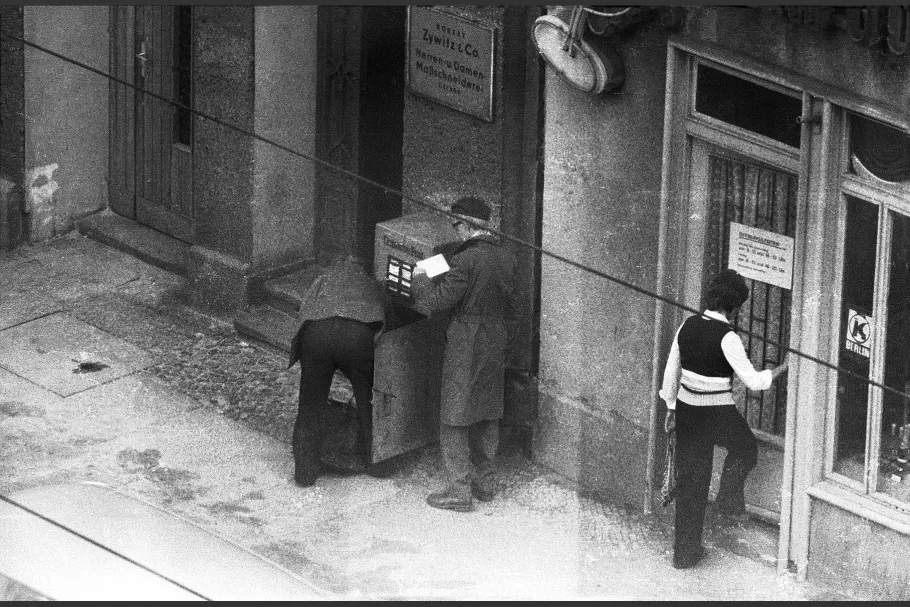
    Offizieren im besonderen Einsatz (OibE) (English: Officers in Special Operations) groups were formed specifically to monitor, and in some cases, empty mailboxes under the cover of the Deutsche Post uniforms and vehicles. They photographed persons of interest as they dropped mail off, and then opened the mail boxes and examined the contents of letters before they even reached the post office. Photographic records of their work exist, and were presented in the exhibition, “Ein offenes Geheimnis. Post- und Telefonkontrolle in der DDR” (English: “An open secret. Postal and telephone control in the GDR”) (Labrenz-Weiß, 22–24)


    Source: BStU

    1. Hanna Labrenz-Weiß, Abteilung M (MfS Handbuch). Hg. BStU. Berlin 2005.

    Stasi / Facebook / Big Data DAAD Day 13 – The Stasi’s Electronic Databases

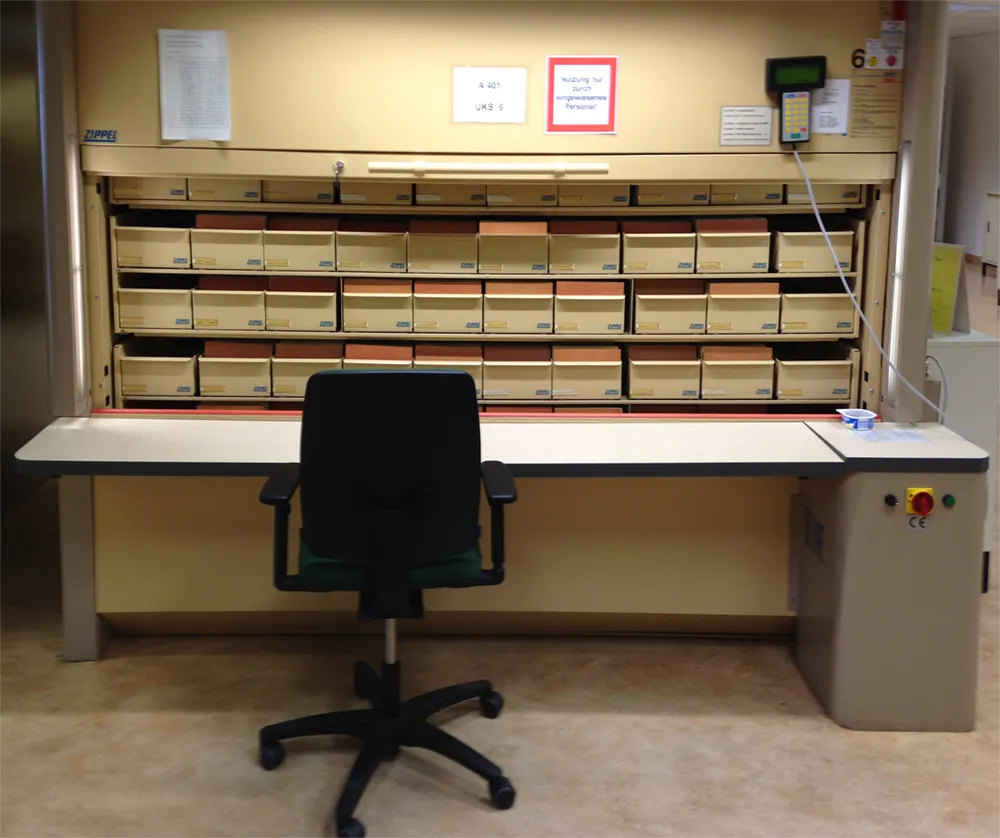
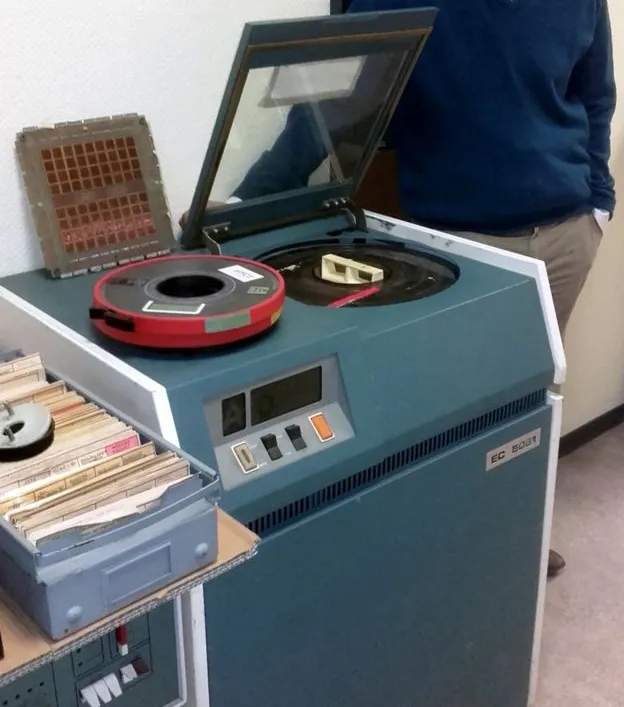
    The number of cards in the Stasi indexes grew to an incredible 39,000,000 by 1989. In order to provide constant access to this massive material data system they created various special storage units and containers as it expanded. The current mechanical powered card indexes in place at the BTsU were found after the end of the GDR and are still in use in order to meet requests of citizens who wish to view the data the Stasi kept on them.


    Mechanical index card file organization system used by the Stasi.

    Beginning in the 1960s, the MfS also used various electronic databases to track citizens.* These databases were never fully implemented as a primary source of storage because computing and software available in the GDR at the time, even machines stolen or purchased in the west, were unreliable. For six years the Stasi mirrored essential data from the F16 personal card into an electronic format. In 1975, Department XII, responsible for central data collection, information and storage, introduced the “System of automatic pre-selection” (SAVO) which allowed workers to verify that a person was “not yet recorded” in the system. This considerably reduced the time it took for verification, however it still required a substantial 12–21 days for a process to complete.

    By 1986 SAVO 2.0 was introduced providing printing functionality, increased capacity—now containing all data from the F16 card—and reducing search times to 1–6 days. It also provided teletype connections eliminating the need for couriers and allowing multiple agencies (passport control, tourism, etc.) to use the same data source simultaneously. (The Key to Power, 6) While this greatly modernized the surveillance workflow of the Stasi, it continued to act only as a duplicate of the F16 card, which was still faster for priority inquiries, and less susceptible to errors.


    A computer used by the Stasi. Source: BBC

    The logic for these implementations is echoed in modern database planning and use. While redundancy is employed for backups and increasing access speed across global networks, there is still a “master” copy of all data, or in the case of distributed system, automated processes (software) that merge and maintain distributed data into a master. Like the Stasi’s decision to completely mirror portions of the F16 system, modern systems use whichever implementation is most reliable for the master, while summarizations of that data may be “pushed” to other indexes for faster retrieval.

    The Stasi’s use of multiple systems, as well as the F16 and F22 card also preempt the concept of “joins”, which is a powerful feature in relational database management systems (RDBMS), to allow various pieces of data to be spread out across multiple indexes. Like the registration number on the F16/22 cards, records from multiple discrete RDBMS can be “joined” by matching a single identification field in order to supply additional, or limit access to other data, when performing queries.

    Multiple other computerized database systems were developed or used by the Stasi, including SOUD, a collection of information on the “enemy” shared between the GDR, Bulgaria, Cuba, Poland, the USSR, Czechoslovakia, Hungary, and Vietnam. The most expansive of all their electronic indexes, was the central database of personal data (ZPDB). Introduced in 1981, by the end it contained records on over 1,320,000 people, 417,000 situations, 558,000 objects, and numerous related information.

    The desire to track not just people, but occurrences and objects is directly visible in the largest person tracking organization today. In Facebook’s “Social Graph”, introduced in 2007, any person, place, thing, event, anything that can be named, is recorded in a massive attempt to commodify everything and our connections to it. Like the Stasi ZPDB, everything in the Facebook Social Graph is indexed by a unique identification string as single record, which Facebook considers a “node,” with links or “edges” that connect them. These definitions are based on Facebook’s desire to do data science on the their information, applying statistics and other mathematical operations from graph theory in order to understand their data and predict (and manipulate) the behavior of users.

    *Regrettably, all electronic databases and their magnetic storage was destroyed not long after the end of the GDR. Meaning, BStU staff now use the original paper F16 card system to provide services to the public.

    1. The key to power: Card indexes and other finding aids practices of State Security. Archivar 64. Jahrgang Heft 04 November 2011.

    Stasi / Facebook / Big Data DAAD Day 12 – The VSH card system

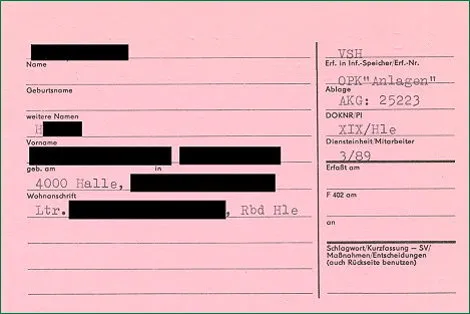
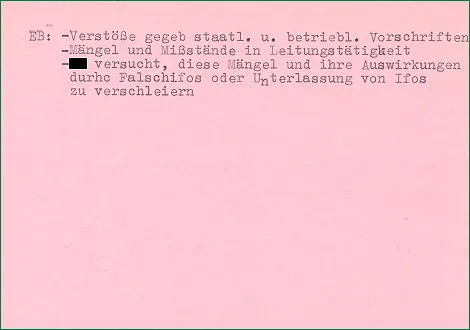
    The VSH index card system was yet another data storage method developed by the Stasi for monitoring and controlling the population. Introduced in 1974, the system used a red F401 card for all “secretly policed” persons, and a corresponding white F402 information card once that person was captured and began informing for the MfS. The system contained information not included on the Kerbloch index, for example, specifics deemed to be “operationally significant” like that person’s activity in the MfS, and ensured the flow of information on persons of interest across operational departments, districts, and facility services. The VSH files enormously expanded the number of persons surveilled, and were the most important cards used by operational service units until the end of the MfS. (The Key to Power, 6)


    Front of the pre-compaction, search and map card. Source: BStU


    Back of the pre-compression, search and map card. Source: BStU

    The VSH cards were divided into 15 categories ( PK ):

    • PK 1: Staff and agents of the enemy intelligence services
    • PK 2: Senior staff of the centers of political and ideological diversion
    • PK 3: Members of terrorist organizations and individual terrorists
    • PK 4: Members of Zionist hostile immigrant, clerical and other organizations
    • PK 5: persons who carried out orders from hostile intelligence agencies, centers of the political-ideological diversion, Zionistically hostile immigrant, clerical and other organizations against the states of the socialist community
    • PK 6: People unmasked as enemies of the opponent
    • PK 7: people who had not offered the information that was real
    • PK 8: persons who carried out provocative actions on the territories of the states of the socialist community as well as against their representatives and citizens
    • PK 9: Persons who were expelled from the states of the socialist community
    • PK 10: People who had committed particularly dangerous crimes
    • PK 11 diplomats and employees of diplomatic and consular missions of NATO , Japan and the People’s Republic of China
    • PK 12: correspondent of NATO -Mitgliedsländer, Japan and the People’s Republic of China
    • PK 13: Employees of trade and economic representatives
    • PK 14: Members of organizations that have been engaged in international smuggling on a large scale
    • PK 15: Persons whose activities were directed at a damage to the economy of the states of the socialist community
    1. The key to power: Card indexes and other finding aids practices of State Security. Archivar 64. Jahrgang Heft 04 November 2011.
    2. BStU: ( VSH ) of the Central Evaluation and Information Group ( ZAIG )
    3. BStU: Pre-compacting, search and identification card ( VSH ) of Division 1

    Stasi / Facebook / Big Data DAAD Day 11 – Kerblochkarten


    A Stasi Kerbloch card

    The Stasi used several other card systems to assist their postal surveillance. The Kerblochkarten (English: Kerbloch cards) system allowed storage of data encoded as a series of hand-made notches. Like other punch card systems, groups of cards could then be automatically processed by a machine based on the presence of notches and a predefined key. The Kerbloch card system made it possible to perform statistical evaluations and targeted searches on up to 350 cards/persons at a time. Importantly, this card amended the functionality of the the F16 cards and allowed the Stasi to quickly search for potential informants by querying characteristics relevant to a particular job. While anyone who has used a computer spreadsheet software today would take this sorting and searching functionality for granted, this was a highly useful tool for the Stasi, which by 1989 had amassed over 39 million index cards. (The Key to Power, 5)

    1. The key to power: Card indexes and other finding aids practices of State Security. Archivar 64. Jahrgang Heft 04 November 2011.
    2. BStU: Kerblochkarten (KK)

    Stasi / Facebook / Big Data DAAD Day 10 – Card systems of the Stasi

    The early days of the Stasi were marked by the development of new systems for monitoring the population. In the 1950s, having already incorporated a post-WWII file system used for denazification, the MfS implemented three new index card types to track citizens, all of which were stored in a central card index. These cards were distinguished by color and used to track persons considered hostile to the state (form A1 which was yellow), official staff (form B1, later replaced by the blue and grey F19), and persons who were arrested (the red, form C1).

    While official staff had titles and were on the payroll, the Stasi used hundreds of “unofficial staff.” These “Inoffizielle Mitarbeiter” (or IMs) were either foreign citizens who turned over valuable information like trade secrets, or domestic informants who spied on their colleagues, neighbors, and relatives (and sometimes even spouses). While money was a primary motivation, they were compelled for a number of other reasons, including blackmail, ideological commitments to the GDR, or gifts other than money, like lavish vacations, prostitutes, and official state awards. In fact, the Stasi implemented an impressive number of medals and rewards in order to convince both IMs and official staff to maintain loyalty and faithfully contribute their labor to the state. (Macrakis, loc 386) These awards are not unlike the loyalty cards, badges, and other gamification tactics that today’s corporations employ across their databases of customers in order to increase brand allegiance and sales.

    Similar to modern software development, the Stasi index card systems, like many of their methods over the years, were constantly being reworked and improved with each new iteration. For example, while the previous system used separate cards to track “enemies” and “friends,” as the Stasi learned to coerce those formerly consider hostile into becoming secret informants it became necessary to track persons who evolved into “frenemies of the state.”

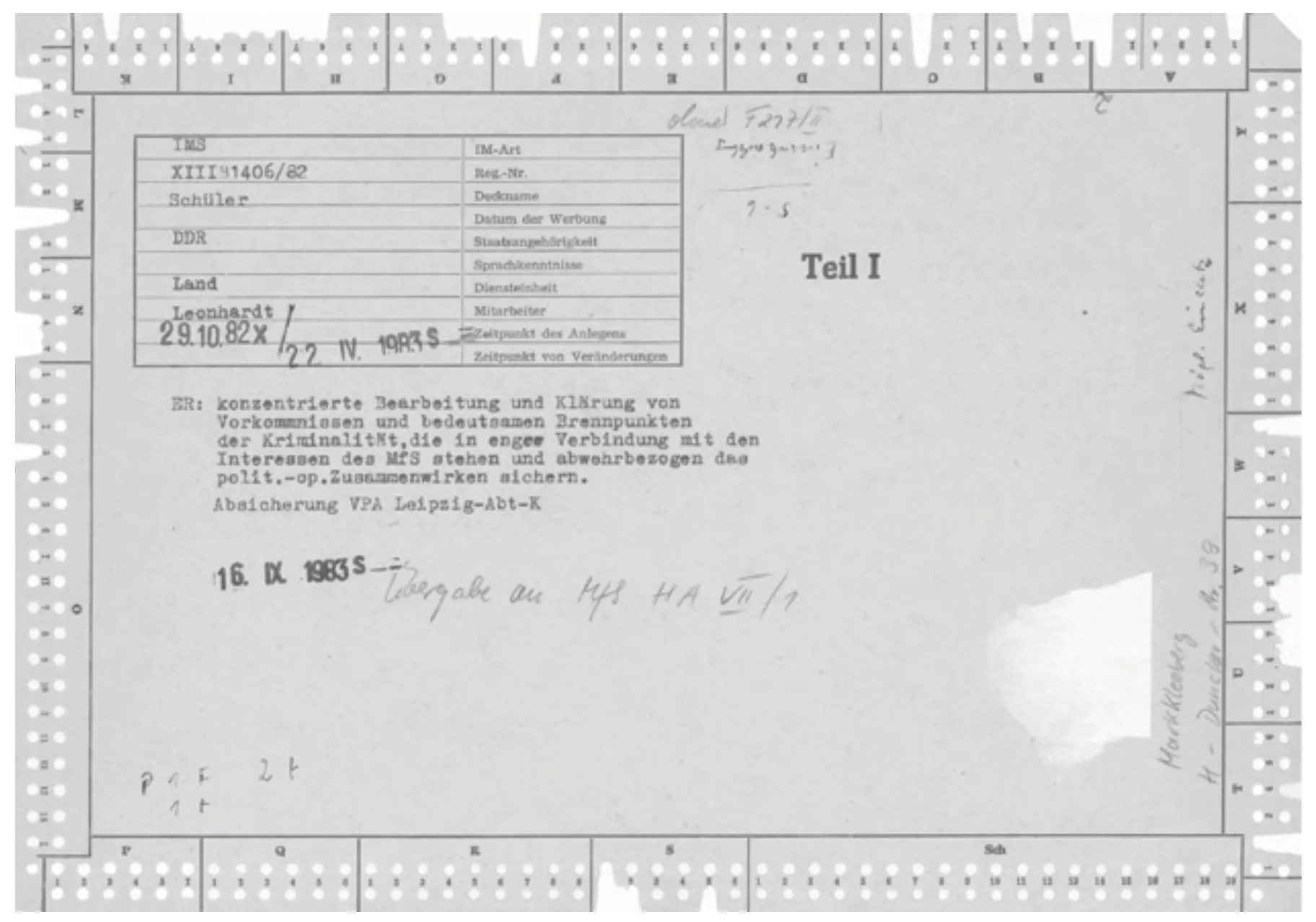
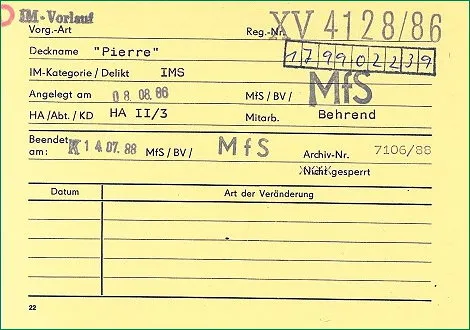
    This situation presented a particular problem, as the Stasi needed to record and track personal data on these people, but their real identities needed to be protected should they agree to turn over valuable information. For these persons the Stasi implemented a separate “transaction card” (F22) that augmented the standard cards. The change updated the yellow card (F16, formerly A1), which contained the real name, address, birth date and place, occupational status, workplace or school, and the red card (F18, formerly C1), used for those arrested, which contained this information, as well as a mugshot, a visual description, and data related to their crime, and added a registration number if they were a Stasi informer or agent. (The Key to Power, 3–4)


    The central operation card “F22” Credit: BStU

    The new “transaction card” (F22) recorded Stasi informants only by this registration number, as well as a secret code name and name of the case officer who managed the agent. Finding the real name of a Stasi operative meant matching not only the registration numbers on these cards, but additional comparisons, because many agents purposely shared registration numbers to add extra layers of secrecy. (Macrakis, 78) This method is similar in theory to modern relational database lookup tables, where a user’s personally identifiable information (PII) is separated and protected from data dumps containing so-called “anonymized data” , or public key encryption, where data is transmitted securely by performing mathematical operations on it using a combination of a unique private and public key.

    1. The key to power: Card indexes and other finding aids practices of State Security. Archivar 64. Jahrgang Heft 04 November 2011.
    2. Macrakis, Kristie. Seduced by Secrets: Inside the Stasi’s Spy-Tech World (Kindle Location 1615). Cambridge University Press.
    3. Jason Koebler This Visualization of NYC’s Taxis Shows the Promise and Pitfalls of Big Data Motherboard (2014)
    4. Alex Hern New York taxi details can be extracted from anonymised data, researchers say The Guardian (2014)

    Stasi / Facebook / Big Data DAAD Day 9 – MfS Department M (1960’s developments)

    The implementation of zip codes across West Germany in 1961 made it much easier to monitor postal traffic between east and west. The Berlin Wall was erected in that same year, leading to a heightening of Cold War suspicions and increased emphasis on monitoring movement of information between east and west.

    The 1960’s also saw the various reorganizations and new leaders, including Lieutenant-Colonel Walter Mehrbach, whose years of experience in the postal service led to the development of the first training manual for Department M, and certification courses in mail surveillance at the MfS Law School in Potsdam. (Labrenz-Weiß, 21)

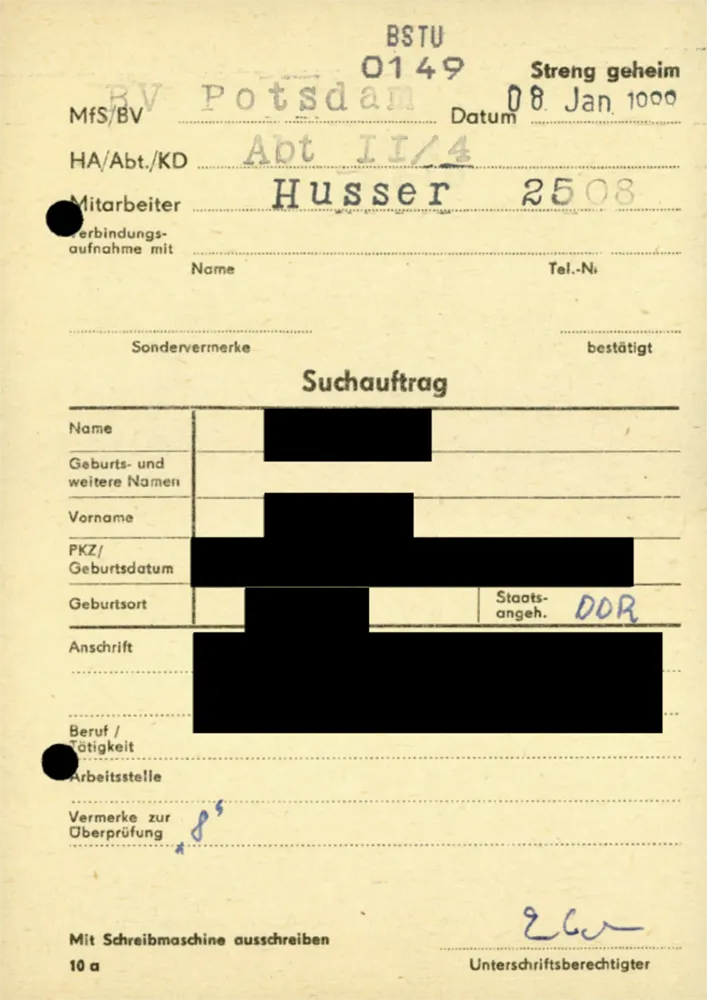
    As Department M grew in the 1960’s, so too did the amount of mail they examined and information they recorded. This demand for intelligence required constantly expanding data storage methods, which led the department to develop a card system for efficient alphabetical sorting and identification of people, places, and objects on both sides of the East/West German border. (Labrenz-Weiß, 19) I’ll dig in a little deeper over the next few days on these cards, for now a photo from my BStU archive research last summer:


    BStU: MfS, BV, Potsdam, Abt II 764 pg 6

    1. Hanna Labrenz-Weiß, Abteilung M (MfS Handbuch). Hg. BStU. Berlin 2005.

    Stasi / Facebook / Big Data DAAD Day 8 – MfS Department M (A captured letter from the BStU archives)

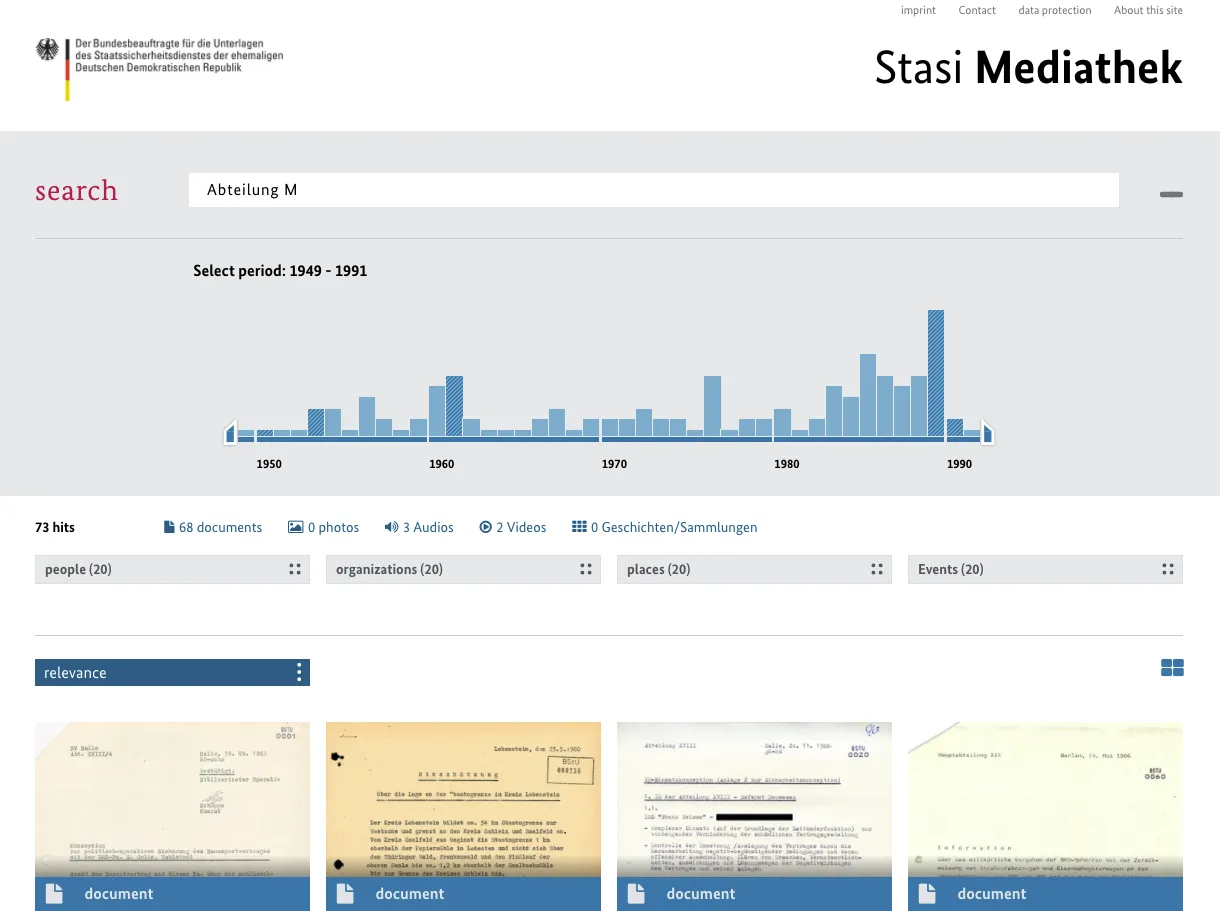
    The Stasi Mediathek website published by the BStU is an amazing resource. One can search for example “Abteilung M” (English: Department M) and find a range of digitized original documents related to the Stasi’s postal surveillance.

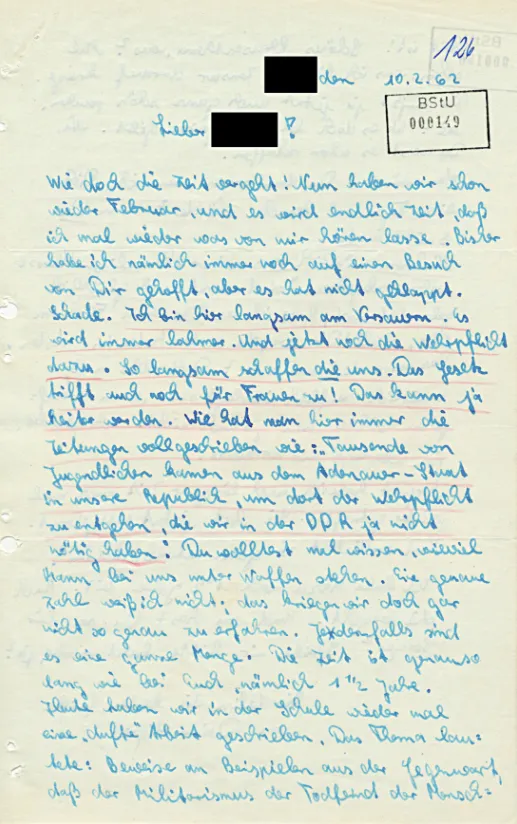
    Stasi / Facebook / Big Data DAAD Day 8 – MfS Department M (A captured letter from the BStU archives)

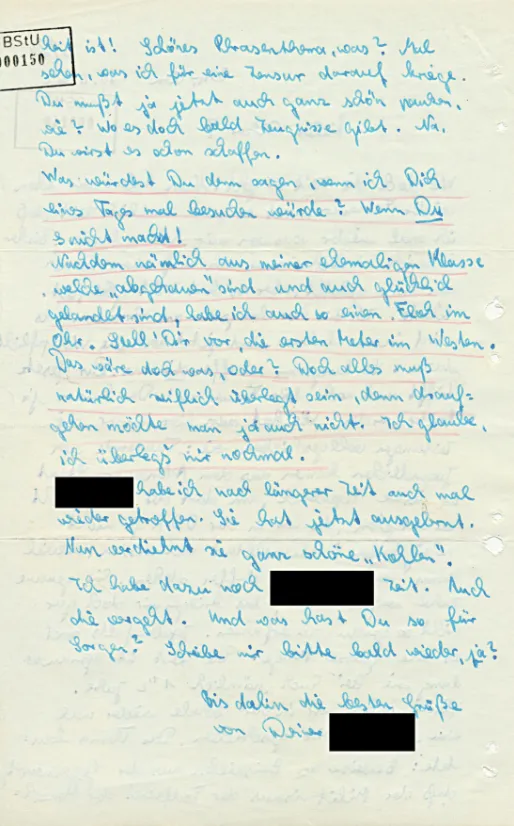
    This is an example of a letter that the Stasi Department M removed from the Deutsche Post in 1962. In the letter an East German student writes to her friend in the west about her dissatisfaction with the militarism and compulsory conscription in the east and says she is considering fleeing the GDR. Surely the Stasi placed her under a watchful eye due to the information they found through their postal surveillance. It’s also interesting the Stasi one, removed the letter altogether from the postal stream, likely in order to prevent negative sentiments from appearing in western press, and two, kept the document, perhaps as evidence against her at a later date, or potentially also as a result of the thoroughness of the bureaucratic surveillance system they had developed. An English translation can be found at the above link as well. (BStU)

    Stasi / Facebook / Big Data DAAD Day 7 – MfS Department M (Development of working methods)

    In the early years of the Department M, or Division VI as it was known at the time, there was no vocational training so the few dozen employees had to conceive of their own workflows. At that time, the standard set for workers who examined the contents of mail was to read “500 letters per person for each working hour.” Post control took place in special rooms of selected central post offices, where employees of Division VI covertly intercepted and opened mail. The onsite locations helped to ensure the Stasi could accumulate as much intelligence as possible while causing the lowest acceptable delay in the Paketstrom (English: packet stream). (Labrenz-Weiß, 13)

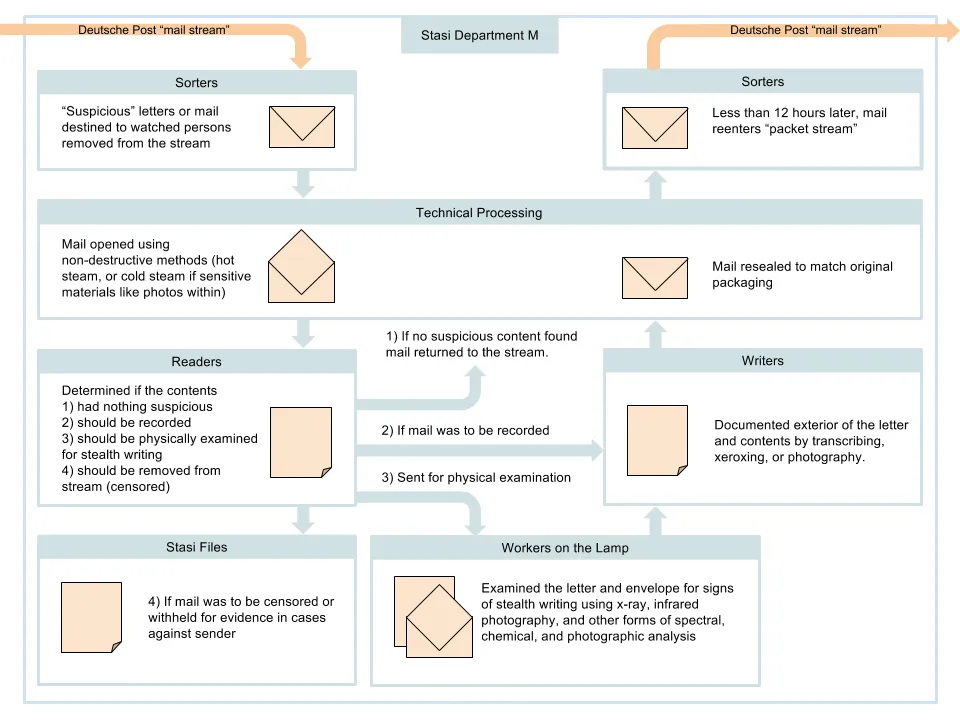
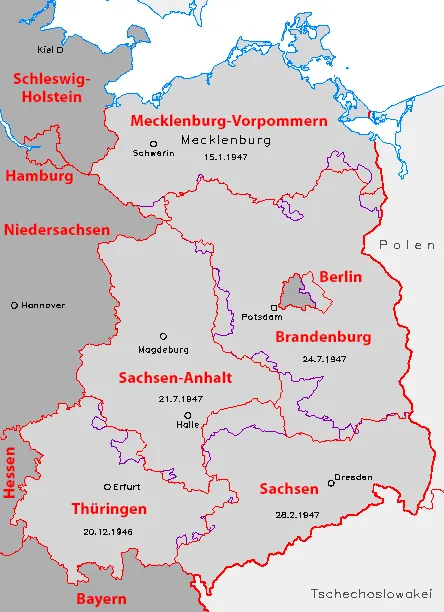
    By 1952 Department M was established and locations for inspection were formalized. The five GDR states (see previous blog post) were divided into 14 districts in order to increase efficiency by moving postal control structurally closer to sender and receiver. Various statutes were established by the MfS allowing for inspection of the post in order to prevent sedition inspired by western influence, as well as to carry out censorship through interception of materials. The process for post control was also more precisely defined and subdivided into specific working groups for: 1) Sorting mail by size; 2) Technical processing; 3) Readers; 4) Writers; and 5) Employees at the lamp.

    Units responsible for “Sorting” the mail passed any letters or parcels that appeared suspicious, as well as all mail destined for persons or organizations under postal control, to “Technical processing” where it was opened using steam or other nondestructive methods. It was then sent to “Readers” who sent letters to the “Writers” once it was determined the contents were worthy of being transcribed. The Writers had the job of recording the documents, preparing reports for each day, and passing information with clues for espionage, sabotage, or, after the addition of the Berlin wall, plans for escape, to relevant departments.

    “The work on the lamp” investigated suspicious consignments in a dark room under a quartz lamp in order to identify clandestine forms of communication like secret writing on the surface of paper, or other methods including invisible ink. If found these documents were then passed to the OTS, or Operational-Technical Sector of the MfS, for special investigation.
    These early divisions of labor served to increase efficiency much in the same way Henry Ford had done at the beginning of the century when he introduced the assembly line. Equally, the divisions helped Stasi employees to become more knowledgeable and specialized in their work, eventually developing machines to augment, improve, and speed up their tasks. (Labrenz-Weiß, 16–17)

    1. Hanna Labrenz-Weiß, Abteilung M (MfS Handbuch). Hg. BStU. Berlin 2005.

    Stasi / Facebook / Big Data DAAD Day 6 – MfS Department M (postal control selection)

    Stasi Department M workers removed enormous amounts of mail from Deutsche Post each day for inspection. Mail was identified visually based on handwriting, types of letters, or specific addresses. Surveillance of mail was technically illegal in the GDR. Still, mail was withheld on an official basis “in order to prevent attacks” by western intelligence agencies, presumably using “threats and explosives.” This led to the inspection of all incoming and outgoing mail to press agencies, embassies and consulates of NATO countries, and other western correspondence.

    Unofficially, in the interest of multiple surveillance, control and censorship possibilities for the Stasi, everything possible was scrutinized, both foreign and domestic. The postal inspections contributed intelligence on GDR and foreign citizens who were suspected of spying for the west. They allowed the Stasi to filter information the citizens of the GDR were allowed to access, share, or communicate to the outside world. The Stasi intercepted undesirable books, seditious content, and other materials with the ultimate goal of preventing public protests, or other conspiratorial activities. While the goal of Department M was to return the mail collected for inspection back to Deutsche Post within a 12-hour window, many deliveries were seized and never returned. This massive operation naturally resulted in frequent delays in delivery or damage to letters or parcels, which including those that never arrived, led the public to become increasingly aware of the ongoing postal inspection.

    Finally, the postal surveillance provided the Stasi with information about the mood of the population in the GDR, by examining personal communications, as well as messages sent between in companies and institutions. Reports prepared by administrators in Department M on population mood included information on economic and political sentiment and specifically targeted demographic groups (Labrenz-Weiß, 13) across specific geographic locations and social strata in the GDR in order to give the best possible assessment. For example, the following population groups are described in BStU documents

    • Brandenburg: 1,000 workers each at the East coaster and the Brandenburg Steel Works, and 1,000 old and new builders
    • Mecklenburg: 1,000 workers of the shipyards, 500 students and 50 teachers of the University of Rostock, and 1,000 old and new builders
    • Saxony-Anhalt: 1,000 workers of the chemical industry and of Magdeburg heavy machinery construction, 800 students and 100 faculty members of the Martin Luther University Hall, and 1,000 old and new farmers in Altmark
    • Saxony: 1,000 workers of the Stahlwerk Riesa as well as tradesmen / merchants, and 800 students and 100 lecturers from the University of Leipzig
    • Thuringia: 1,000 workers of the Unterwellenborn steelworks, Zeiss works in Jena and tradesmen, and 800 students and 100 professors of the Jena University


    East Germany’s State borders established after WWII 1945-1947 in violet. In red the borders of the new states established during reunification. Source: Wikipedia

    1. Hanna Labrenz-Weiß, Abteilung M (MfS Handbuch). Hg. BStU. Berlin 2005.

    Stasi / Facebook / Big Data DAAD Day 5 – MfS Department M (Organizational structure overview)

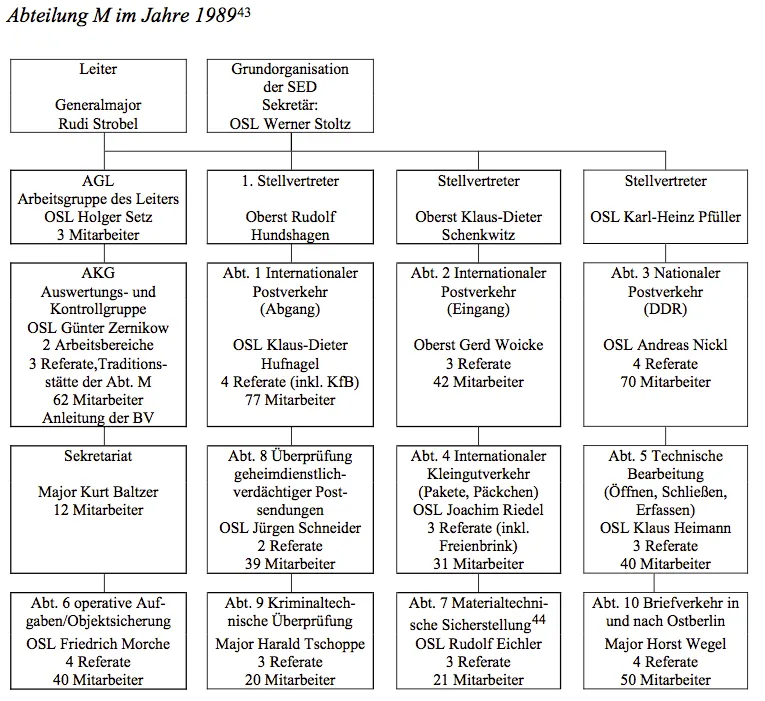
    Stasi / Facebook / Big Data DAAD Day 5 – MfS Department M (Organizational structure overview)

    In 1989 Department M had 10 divisions, which were subdivided into 36 units. The head office, which consisted of 8 divisions and their corresponding units, was located in East Berlin. The divisions were organized based on mail destinations (western, non-communist countries for example), types of mail (like parcels or telegrams), or function within the scope of the work of the Department. Specific units were tasked with selecting mail for examination, while in technical processing units the selected mail was opened, examined, documented, and closed again by their respective units. Other units in Department M were assigned to inspecting customs declarations, maintaining secrecy, or operational engineering, where design, manufacturing, and maintenance of the technology took place. (Labrenz-Weiß, 8–10)

    1. Hanna Labrenz-Weiß, Abteilung M (MfS Handbuch). Hg. BStU. Berlin 2005.

    Stasi / Facebook / Big Data DAAD Day 4 – MfS Department M (the workers)

    The Stasi surveilled the post of the GDR for nearly 40 years, starting with the founding in 1950, until the fall of 1989 when the Berlin wall fell. The number of workers in Department M rose from a few dozen in the beginning, to nearly 2,200 by the end. The largest office occupied two buildings in the massive Stasi headquarters complex in Berlin-Lichtenburg and included almost 500 employees, with the remaining 1,700 spread across 15 district administration offices. (Polzin, 105)

    While the ratio of women to men in Department M shrank over the years possibly due to the increasing focus on technology and automation, it was consistently at least twice that of the entire MfS. In the beginning 80% of Department M employees were women, compared with 25% in the MfS, while in the 1960s 40% were women compared to 14%. In 1989 only 20% of Department M employees were women. (Labrenz-Weiß, 5)

    Employees were subject to numerous specialized training to prepare them for their work. This included courses on typography, x-ray certification, and photography for those performing inspections. Employees who were integrated with Deutsche Post received information like electronic training for working with telegraph devices, operating postal vehicles, and other knowledge related to the movement of mail and parcels. Those employees charged with the development of specialized equipment for Department M studied engineering, paper technology, air and refrigeration systems, and the mechanics around the movement of postal and newspaper materials. (Labrenz-Weiß, 6)

    While Department M employees were physically embedded in Deutsche Post locations, their activities there were considerably constrained in order to ensure the secrecy of their work. For example, they were required to sit in closed groups in the cafeterias in order to avoid direct contact with actual postal workers. Official contacts were only allowed with Stasi officers already embedded in the post control system special operations.

    1. Arno Polzin, Postal Inspection, Telephone Surveillance and Signal Intelligence in Daniela Münkel (eds.), State Security: A Reader on the GDR Secret Police, Berlin 2016.
    2. Hanna Labrenz-Weiß, Abteilung M (MfS Handbuch). Hg. BStU. Berlin 2005.

    Stasi / Facebook / Big Data DAAD Day 3 – MfS Department M

    The Ministry for State Security’s Department M was tasked with “postal control”, or the inspection of domestic and international letters and packages. They conducted their work thanks to cooperation with Deutsche Post which, as another state institution concerned with “security of the state,” was subject to the same politics and power infrastructure of the single party system of the DDR (1). Consequently, the Department M had access to every letter and parcel which traveled throughout East Germany by inserting itself in the logistical operations of the postal system. The Stasi reserved special rooms or entire floors within the Deutsche Post buildings, which were off limits to regular post workers.

    In Berlin, Department M had offices in the post office at Nordbahnhof, in the central telegraph office on Oranienburger Strasse and in the railway post office at Ostbahnhof. These rooms used by the MfS were designated “Department 12” of the German Postal Service, both internally and officially.(2)

    1. Arno Polzin, Postal Inspection, Telephone Surveillance and Signal Intelligence in Daniela Münkel (eds.), State Security: A Reader on the GDR Secret Police, Berlin 2016.
    2. Hanna Labrenz-Weiß: Abteilung M (MfS Handbuch). Hg. BStU. Berlin 2005.

    Stasi / Facebook / Big Data DAAD Day 2 – The Stasi’s automatic letter opener invention

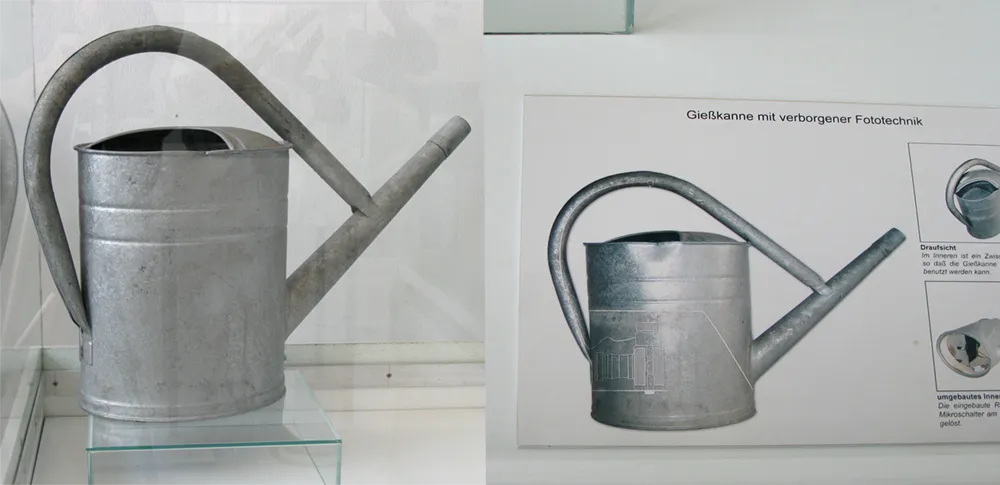
    The former East Germany’s Ministry for State Security (more popularly referred to as the MfS or “Stasi”) is widely known for the inventive and clandestine gadgets that appear in films like Das Leben der Anderen (English: The Lives of Others) or on exhibit at the Stasi Museum in Berlin. Some of my favorites from the museum are the cameras disguised as everyday, boring objects. Take this watering can with a hidden camera.

    Imagine a sweet old Oma in her garden, tipping the can just so, with the intention of spying on the grandma next door. This technologically-enabled interpersonal collection of data of our “friends” was very much like how Facebook operates today. The Stasi used blackmail to infiltrate networks and get people to give up their neighbors, while Facebook coerces us in different ways; for example, through algorithms that implore us to post details from our private lives in order to build up one’s cultural capital and sense of self worth. I’ll explore this connection more in later weeks, particularly in reference to a special type of behind the scenes inventions of the Stasi: a series of machines that automatically opened personal letters and closed and resealed them after their contents were examined.

    In this project, a central question is what do the motivations and methods of this machine, which was used to intercept and automate the secret unpacking and examination of personal information of letters between private citizens, tell us about how the software used by the NSA for monitoring citizens around the globe? Or about the even more secretive methods of Google or Facebook as they examine our personal information in order to influence our behavior? Until tomorrow.

    Stasi / Facebook / Big Data DAAD Day 1 – Willkommen in Deutschland

    This is the first post in a long time. Over the next two months I will add one every day while I’m working on a new stage of an ongoing project I began in Berlin in 2010. I haven’t posted like this in a while. I find it extremely helpful to share and collect research, create an arc for the work, and of course to stay focused. While the project will evolve as I add content to this space, I’ll share the essential bits from my plans here:

    This proposal for a DAAD grant will support research and a series of writings and visualizations that examine how the technological inventions of the East German Ministry for State Security preempt Facebook, the NSA, and the world of Big Data. I will work at Humboldt University and the Stasi Records Agency (BStU) in Berlin and the Museum at the Round Corner in Leipzig, researching and documenting the schematics and actual machines developed by the Stasi for surveillance. With this knowledge I will frame an investigation that uses the analog devices of the Stasi to lend insight into the methods implemented today as software by social media, advertising groups, and intelligence agencies in the service of domestic surveillance and censorship.

    I feel super fortunate to be able to continue this project I started almost seven years ago thanks to support from the German Academic Exchange Service or DAAD (German: Deutscher Akademischer Austauschdienst) and Prof. Dr. Wolfgang Ernst at the Institute of Musicology and Media Studies at Humboldt University Berlin.

    Stasi / Facebook / Big Data DAAD Day 1 – Willkommen in Deutschland

    Stasi files at the BStU. These are not the personal files the Stasi collected, but notes, diagrams, and parts lists detailing the inventions and processes developed during the Stasi’s almost 40 year reign.