Year: 2012

MutaMorphosis: Examining Networks of Power stream today

I am an “attractor” for a stream of interest at a conference that is happening this weekend in Prague. There are thought-provoking presentations lined-up. Check it out if you are nearby.
MutaMorphosis: Examining Networks of Power stream today

Examining Networks of Power
Attractor: Owen Mundy (US)

Addressing the Future: The Tactics of Uncertainty
Attractor: Claudia Westermann (AT)

MutaMorphosis: Tribute To Uncertainty
Saturday, December 8, 2012
13:30-15:30 | Academy 2

Marc Garrett (UK) | Revisiting the Curious World of Art & Hacktivism
Diane Derr (QA) | Morphological Mapping of the Arab Spring through an Ecological Lens
Daphne Dragona (GR) The power of counterpower
Katerina Karoussos (UK) | LUMEN HILARE – The (bio)photonic emission of a church and its metabolism in human consciousness

Owen Mundy: This thread intends to examine representations of contemporary control structures and discuss whether or not an image, particularly network graphs depicting power relationships, information flows, economic activity, etc. have the ability to reverse trends of concentrated power. Does depicting power lead to greater democratization of said power or are we merely creating beautiful images that detract from their original intent—to reveal, examine, and act. To what effect does mapping complex data depicting influential actors, institutions, moments in time, finance systems, mapped onto a two-dimensional surface unravel the power they represent by distributing that power? Methodology: We’ll begin the discussion by looking at historical examples of communication that intend to affect power structures. We’ll examine works by artists and cultural practitioners such as Hans Haacke, Mark Lombardi, Josh On (theyrule.net), Bureau d’études, and more. We’ll consider Manual Castells‘ “Network Theory of Power” within these context(s). Then we’ll discuss visual components of network graphs, asking in particular; what data and
representational forms help make a graph speak to as many people as possible. Finally we’ll work in groups to extend the discussion into possible solutions and various statements and recommendations for such representations.

Claudia Westermann: More than 30 years ago, Michel de Certeau suggested that a shift in methodologies was necessary from strategies that operate on the basis of planning and prediction to tactics that operate on the basis of appropriation. Within this context, competition for the best prediction is substituted for a search for authorities that create the places that give space. This stream of interest with the title ‘Addressing the Future – The Tactics of Uncertainty’ suggests that even though Utopia has not been valued recently, it is nevertheless the actual turn towards the future – this radical uncertainty – that allows for a profound re- questioning of our methodologies. How do the sciences and the arts address the future? Can we speak to it, and in doing so, can we create openings in the present? Methodology: The main intention of this suggested stream of interest is to provide for a ‘good’ start question from which the theme of uncertainty could be addressed in a rather radical way. I am interested in viewpoints from all areas of the sciences and arts. In addition to presentations, there could be conversational panels and workshops. The latter could also be contextualized within the city of Prague. Which inclination this theme takes also depends on the other streams of interest and should be discussed.

PRAGUE | CZECH REPUBLIC | DECEMBER 6-8, 2012 | WWW.MUTAMORPHOSIS.ORG | ORGANIZED BY CIANT | WWW.CIANT.ORG
CulturalDC Presents: Joelle Dietrick & Owen Mundy: Grid, Sequence Me

e1354563477

CulturalDC Presents
Joelle Dietrick & Owen Mundy: Grid, Sequence Me

Flashpoint Gallery
916 G Street, NW, Washington, DC 20001
01.05.13 – 02.02.13
Opening: 01.05.13, SAT, 6 – 8pm

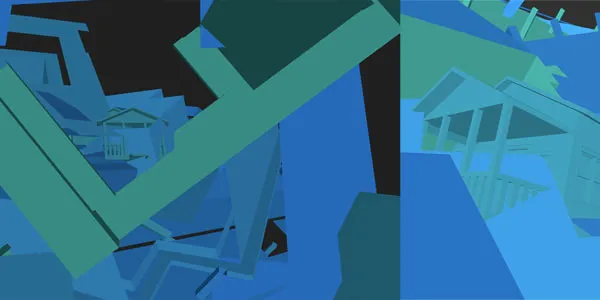
WASHINGTON, DC – Florida-based art team Joelle Dietrick and Owen Mundy will transform Flashpoint Gallery with an installation of projected animations called Grid, Sequence Me, opening on January 5. Surrounded by images of cross-sectioned buildings and source code excerpts, gallery visitors will encounter fragments of Washington, DC architecture—a vaguely familiar roofline or grid of office windows—remixed with phrases spidered from housing-related websites. Constantly changing, the data will be streamed live into the gallery from both local sources (DC short sale listings) and national (federal policy sites). The inclusion of both local and national data will emphasize the effects of related micro-macro shifts.

Generated by custom software designed by the artists, these fragments will echo the financial systems that led to recent housing market declines. They mirror mortgages repackaged and sold, titles lost in administrative tape, and dreams confused by legal jargon. Like the complex financial systems of the housing market heyday, the software is specifically written to generate an infinite number of arrangements. The complexity of constantly changing outcomes, never repeated, stands in stark contrast to the exhibition’s title, Grid, Sequence Me. We implement grids hoping for comforting, predictable results, even in areas of life—like living arrangements and job creation—that are filled with human folly.

The exhibition offers a space where a visitor can consider how automated, often unseen technological communications and economic systems affect our daily lives and basic human needs.

There will be an artist talk and preview on Saturday, January 5 at 5pm as a part of our membership program. Others are invited to join us. RSVP to gallery@culturaldc.org to attend the artist talk. The public reception will follow immediately after the talk from 6-8pm.

ABOUT THE ARTISTS

Joelle Dietrick’s paintings, drawings and animations explore contemporary nesting instincts and their manipulation by global economic systems. Her recent artworks and research consider housing trends that complicate relationships to place. Her work has been shown at Transitio_MX in Mexico City, TINA B Festival in Prague and Venice, Museum of Contemporary Art (MCA) Chicago, MCA San Diego, Long March Space Beijing, ARC Gallery Chicago, Soho20 New York and MPG Contemporary Boston. She has attended residencies at the Künstlerhaus Salzburg, Anderson Ranch, the Virginia Center for the Creative Arts, Banff Centre for the Arts and the School of the Visual Arts and received fellowships from the University of California, Florida State University and the Deutscher Akademischer Austausch Dienst (DAAD).

Owen Mundy is an artist, designer, and programmer who investigates public space and its relationship to data. His artwork highlights inconspicuous trends and offers tools to make hackers out of everyday users. His work has been shown at Transitio_MX in Mexico City, the California Center for the Arts in Escondido, CA, Compactspace in Los Angeles, Golden Thread Gallery in Belfast, the Sarai Media Lab in New Dehli, Bauer&Ewald Gallery in Berlin and APEXART, Flux Factory and Art Currents Gallery, in New York. He is the recipient of an Individual Artist Fellowship from the State of Indiana, a Planning Grant from Florida State University, a Center for Humanities Fellowship and San Diego Fellowship from University of California, San Diego and a DAAD Arts Study Fellowship. He has an MFA in Visual Art from the University of California, San Diego and is an Assistant Professor of Art at Florida State University.

ABOUT CULTURALDC’S VISUAL ARTS PROGRAM

CulturalDC operates Flashpoint Gallery and produces public art interventions throughout DC. We nurture talented emerging and mid-career artists by providing opportunities for peer learning and mentorship. At Flashpoint Gallery we showcase bold, new work from artists working in a variety of media including site-specific installations, performance pieces, new media and other experimental forms. As a nonprofit gallery free from the constraints of commercial expectations, Flashpoint provides artists and curators a unique opportunity to take creative risks. An advisory panel of noted artists and arts professionals makes programming recommendations for the gallery and provides mentorship and support to exhibiting artists.

Flashpoint Gallery is generously supported by Natalie and Paul Abrams and by DESHO Productions and The Washington Post Company. Hotel Helix is Flashpoint’s 2012-13 Hotel Partner. Marvin is CulturalDC’s 2012-13 Wine Partner.

Funding for CulturalDC is generously provided by The Morris & Gwendolyn Cafritz Foundation, DC Commission on the Arts & Humanities, The Community Foundation for the National Capital Region, The Kresge Foundation, the MARPAT Foundation, the Eugene & Agnes E. Meyer Foundation, the National Endowment for the Arts, Prince Charitable Trusts, The Share Fund of the Community Foundation for the National Capital Region and many other generous partners.

ABOUT FLASHPOINT

Flashpoint is a multi-disciplinary arts space. Flashpoint includes a contemporary art gallery, the 75-seat Mead Theatre Lab, the Coors Dance Studio and shared office space for arts organizations.

Joelle Dietrick & Owen Mundy: Grid, Sequence Me
Opening Reception: Saturday, January 5, 6-8pm
Exhibition: January 5 – February 2, 2013
Gallery Hours: Tuesday – Saturday, 12-6 pm or by appointment
For more information: Call 202.315.1310 or visit culturaldc.org

e1336766027

CulturalDC • 916 G Street, NW • Washington, DC 20001
General: 202.315.1305 Press: 202.315.1310 Fax: 202.315.1303
Email: karyn@culturaldc.org

Packet Switching, College of Journalism and Communications at the University of Florida

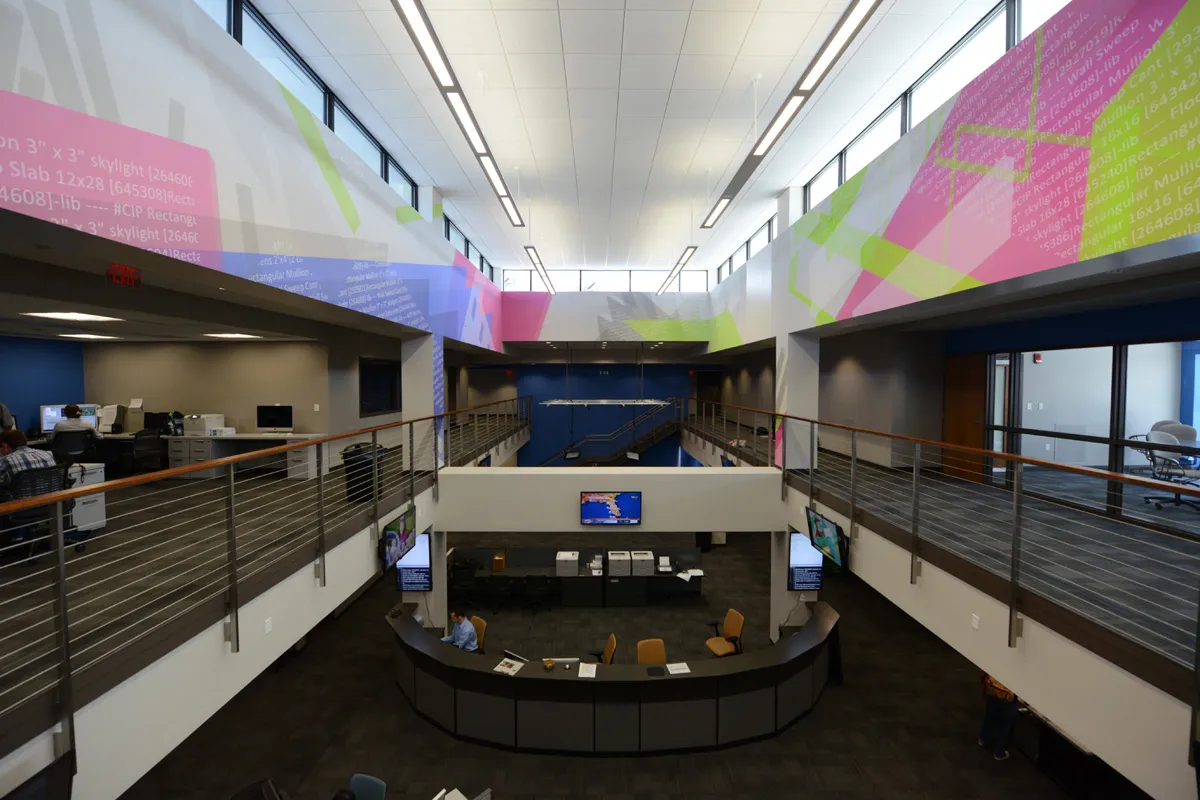
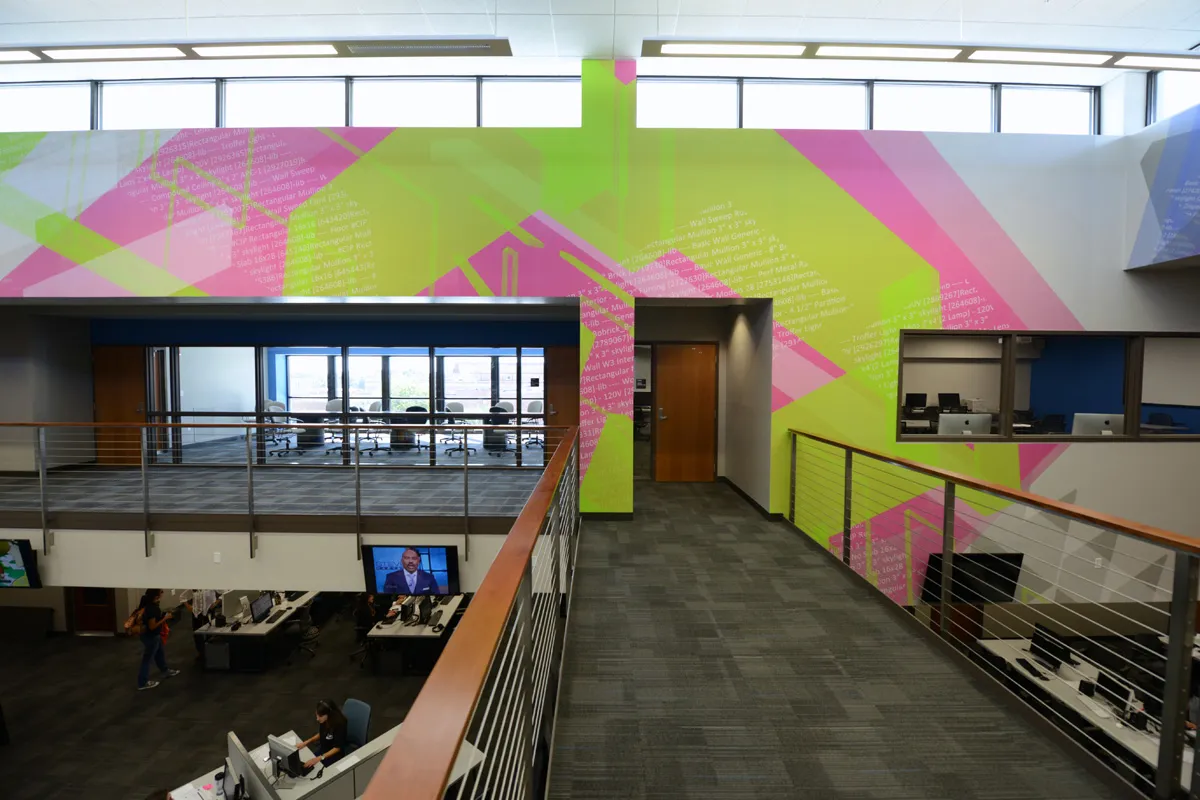
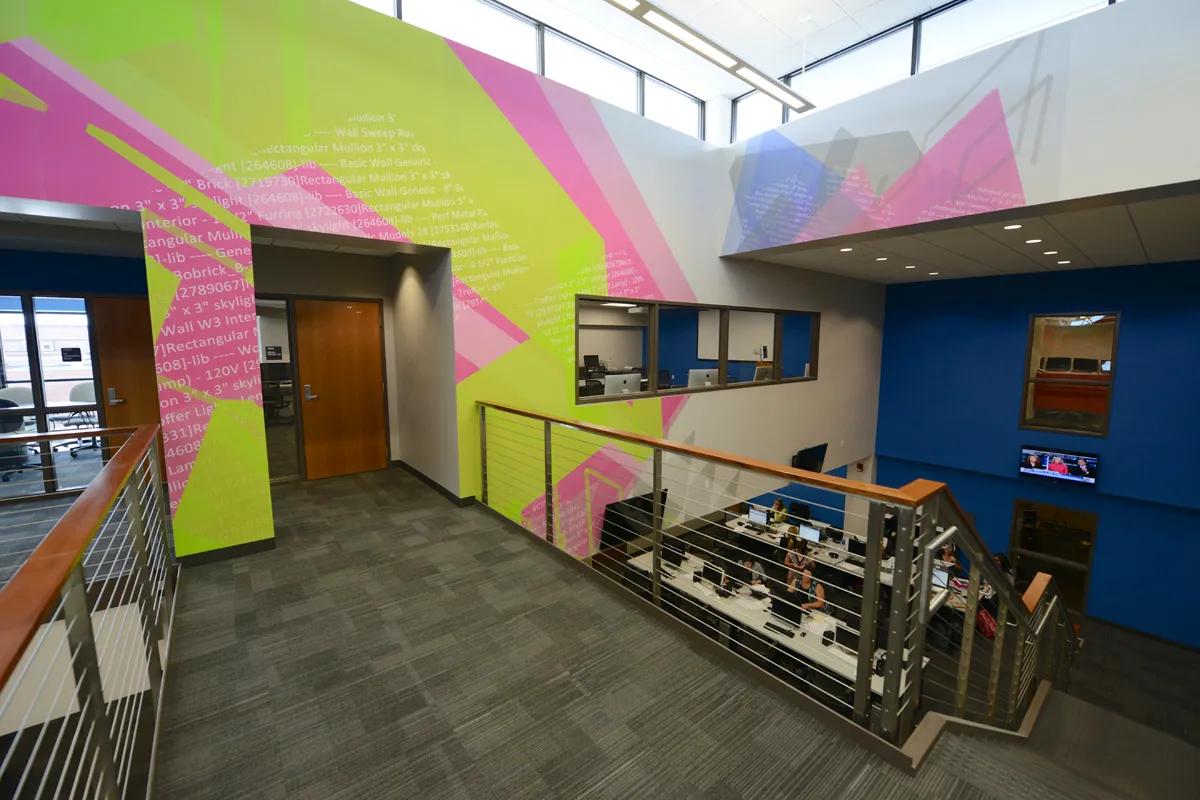
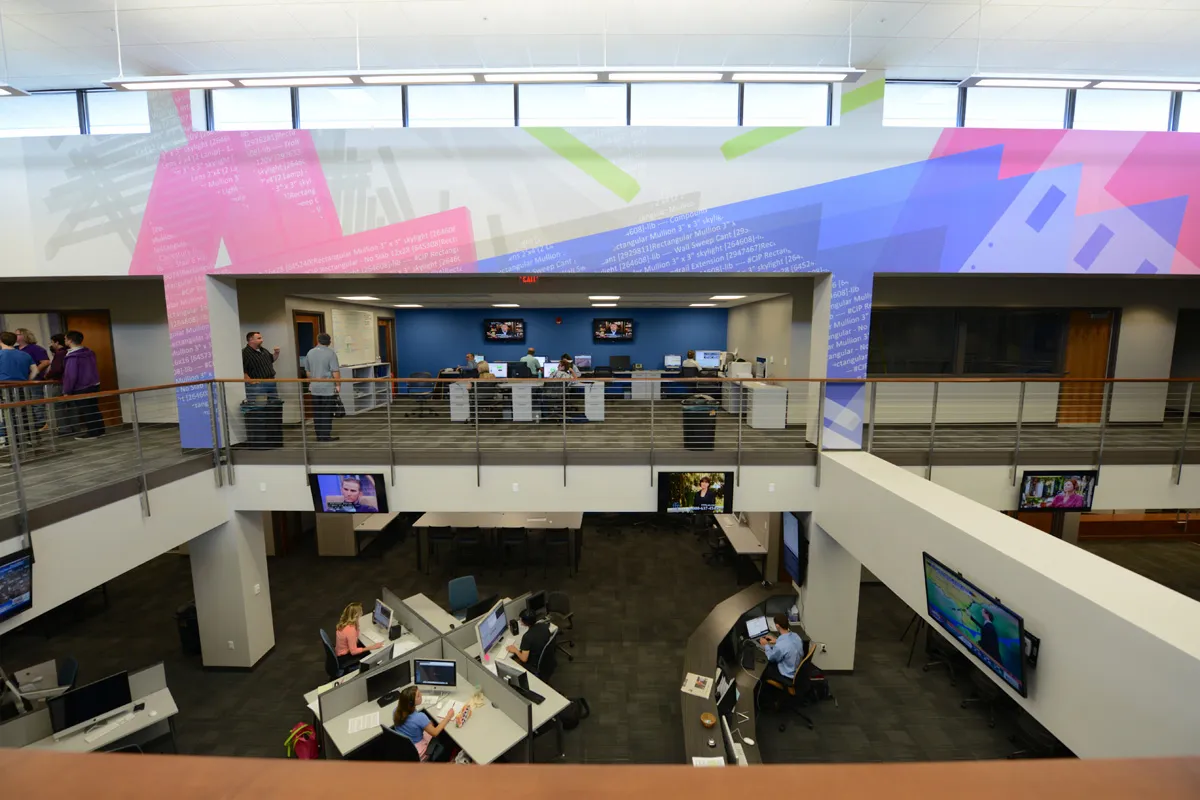
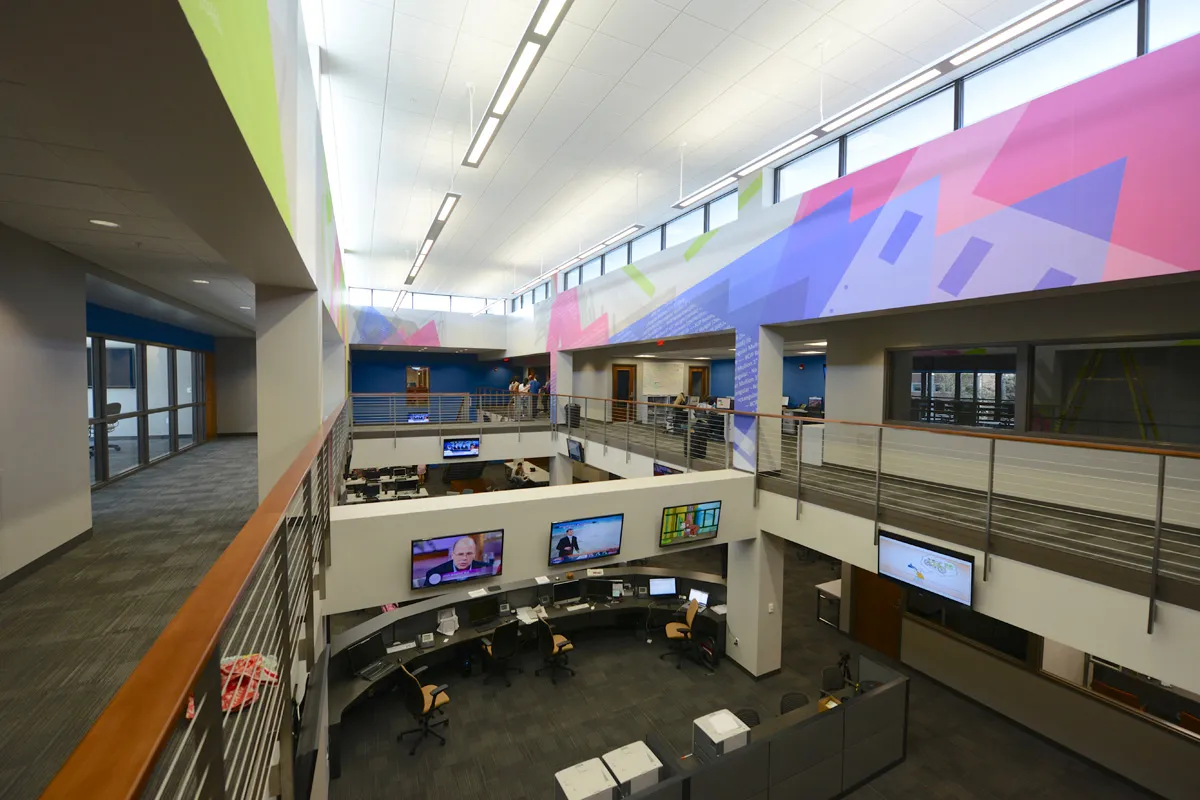
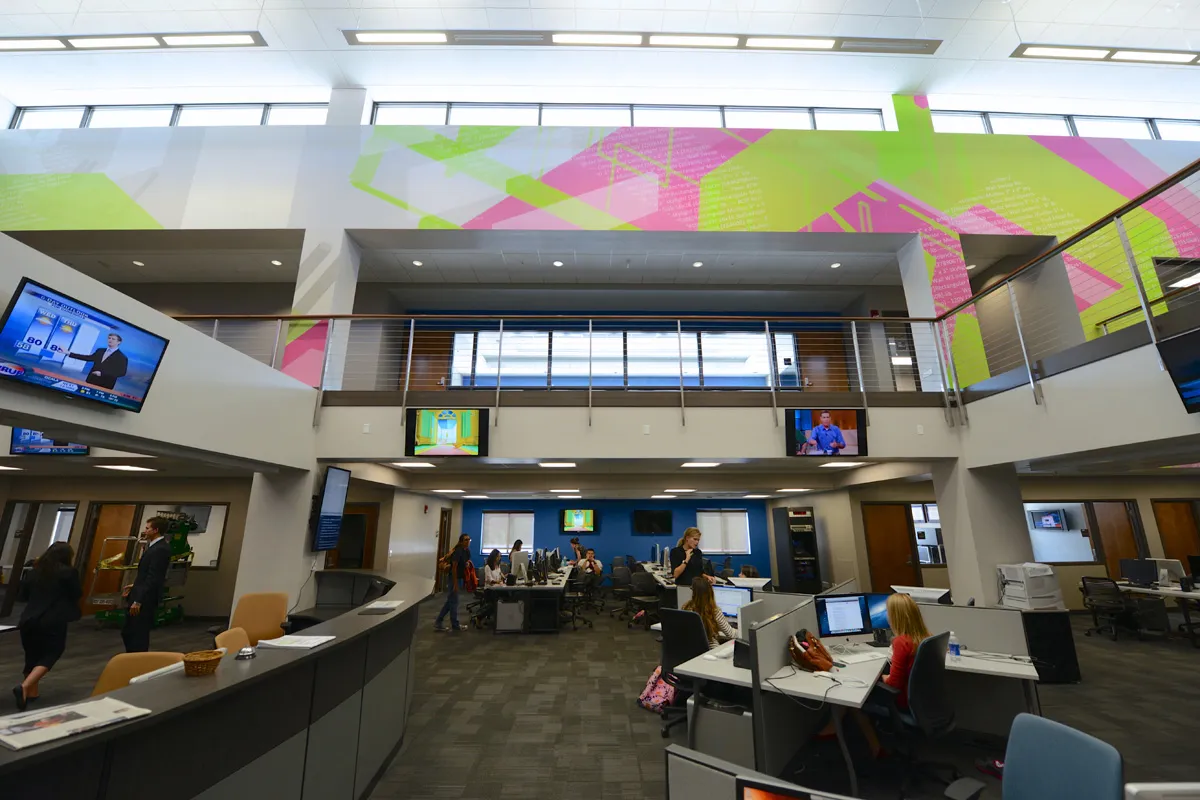
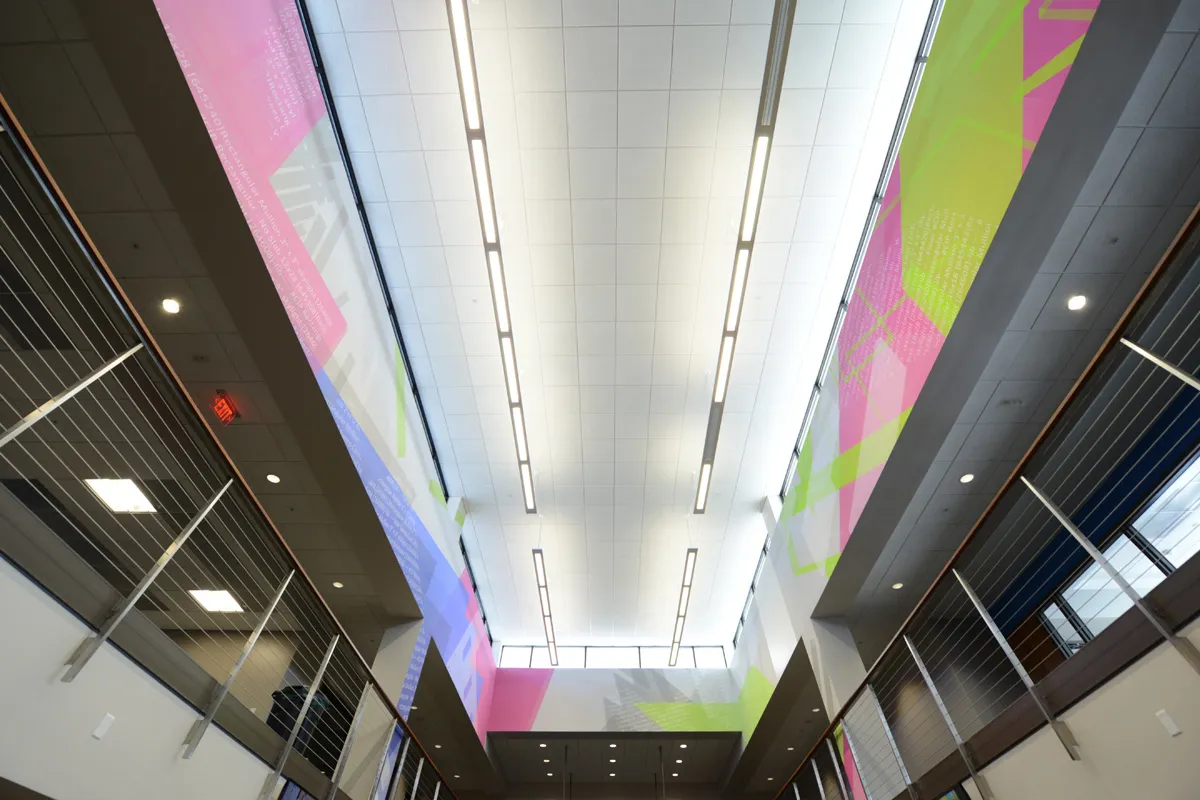
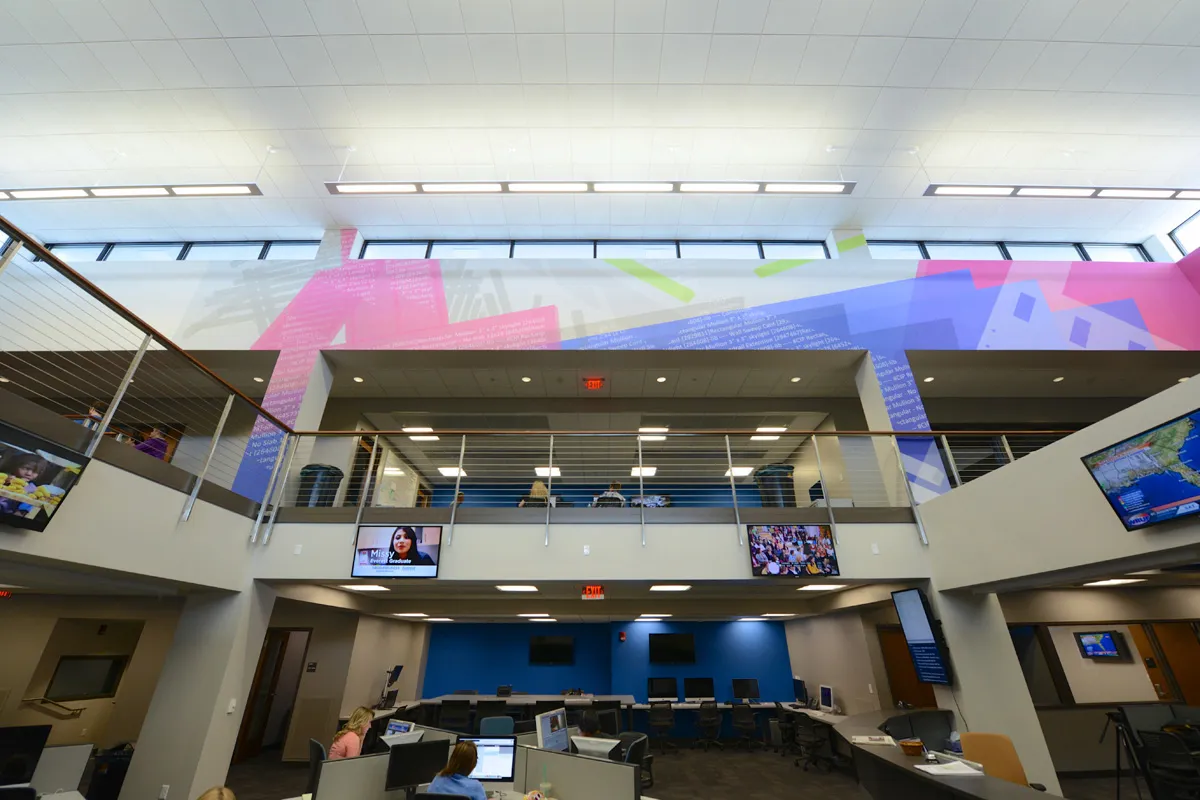
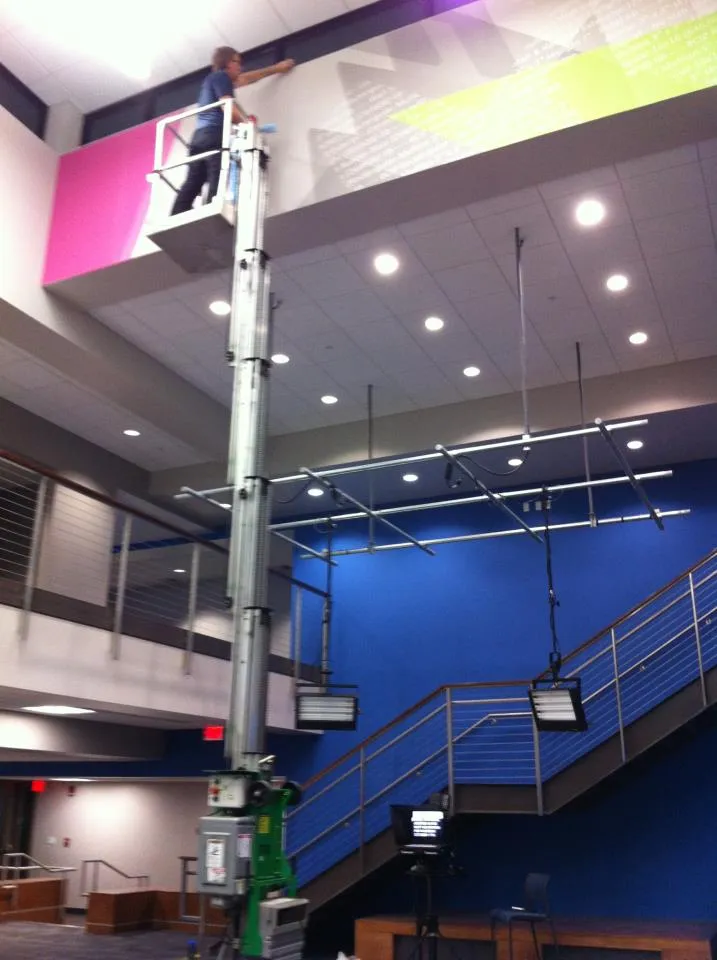
Joelle and have completed our Packet Switching (Weimer Hall) commission in the College of Journalism and Communications at the University of Florida. Read about the process for this project here.

uf_2012_johnson_01_1200w

Packet Switching (Weimer Hall), (detail) College of Journalism and Communications, University of Florida, inkjet on polyester on panel, 177.5 ft. x 20.21 ft., 2012; Photograph by Steve Johnson / UF College of Journalism and Communications

uf_2012_johnson_02_1200w

Packet Switching (Weimer Hall), (detail) College of Journalism and Communications, University of Florida, inkjet on polyester on panel, 177.5 ft. x 20.21 ft., 2012; Photograph by Steve Johnson / UF College of Journalism and Communications

uf_2012_johnson_03_1200w

Packet Switching (Weimer Hall), (detail) College of Journalism and Communications, University of Florida, inkjet on polyester on panel, 177.5 ft. x 20.21 ft., 2012; Photograph by Steve Johnson / UF College of Journalism and Communications

uf_2012_johnson_04_1200w

Packet Switching (Weimer Hall), (detail) College of Journalism and Communications, University of Florida, inkjet on polyester on panel, 177.5 ft. x 20.21 ft., 2012; Photograph by Steve Johnson / UF College of Journalism and Communications

uf_2012_johnson_05_1200w

Packet Switching (Weimer Hall), (detail) College of Journalism and Communications, University of Florida, inkjet on polyester on panel, 177.5 ft. x 20.21 ft., 2012; Photograph by Steve Johnson / UF College of Journalism and Communications

uf_2012_johnson_06_1200w

Packet Switching (Weimer Hall), (detail) College of Journalism and Communications, University of Florida, inkjet on polyester on panel, 177.5 ft. x 20.21 ft., 2012; Photograph by Steve Johnson / UF College of Journalism and Communications

uf_2012_johnson_07_1200w

Packet Switching (Weimer Hall), (detail) College of Journalism and Communications, University of Florida, inkjet on polyester on panel, 177.5 ft. x 20.21 ft., 2012; Photograph by Steve Johnson / UF College of Journalism and Communications

uf_2012_johnson_08_1200w

Packet Switching (Weimer Hall), (detail) College of Journalism and Communications, University of Florida, inkjet on polyester on panel, 177.5 ft. x 20.21 ft., 2012; Photograph by Steve Johnson / UF College of Journalism and Communications

Grid, Sequence Me projection test (cyan) – work in progress

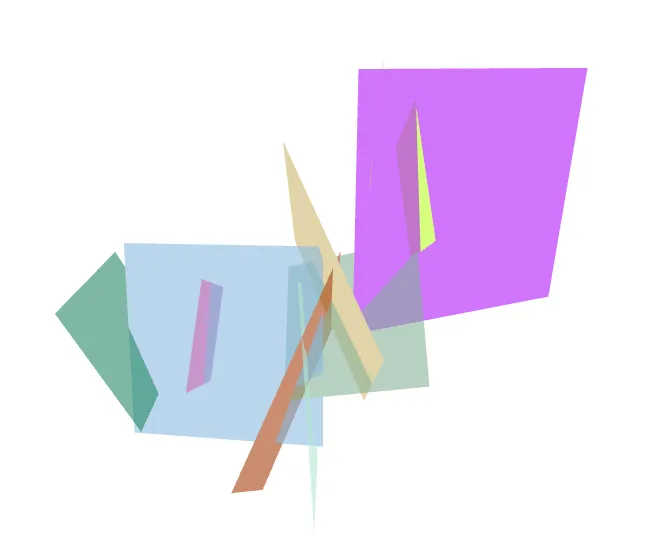
Joelle and I are working on an installation for Flashpoint Gallery in Washington D.C. This animation was made using ColladaFragmenter to deconstruct the architecture, and Processing with OBJloader to visualize the 3D fragments. The text is scraped from pages describing short sell real estate in D.C. This is work in progress:

Packet Switching project: ColladaFragmenter software, Kassel, Germany and University of Florida Public Commission

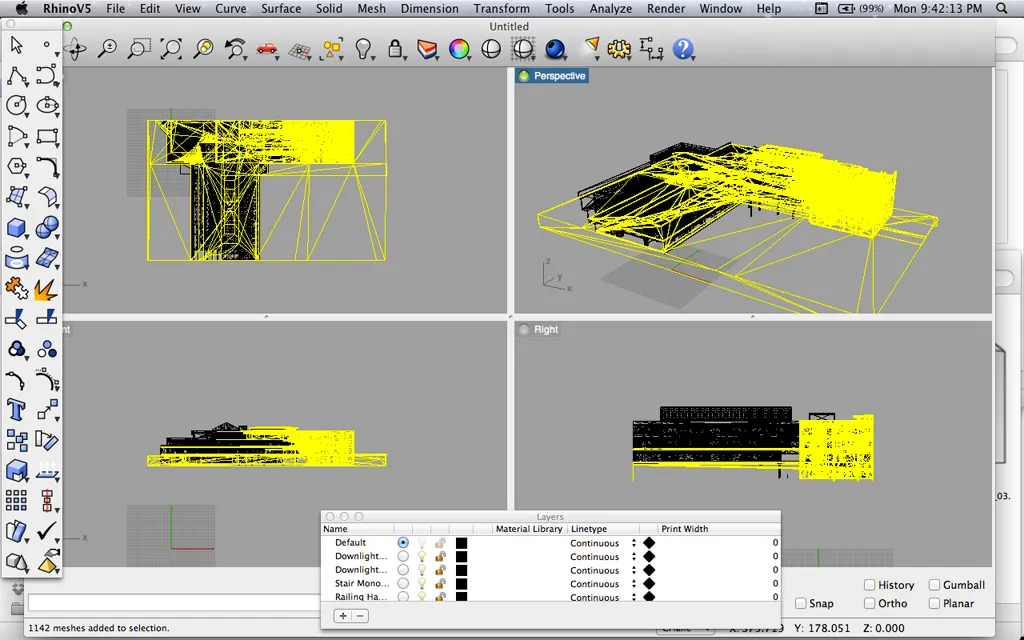
3d_model_in_Rhino_1024w

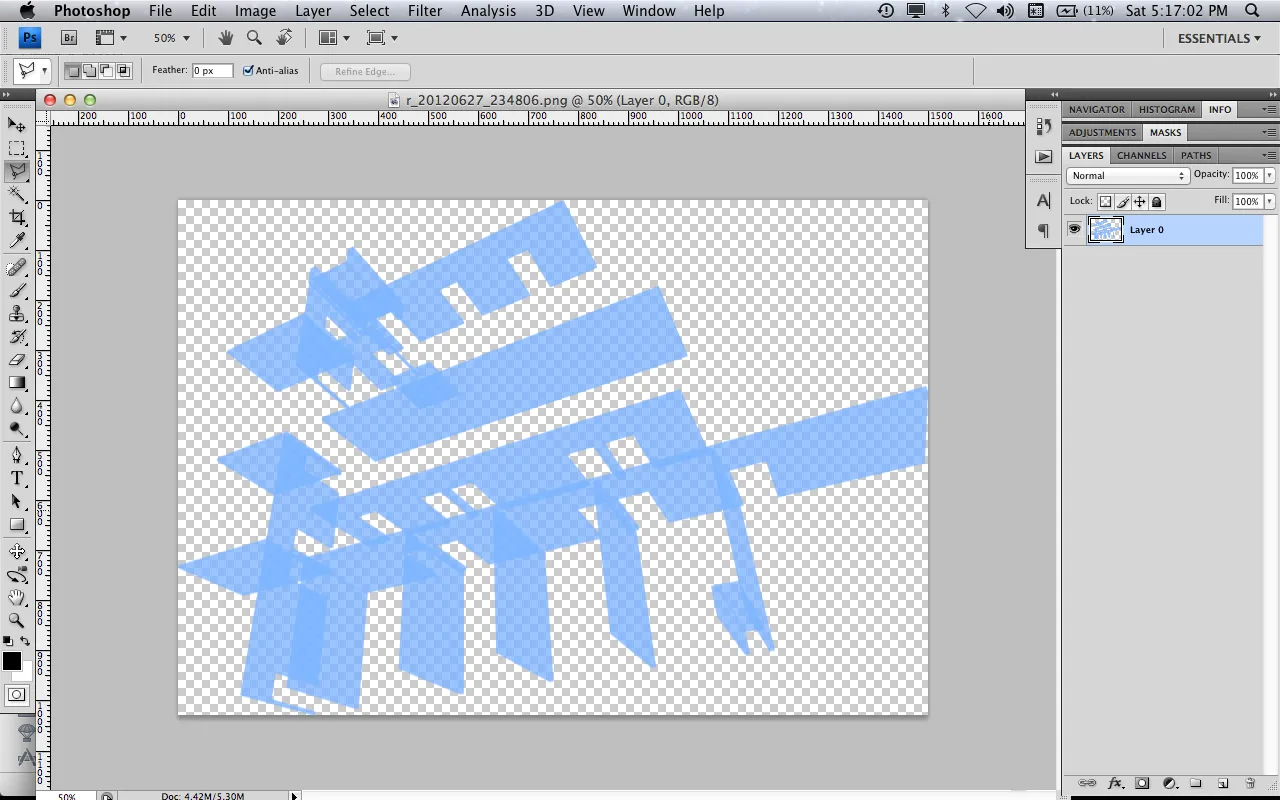
Joelle Dietrick and I embarked on a new body of work this summer called “Packet Switching.” Inspired by her Sherwin Series images and wall paintings, and my work deconstructing and re-visualizing source code and other data, we’ve created two new software projects, as well as a series of limited edition prints, large photo installations, wall-sized paintings, and animations.

3d_model_in_pshop

The full statement explains our process and intent clearly:

Packet Switching is an ongoing body of work by Joelle Dietrick and Owen Mundy that visualizes architecture as fragments affected by economic and communications systems.

The title of the series references how contemporary communications systems break digital files into smaller manageable blocks of data called packets. Each packet is then sent through a network, taking the quickest route possible, and reassembled once they reach their destination. One JPG image, for example, might be broken into several packets, each of which may travel a different path through the net, even through different cities, before being recompiled into a copy of the original file.

To reference this common process used in networked systems, we wrote custom software that deconstructs a 3D model’s source code and produces unique fragments. We further remixed these fragments using an original application created in Processing. The resulting images become limited edition prints, large photo installations, wall-sized paintings, and animations.

Our process underscores how incidental fragmentation and automation can streamline markets, but also make them vulnerable to systems failure. The use of architecture specifically points to recent real estate market volatility and considers how communication technology-enabled pursuits of profit margins alters our most basic needs.

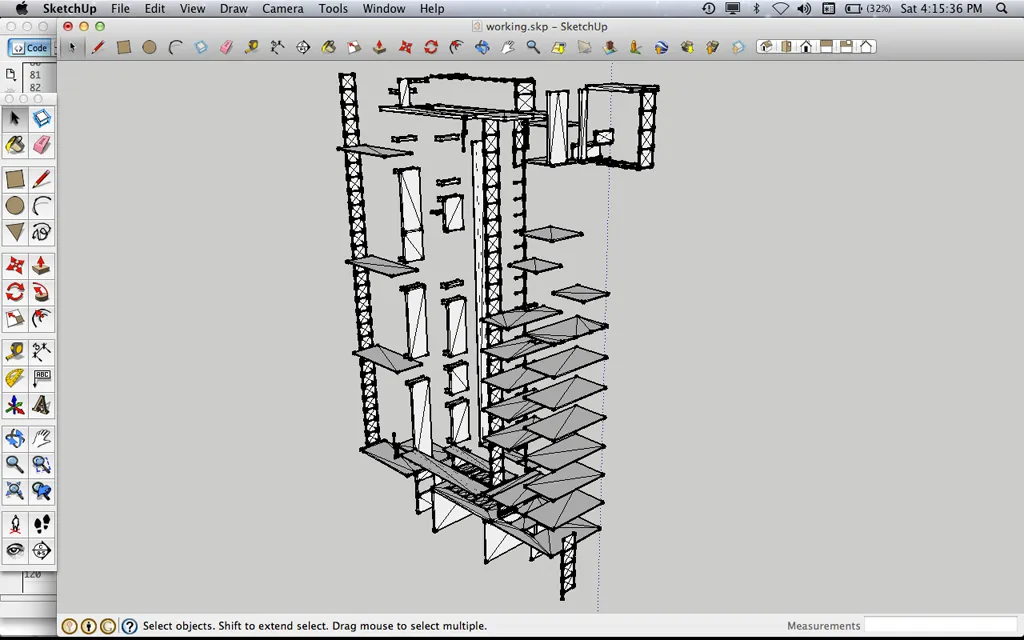
3d_model_in_sketchup_01_1024w

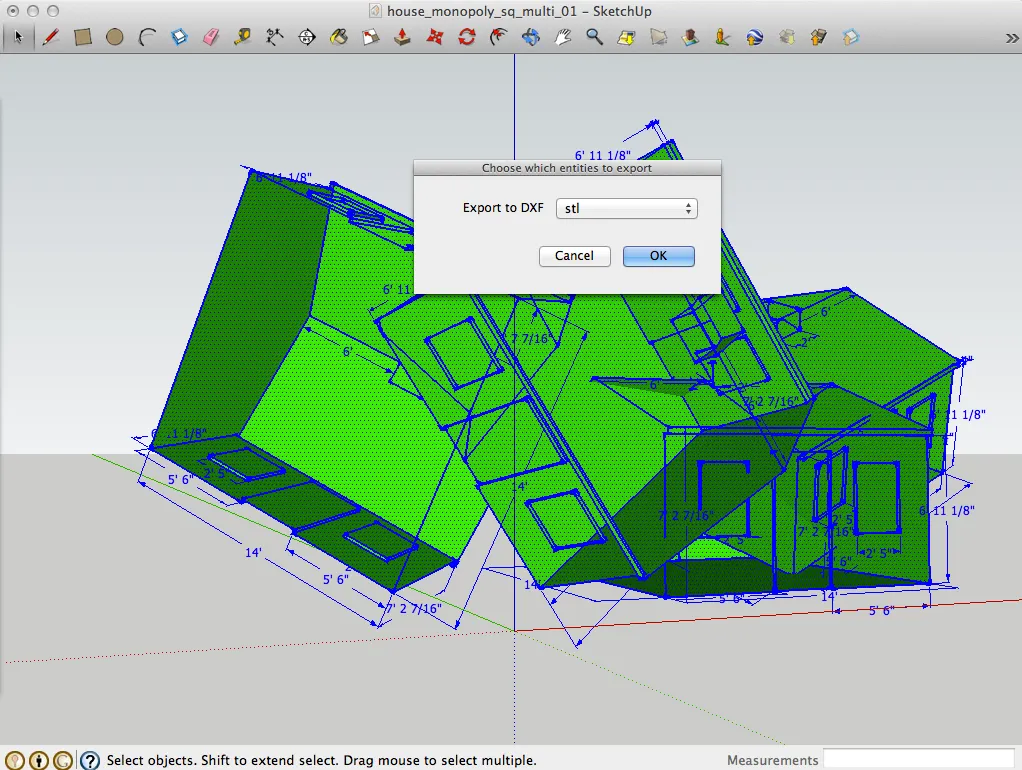
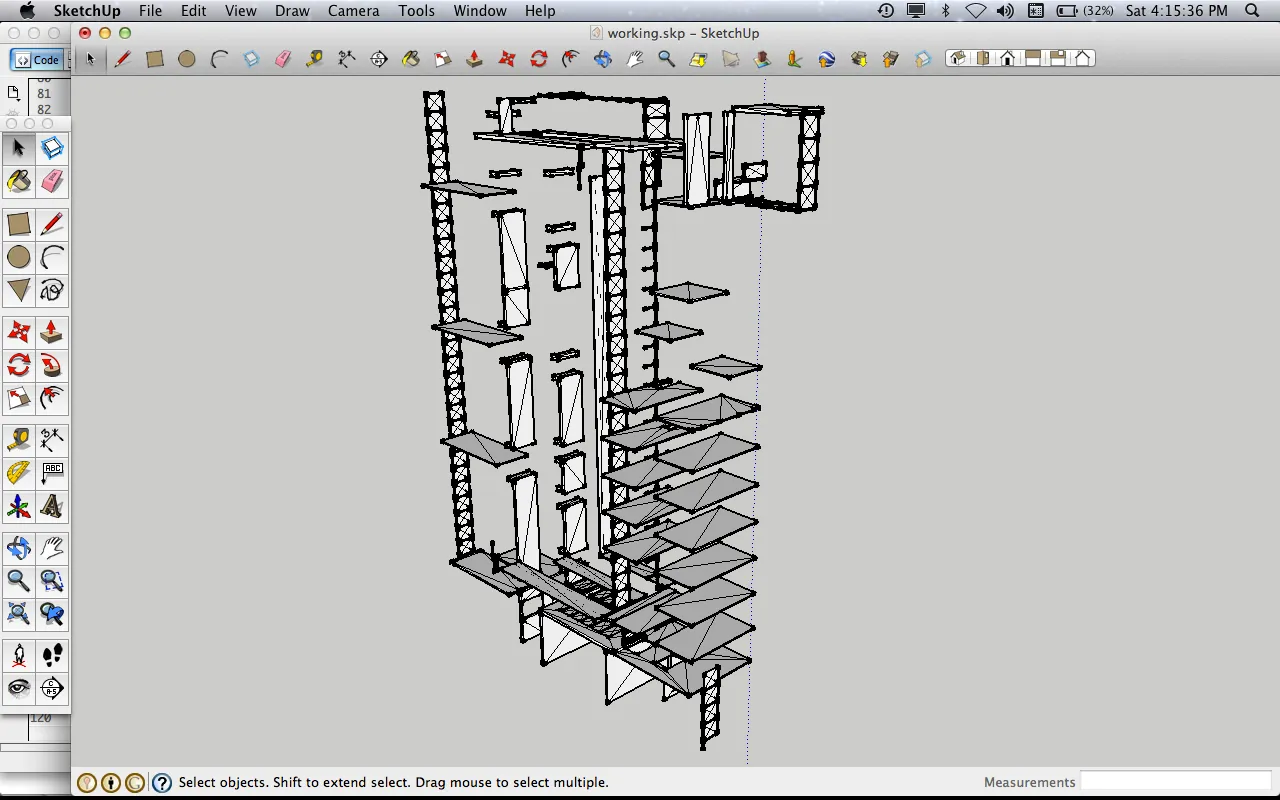
The first software, that “deconstructs a 3D model’s source code and produces unique fragments,” is open source and available on Github. Essentially, the PHP software, parses a 3D COLLADA file and exports a set number of geometries, that can then be further broken down and used in an artwork or design.

The second software, which we will release soon, remixes these fragments using Processing. The video below shows an example of the whole process.

Wall painting at “Temporary Home” in Kassel, Germany

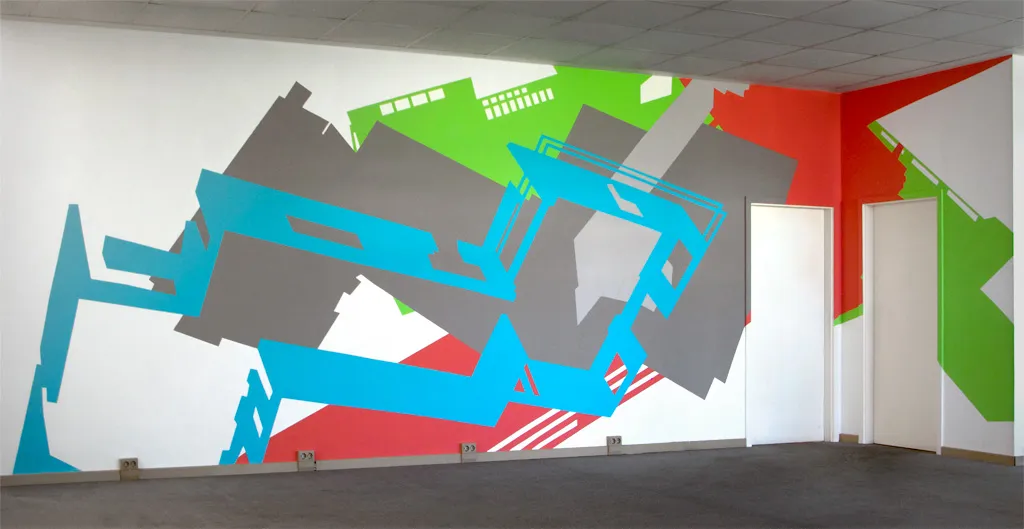
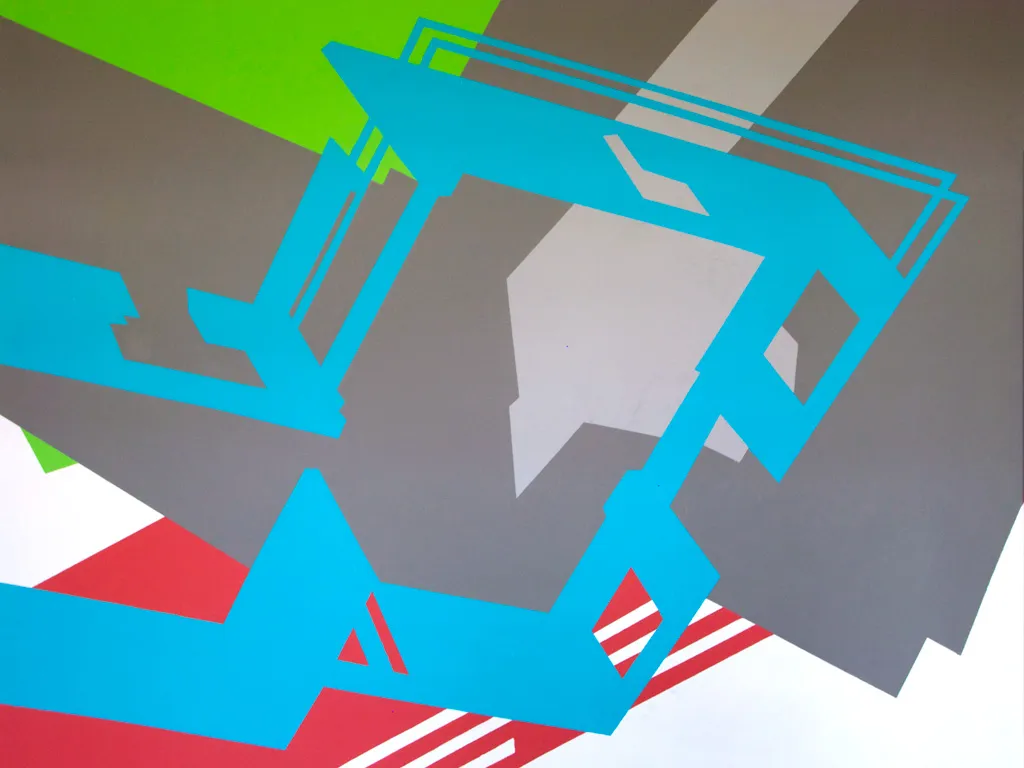
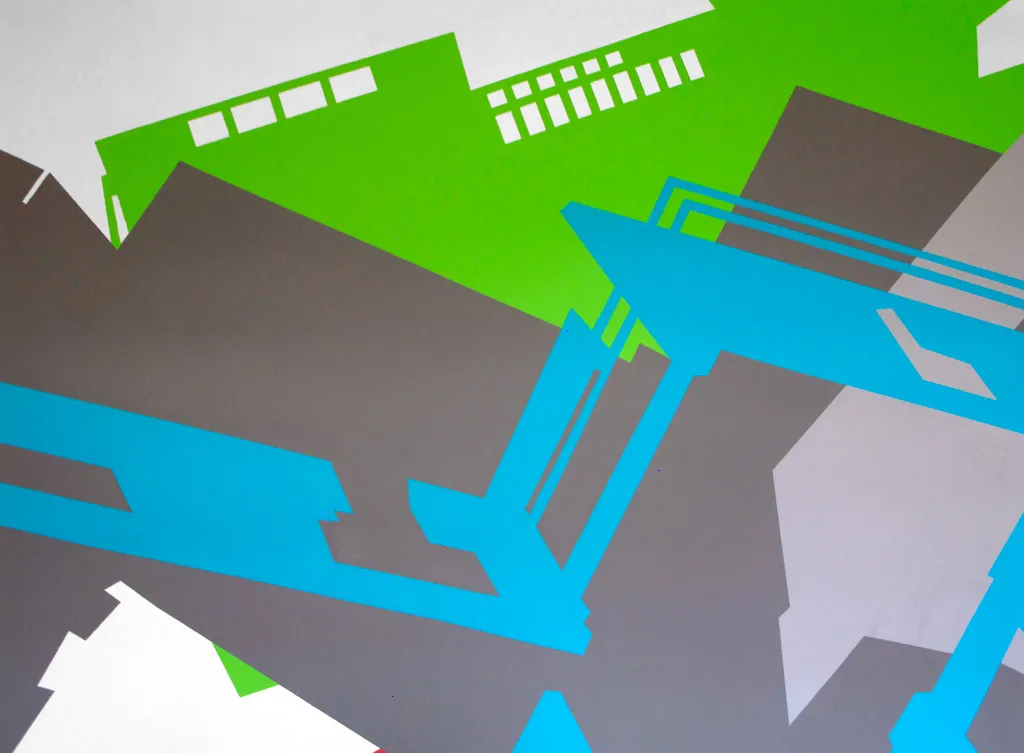
While artists-in-residence at Temporary Home, in Kassel, Germany, which coincided with Documenta13, Joelle Dietrick and I completed a wall-sized temporary painting based on the architecture from the Bauhaus School at Dessau and 2012 American color forecasts.

temphome_06_1024w

temphome_08_1024w

temphome_11_1024w

Commission at Weimer Hall at the University of Florida

Joelle and I have also received a commission to complete Packet Switching (Weimer Hall) at the University of Florida College of Journalism and Communications this fall. This will be inkjet on adhesive polyester on a large wall (approx. 177.5 ft. x 20.2 ft.). More details soon.

PaletteVisualizer

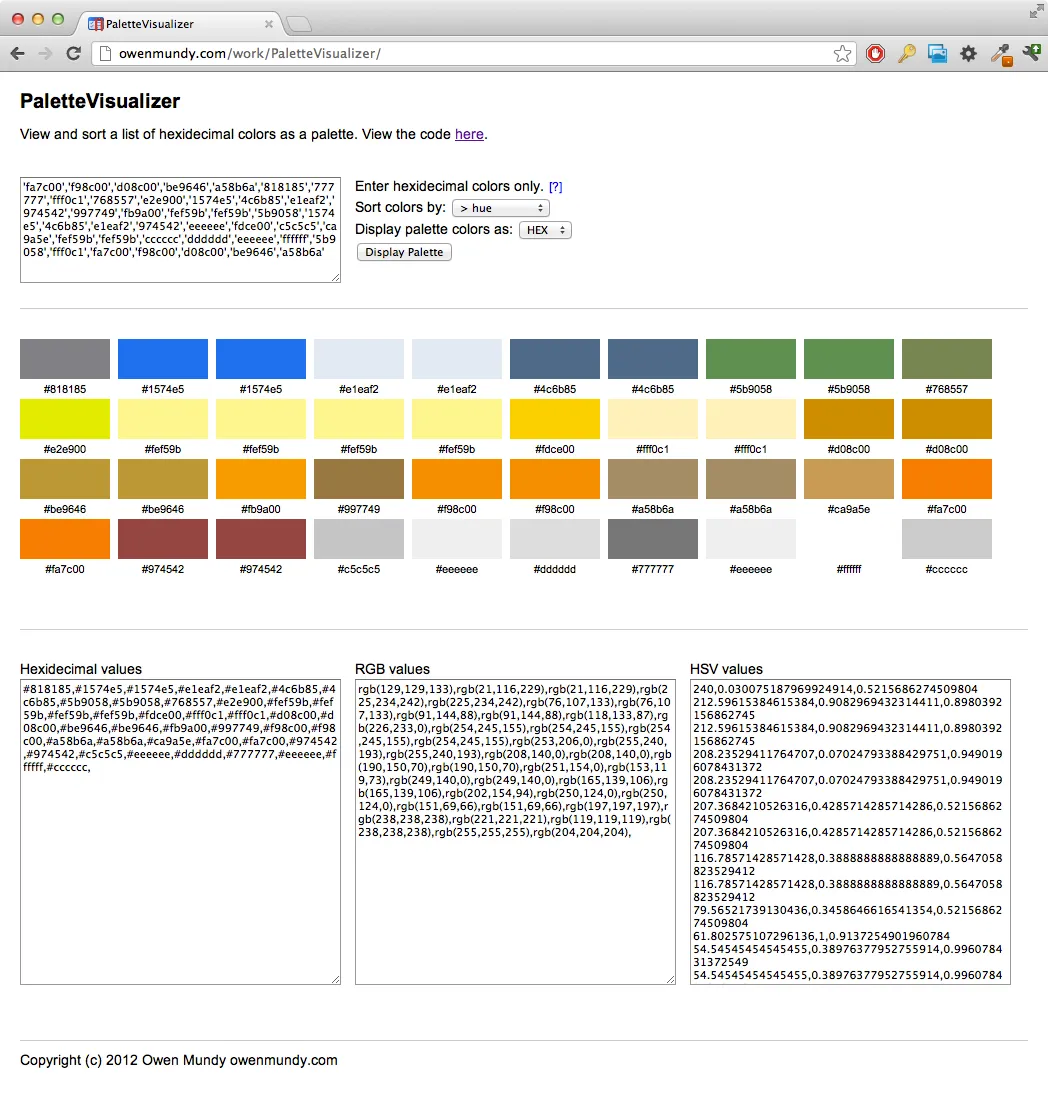
I’ve been working on a lot of projects this summer using various color palettes. Since my work involves writing programs to use these palettes in different visual outcomes, I keep wishing for an easy way to view and negotiate the lists of colors. So today I wrote a simple app to visualize a list of hexadecimal values and sort them by hue, saturation, and value (HSV). The app can be used here, and the code is open under the MIT License.

screenshot

Thanks to Alexei Kourbatov for the color format exchange functions.

Project Presentation and Mini-Seminar: Live Project Launch, Workshop Outcomes and Talks on [Social] Media Hacking

IMG_7520

Tonight Tim Schwartz, Walter Langelaar, Birgit Bachler, and I share our new project. The concept has taken a turn from the original plan, but will be exciting nonetheless.

Project Presentation and Mini-Seminar: Live Project Launch, Workshop Outcomes and Talks on [Social] Media Hacking
Friday, July 27, 2012

Tonight we launch the new version of “Give Me My Data!”, a project that together with Artists In Residence Tim C. Schwartz and Owen Mundy was revised and revived in WORM’s moddr_lab.

Give Me My Data offers functionality to its users with which they can retrieve and backup data and files from several key social networks; partly designed as a backup tool moreover targeted at networks that completely lack these functions.

Besides launching the project and am in-depth presentation by the artists, Walter Langelaar of WORM will give an introduction and overview of similar (art)works and earlier projects that came out of WORMs studios like the “Web2.0 Suicide Machine”.

Further more we’ll have presentations of current and ongoing projects from the lab, like Birgit Bachler’s ‘online social gardening’ platform “Talk To The Plant”, the Force of Freedom (Roel Roscam Abbing and Micha Prinsen) present “partsba.se”, and Geert Lovink talks about the “Unlike Us” initiative. The last addition to tonights programme is a presentation by Greenhost.nl on their very excellent RePress project; a WordPress plugin that automagically converts your site to a proxy-server countering censorship on the internet!

In conclusion there will be an open Q&A and panel discussion moderated by Florian Cramer of Creating010.

Projects & Speakers

Florian Cramer – Creating010
Florian Cramer, is a reader and programme director at the applied research center Creating 010 at Hogeschool Rotterdam, The Netherlands. he is a critical writer on arts, culture and information technology. Recent publications include: Exe.cut(up)able statements: Poetische Kalküle und Phantasmen des selbstausführenden Texts, Wilhelm Fink, 201.

Unlike Us / Geert Lovink
The aim of Unlike Us is to establish a research network of artists, designers, scholars, activists and programmers who work on ‘alternatives in social media’. Through workshops, conferences, online dialogues and publications, Unlike Us intends to both analyze the economic and cultural aspects of dominant social media platforms and to propagate the further development and proliferation of alternative, decentralized social media software.

Tim C. Schwartz – moddr_/WORM Artist in Residence
Tim Schwartz grew up in St. Louis, MO. He received a BA in Physics from Wesleyan University and an MFA in Visual Arts from the University of California, San Diego. In January 2010, he developed a technology to help reunited missing people affected by the earthquake in Haiti and now co-runs an organization dealing with family reunification. Last year Schwartz spent four months traveling the country in a mobile research laboratory investigating what is lost as archives become digital.

Birgit Bachler – moddr_/WORM
Birgit is an Austrian artist living and working in Rotterdam/NL. She graduated as BA in Information Design / Media & Interactiondesign at the Universityof Applied Sciences in Graz/AT and is a recent graduate of the MA Networked Media at Piet Zwart Institute Rotterdam. She has a background in interactive, audiovisual media and programming. Her interests focus on the influence of new media on our everyday lives and the similarities and differences between human and computational behavior.

RePress / Greenhost.nl
“This plugin was made in response to the ongoing limitation of the Open Web. In the dawn of 2012 we found ourselves confronted with a court-ruling blocking the Piratebay.org in the Netherlands. On the other side of the ocean new laws are being discussed to curtail web-freedom even further.”

We zijn pioneer in groene hosting. We ontwikkelden een innovatief energiebesparend hostingplatform waardoor we 70% minder energie gebruiken dan andere hosters. Onze servers staat bij Evoswitch, het meest duurzame datacenter van Nederland.

Owen Mundy – moddr_/WORM Artist in Residence
Owen Mundy is an artist, designer, and programmer who investigates public space and its relationship to data. His artwork highlights inconspicuous trends and offers tools to make hackers out of everyday users. He has an MFA in Visual Art from the University of California, San Diego and is an Assistant Professor of Art at Florida State University.

partsba.se / Force Of Freedom
At partsba.se you can upload, share and download digital designs for real physical products. Partsba.se allows you to share designs of any nature, whether these designs are copyrighted or dangerous. Unlike other websites partsba.se does not claim any rights of your designs once you upload them.In the near future partsba.se will run on a fully secure and anonymous server.

We believe that users should be free to reverse engineer any everyday objects that surround them. Either to improve these objects, customize them, repair them or just to understand them.

The Force Of Freedom is a Rotterdam based collective founded by Micha Prinsen and Roel Roscam Abbing in 2009. Researching ways in which we can relate to things that happen on-line.

Kaarten
De volgende kaarten zijn beschikbaar:
Normaal Voorverkoop: € 5.00 Deurverkoop: € 5.00

Locatie
WORM
Boomgaardsstraat 71
3012 XA Rotterdam

Give Me My Data API Hacking Masterclass

IMG_7522

Give Me My Data API Hacking Masterclass
Thursday, July 27, 2012

A ‘hands-on’ workshop with technical and theoretical overview of contemporary ‘Application Programming Interfaces’ (API’s) of large social networks, en how to use these for your own project or application.

We will cover the ins and outs of creating Facebook apps, web applications, and how to play with the Twitter, Foursquare, Flickr and Instagram APIs.

With WORM’s current ‘Artists In Residence’ Tim C. Schwartz and Owen Mundy you’ll learn from a programmers perspective how to approach your target network, to subsequently make it do what you need it to… As an example you can think of Owen’s project “Give Me My Data” or WORM’s previous release of the “Web2.0 Suicide Machine”

No specific technical skills required, but a curious mind towards the ins&outs of social networking is a must!

[EN] buy your ticket online or send your resrvation tomoddr@worm.org, Participation is limited so act fast!
– reduced/discount tickets available for WORM volunteers & students (with ID)

Normaal Voorverkoop: € 15.00 Deurverkoop: € 15.00
Normaal reductie Voorverkoop: € 10.00 Deurverkoop: € 10.00

Location: WORM, Boomgaardsstraat 71, 3012 XA Rotterdam

WORM residency / Tech Talk and Discussion on Social Media Hacking

wormlogo


I’m currently a moddr_/WORM Artist in Residence in Rotterdam, the Netherlands. Here, I’m collaborating with Tim C. Schwartz (MFA, UCSD) and Walter Langlaar (Web2.0 Suicide Machine), Birgit Bachler, and others, working on some social media hacking-related projects similar to Give Me My Data.

During the residency we will be conducting multiple workshops, including an API Hacking Masterclass, to discuss the technical underpinnings and conceptual challenges in working with APIs in the service of media art. The two-week residency will conclude with a mini-seminar on social media hacking with guest commentators Florian Cramer, Piet Zwart Institute, Willem de Kooning Academie Rotterdam, and Dr. Geert Lovink, Professor of Interactive Media at the Hogeschool van Amsterdam(HvA).

I’ll be posting some links to upcoming events starting with an Open Lab session:

Tech Talk and Discussion on Social Media Hacking
July 25, 2012

From 14th till 30th of July Tim C. Schwartz and Owen Mundy will be our guests as Artists In Residence. They’ll be working in WORM’s medialab with the moddr_crew on a new version of Owen earlier project “Give Me My Data”; a Facebook application that let’s you retrieve all your input and data from the network.

In today’s ‘Open Lab’ session Tim and Owen will share some insights on the project, and there’ll be room for informal discussion on technical aspect of the project, as well as the more socio-political implications of this type of work.

Location: WORM, Boomgaardsstraat 71, 3012 XA Rotterdam

ListSearch tool launch

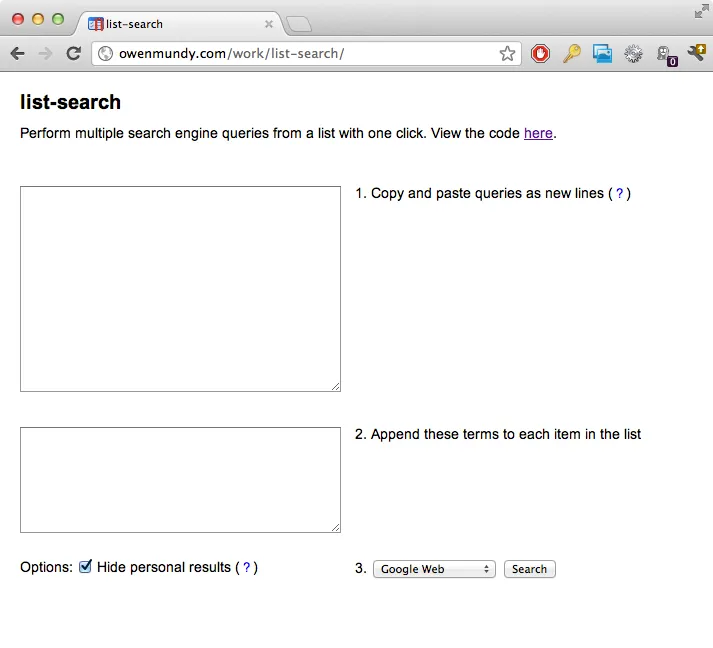
On many occasions over the past few years I’ve wished I knew of a tool that would allow me to search multiple items in a list in separate Google searches, without copying and pasting and submitting each item over and over and over. For example if I’m in a group exhibition and I want to see what work the other artists do. So, I finally took a few hours and created it. It’s called “list-search” and you can use it here and view the code here.

ListSearch

Call for Abstracts: MutaMorphosis: Tribute to Uncertainty

MutaMorphosis: Tribute to Uncertainty conference
December 6-8, 2012, Prague, Czech Republic.

Call for Abstracts
Deadline: July 1, 2012

user-705598602-33x33in_700w_detail

Examining Networks of Power
By Owen Mundy

This thread intends to examine representations of contemporary control structures and discuss whether or not an image, particularly network graphs depicting power relationships, information flows, economic activity, etc. have the ability to reverse trends of concentrated power. Does depicting power lead to greater democratization of said power or are we merely creating beautiful images that detract from their original intent—to reveal, examine, and act. To what effect does mapping complex data depicting influential actors, institutions, moments in time, finance systems, mapped onto a two-dimensional surface unravel the power they represent by distributing that power?

Methodology: We’ll begin the discussion by looking at historical examples of communication that intend to affect power structures. We’ll examine works by artists and cultural practitioners such as Hans Haacke, Mark Lombardi, Josh On (theyrule.net), Bureau d’études, and more. We’ll consider Manual Castells‘ “Network Theory of Power” within these context(s). Then we’ll discuss visual components of network graphs, asking in particular; what data and representational forms help make a graph speak to as many people as possible. Finally we’ll work in groups to extend the discussion into possible solutions and various statements and recommendations for such representations.

Keywords: Networks; Power; Data; Politics

We invite you to respond to the Tribute to Uncertainty theme and/or to address one of the 21 streams of interest led by 28 conference Attractors.

Do you have something original to say about our world that is increasingly fuzzy, unstable and chaotic? Are you interested in how crisis, uncertainty and complexity can come together in order to question the known as well as predict and/or model yet unknown? Do you want to share projects intrinsically linking domains of scientific, artistic and technological research and creativity that can be introduced as relevant tools for better understanding of our common future?

The aim of this Call for Abstracts is to provide opportunity for community of interdisciplinary practitioners to get engaged in a transformative conversation on mutant futures.

Feel free to address conference Attractors and respond to a specific stream of interest in order to get involved with other interested individuals and collectives in structured collaborative efforts before, during, and hopefully also after the conference. Research groups formed by the Attractors -who serve as the Reviewers- will be expected to elaborate on the general theme Tribute to Uncertainty while turning attention to concrete research objectives as defined by the streams.

The results should be curated panels, roundtables, workshops as well as publications.

For more information about MutaMorphosis conference (planned publications, preparatory committee, partnerships) please visit mutamorphosis.org.

Drones at Home: Phase 1 – Gallery@Calit2

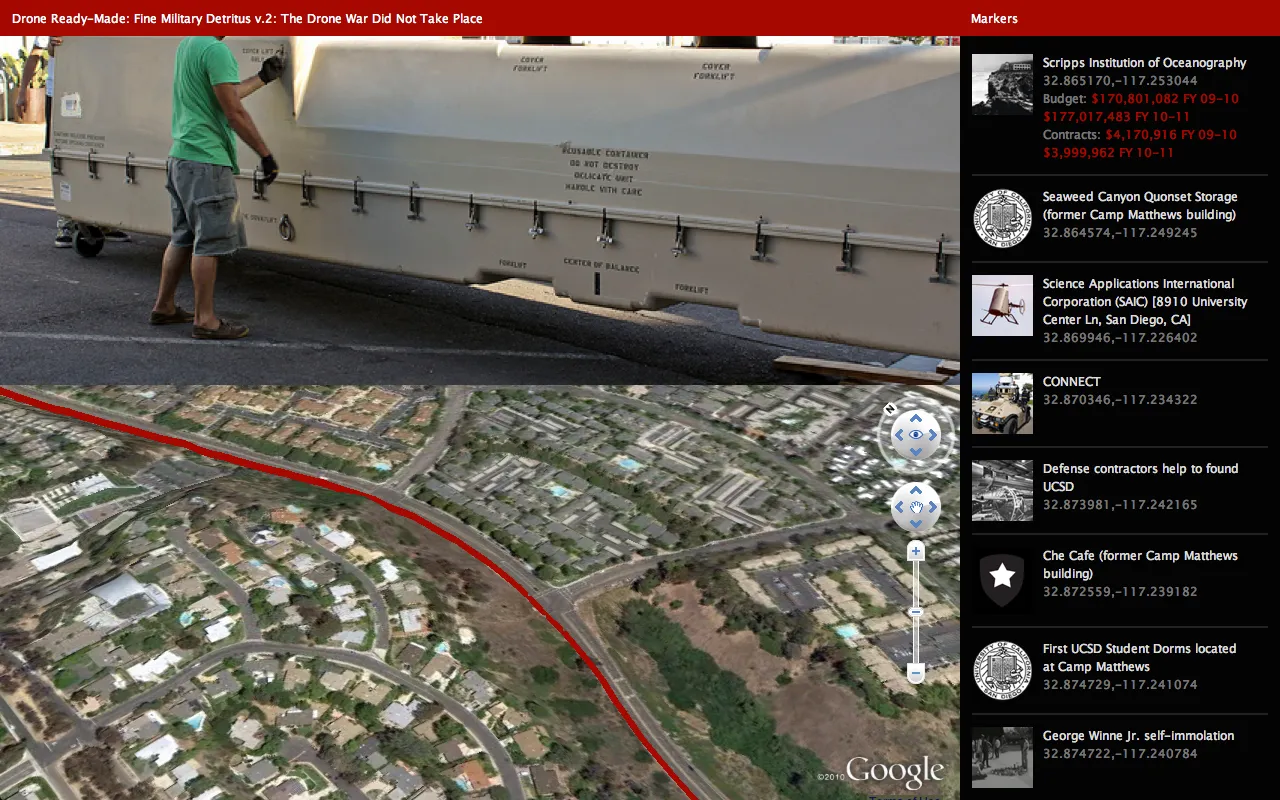
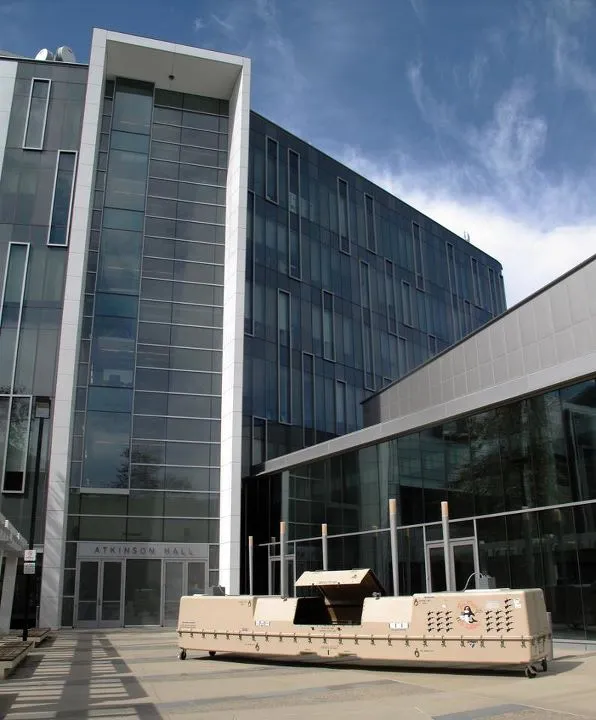
I’m collaborating with The Periscope Project (TPP) on version 2 of their “Drone Ready-Made: Fine Military Detritus” project in conjunction with the Drones at Home exhibition at Calit2 (see below). In the gallery and online, an interface I programmed, “The Drone War Did Not Take Place,” tracks a Predator drone shipping container, found on Craigslist and retrofitted by The Periscope Project as a camping apparatus, as TPP members guide it through the city of San Diego.

Drones at Home: Phase 1 – Gallery@Calit2

Their path will take them from UC San Diego, past various defense contractors and government agencies including The Space and Naval Warfare Systems Command (SPAWAR), to finally rest at TPP’s downtown location. By (re)mapping data from my Camp La Jolla Military Park project, the tracking interface reveals the connections between the physicality of TPP’s laborious gesture, and the economic and political ties between the object they push and the sites and corporations where everyone employed is implicated in the destructive impact of a permanent arms economy.

The interface will be made public during the upcoming three-day performance by The Periscope Project. It will display their location in real-time, along with images from their journey, and a twitter feed displaying news and unfiltered dialog (hashtag: #dronebox) as they treck through “the largest concentration of military facilities and defense industries in the world.”(1)

1. “San Diego Military Economic Impact Study,” San Diego Regional Chamber of Commerce, January 2007, http://www.sddt.com/files/2007_Military_Economic_Impact_Study.pdf

DronesPosterFrV5

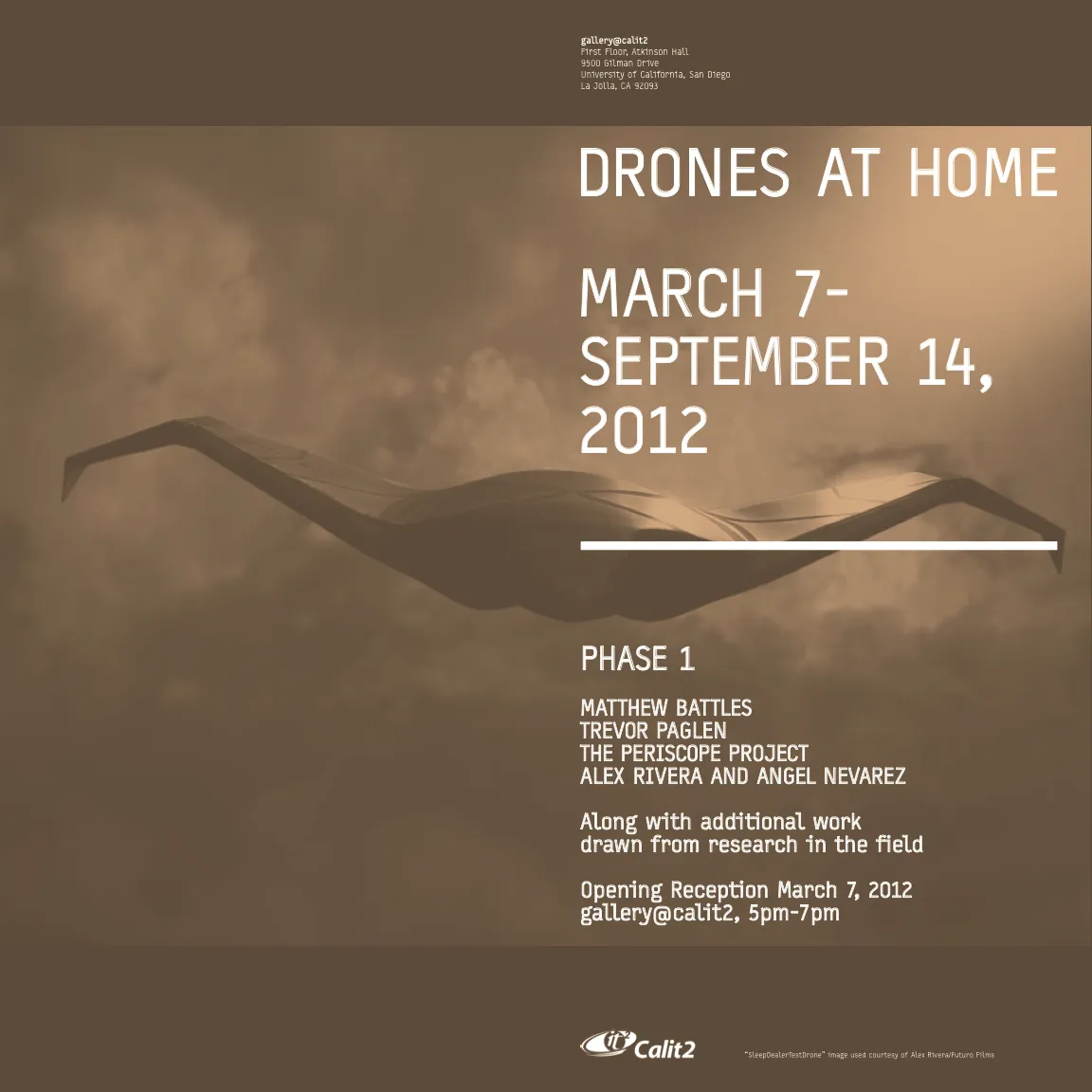
Drones at Home
March 7–September 14, 2012

Drones at Home explores the strange allure of drones and the push for their domestication —by governments, corporations, and everyday citizens.

Phase 1
Opening Reception March 7, 2012 gallery@calit2, 5pm-7pm

Phase 2
Symposium May 11 & 12, 2012 Calit2 Auditorium, 9am-8pm

Phase 3
Opening Reception June 6, 2012 gallery@calit2, 5pm-7pm
Closing Reception September 14, 2012 gallery@calit2, 5pm-7pm

“Home” is understood at multiple scales-at the level of the individual, backyard, community, border region, and homeland. The San Diego region is featured prominently and regional issues are explored as exemplars of global phenomena. The exhibition also departs from any strict interpretation of the form that a drone must take; the project expands on the “unmanned” nature of the drone as symbolic of a larger condition–ecologies where the status of the human is called into question, distributed and embedded in a wider field of shared intelligence.

Drones at Home will be presented in three phases. Phase 1 includes an exhibition; Phase 2 consists of panels and a workshop; and Phase 3, which continues through the summer, will include the creation of new drone projects in collaboration with invited artists and research groups at Calit2. Co-curated by Sheldon Brown, Jordan Crandall, and Ricardo Dominguez, this first phase will feature the work of Matthew Battles, Trevor Paglen, The Periscope Project, Alex Rivera and Angel Nevarez, along with additional work drawn from research in the field.

Matthew Battles is a poet, writer, and co-founder of HiLobrow.com. His forthcoming books include Letter by Letter (W. W. Norton), a sentimental and natural history of writing, and a short story collection, The Sovereignties of Invention (Red Lemonade). He is a research fellow with metaLAB, an academic and creative collaborative devoted to the exploration of technology in the arts and humanities, hosted by Harvard University’s Berkman Center for Internet and Society.

Alex Rivera is a New York based digital media artist and filmmaker. His first feature film, SLEEP DEALER premiered at Sundance 2008, and won two awards, including the Waldo Salt Screenwriting Award. Rivera is a Sundance Fellow and a Rockefeller Fellow. His work, which addresses concerns of the Latino community through a language of humor, satire, and metaphor, has also been screened at The Berlin International Film Festival, New Directors/New Films, The Guggenheim Museum, PBS, Telluride, and other international venues.

Angel Nevarez is an artist, musician, and DJ. He has produced works which investigate contemporary music, dissent, and public fora, and move between the spatial simultaneity of performance and enunciation, reflecting upon the projection of political agency through transmission and song. His interests lie in the formation of mobile, performative, and discursive-based social spaces, along with the re-articulation of communicatory systems within such locales. Nevarez is also a faculty member of MIT’s Art, Culture, and Technology Program.

Trevor Paglen’s work deliberately blurs lines between science, contemporary art, journalism, and other disciplines to construct unfamiliar, yet meticulously researched ways to see and interpret the world around us. Paglen’s visual work has been exhibited at the Metropolitan Museum of Art, New York; The Tate Modern, London; The Walker Arts Center, Minneapolis; The Andy Warhol Museum, Pittsburgh; Institute for Contemporary Art, Philadelphia; The San Francisco Museum of Modern Art; Massachusetts Museum of Contemporary Art, North Adams; the 2008 Taipei Biennial; the Istanbul Biennial 2009, and numerous other solo and group exhibitions.

The Periscope Project is a space and co-operative based in downtown San Diego committed to the transdisciplinary nexus of art, architecture, and regional urban issues. Operating by the efforts of its resident practitioners; Drone Readymade represents the first discreet project (outside of The Periscope Project itself) undertaken collaboratively. The project’s primary authors are James Enos (M.Arch, NSAD, MFA UCSD, Visiting Assistant Professor, FSU), Molly Enos (M.Arch NSAD, AIA), Charles G. Miller (MFA UCSD), Keith Muller, Andrea Ngan, David Kim, Jon Barth, Jason Durr and Jay Ojeda; with key contributions from Jon Zuppan. For Drones at Home, The Periscope Project is collaborating with Owen Mundy (MFA UCSD, Assistant Professor FSU).

All gallery events are FREE and open to the public.
Please RSVP to Trish Stone, Gallery Coordinator, tstone@ucsd.edu
Media Contact: Tiffany Fox, tfox@ucsd.edu

419415_404788232871062_112784495404772_1796059_516778046_n

“Disrupt this Session”: Rebellion in Art Practices Today (today at CAA Los Angeles)

I’m participating a panel today at the College Art Association conference in Los Angeles. Sounds like it might be lively.

“Disrupt this Session”: Rebellion in Art Practices Today
Saturday, February 25, 9:30 AM–12:00 PM
Concourse Meeting Room 403B, Level 2, Los Angeles Convention Center
Chair: Wendy DesChene, Auburn University

WTF: It’s Only a Sticker
Catherine Tedford, St. Lawrence University

Strategies of Resistance in Contemporary Art
Selene Preciado, Museum of Latin American Art

Unauthorized Autonomy, Invisible Venue
Christian L. Frock, Invisible Venue

Monsantra: A New Agricultural Revolution
Jeff Schmuki, Plantbot Genetics

Your Art Here, Camp La Jolla Military Park, and Give Me My Data
Owen Mundy, Florida State University

“Google” one-week performance at Transmediale

logo3w

I am tele-participating in a one-week online performance of Google queries at Transmediale 2012 in Berlin. The project, plainly titled, “Google,” is organized by Johannes P. Osterhoff and will run from Jan 30 to Feb 5, 2012. Each participant edits the search method for their browser search bar so that everything they type in this box, from the personal to the mundane, becomes instantly visible at google-performance.org.

The project (“manifesto” below) makes public what Facebook, Google, and any online search engine, crowdsourcing website, or social network already does by harvesting searches from users, and re-representing that data in a new context. While Google uses these queries to build and sell condensed user demographic data to advertisers, Osterhoff’s project asks, who actually owns your search data?

We shall do an one-week performance piece.

The piece is called “Google” and documents all searches we perform withthe search engine of the same name.

The performance shall take place during transmediale 2012 and shall start on Monday, January 30 and shall end on Sunday, February 5, 2012.

We shall not use undocumented ways to use the search engine Google during this time.

Each of our search queries shall create a web page that is indexed by this search engine and thus makes our searches publicly available as search results for everybody.