Beautiful Data II @ Metalab at Harvard University

This month found me at the excellent Beautiful Data II workshop at the MetaLab at Harvard University sponsored by the Getty Foundation. Participants worked together in the Carpenter Center and Harvard Art Museum under the theme “Telling Stories About Art with Open Collections.”

Screen Shot 2015-08-01 at 7.03.00 PM

There were presentations by known visualization and museums experts, breakout sessions exploring how to represent problem data and collections, and talks by participants and Metalab staff and fellows, including a wonderful group of artists, curators, designers, and scholars in attendance.

Here are a few of the many highlights starting with this nerdy shot of me…
P1030056

P1000822
Data Therapy workshop with Rahul Bhargava (slides1, slides2).

Screen Shot 2015-08-04 at 8.18.09 PM
Learning about provenance at the Harvard Art Museum (note stamp declaring Nazi property)

This spanking cat statuette from the Cooper Hewitt collection.
Colour Lens produced at Beautiful Data I.
Presentation by Seb Chan Director of Digital at Cooper Hewitt.
Memory Slam by Nick Montfort.
Meow Met Chrome extension shows cats from the Met Museum in new tabs.

IMG_3966
Behind the scenes of Ivan Sigal‘s Karachi Circular Railway, Harvard Art Museum Lightbox.

The Life and Death of Data by Yanni Loukissas.
Ben Rubin discussing his and works by Mario Klingemann, Ryoji Ikeda, Jer Thorp and others.
William James Twitter Bot by Rachel Boyce.


Cold Storage documentary by Jeffrey Schnapp, Cristoforo Magliozzi, Matthew Battles, et al.
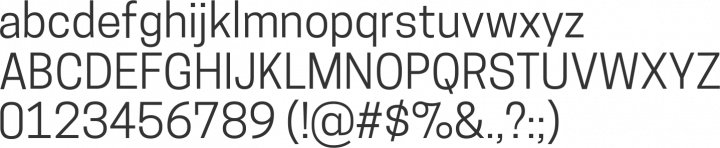
Cooper Hewitt Font Specimen
Cooper Hewitt typeface by Chester Jenkins


“Unicode” by Jörg Piringer shows all 49571 displayable characters in the unicode range.

*Most photos by Metalab staff

Art In The Age Of… Planetary Computation, Witte de With Center for Contemporary Art

I Know Where Your Cat Lives at Witte de With Center for Contemporary Art in Rotterdam.

2015_witte_de_with_01
Opening of the exhibition ‘Art In The Age Of…Planetary Computation’, 21 May 2015. Photo: Aad Hoogendoorn

2015_witte_de_with_02
Opening of the exhibition ‘Art In The Age Of…Planetary Computation’, 21 May 2015. Photo: Aad Hoogendoorn

Art In The Age Of… Planetary Computation
22 May – 16 August 2015
Opening: 21 May 2015, 5pm

With: Aram Bartholl, Rossella Biscotti, Nina Canell, John Gerrard, Femke Herregraven, Antonia Hirsch, David Jablonowski, Navine G. Khan-Dossos, John Menick, Owen Mundy, Trevor Paglen, Lucy Raven, Stephan Tillmans, Julia Weist

How would you draw a picture of the Internet; through the machines and ‘their’ language that broadcast and store ‘our’ messages, or through the affect and power relations that those messages and their movement produce?


Exhibition visitors guide

Art In The Age Of… Planetary Computation investigates how quantification, telecommunications, and our ever-expanding information apparati not only inform contemporary artistic production, but also how contemporary art can hold a mirror up to these processes and formations. The participating artists explore the fissure between literal infrastructure—code, machines, wires, and other like-vocabularies—and the subjective socio-political interactions fostered by using these devices. Guided not only by that which can be seen on the computer screen, and the various other black mirrors we stare into day in and day out, this exhibition also looks to what happens behind these screens. Moving from objects to subjects, we ask, how do these positions impact daily life, or said in another way: what does it mean to be ‘screened’?

Art In The Age Of… Planetary Computation is the second iteration of Art In The Age Of…, a three-part presentation series running throughout 2015, that investigates future vectors of art production in the 21st century.

witte_de_with_logoWitte de With
Center for Contemporary Art
Witte de Withstraat 50
3012 BR Rotterdam
The Netherlands
www.wdw.nl

Upcoming workshop at FSU, “I Know Where Your Cat Lives”: The Process of Mapping Big Data for Inconspicuous Trends

I’m doing a workshop / lecture as part of the ongoing Digital Scholars digital humanities discussion group here at Florida State University. Workshop is free and open to the public.

Wednesday, March 25, 2:00-3:30 pm
Fine Arts Building (FAB) 320A [530 W. Call St. map]

Screen Shot 2014-10-29 at 4.32.37 PM

“I Know Where Your Cat Lives”: The Process of Mapping Big Data for Inconspicuous Trends

Big Data culture has its supporters and its skeptics, but it can have critical or aesthetic value even for those who are ambivalent. How is it possible, for example, to consider data as more than information — as the performance of particular behaviors, the practice of communal ideals, and the ethic motivating new media displays? Professor Owen Mundy from FSU’s College of Fine Arts invites us to take up these questions in a guided exploration of works of art that will highlight what he calls “inconspicuous trends.” Using the “I Know Where Your Cat Lives” project as a starting point, Professor Mundy will introduce us to the technical and design process for mapping big data in projects such as this one, showing us the various APIs (Application Program Interfaces) that are constructed to support them and considering the various ways we might want to visualize their results.

This session offers a hands-on demonstration and is designed with a low barrier of entry in mind. For those completely unfamiliar with APIs, this session will serve as a useful introduction, as Professor Mundy will walk us through the process of connecting to and retrieving live social media data from the Instagram API and rendering it using the Google Maps API. Participants should not worry if they do not have expertise in big data projects or are still learning the associated vocabulary. We come together to learn together, and all levels of skill will be accommodated, as will all attitudes and leanings. Desktop computers are installed in FAB 320A, but participants are welcome to bring their own laptops and wireless devices.

Participants are encouraged to read the following in advance of the meeting:

and to browse the following resources for press on Mundy’s project:

For further (future) reading:

“Owen Mundy just ruined the Internet” and the last days for the kickstarter

It has been an intense couple weeks since my last post. It turns out the internet loves cats even more than data, maps, and politics. So here is an update on many things “cat”…

Update on the project

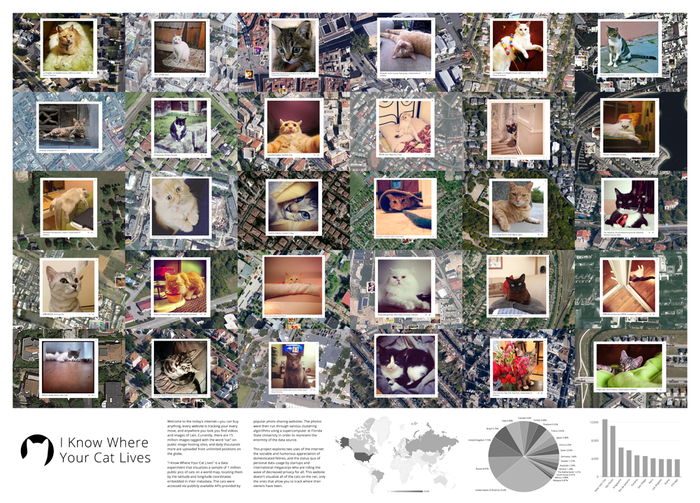
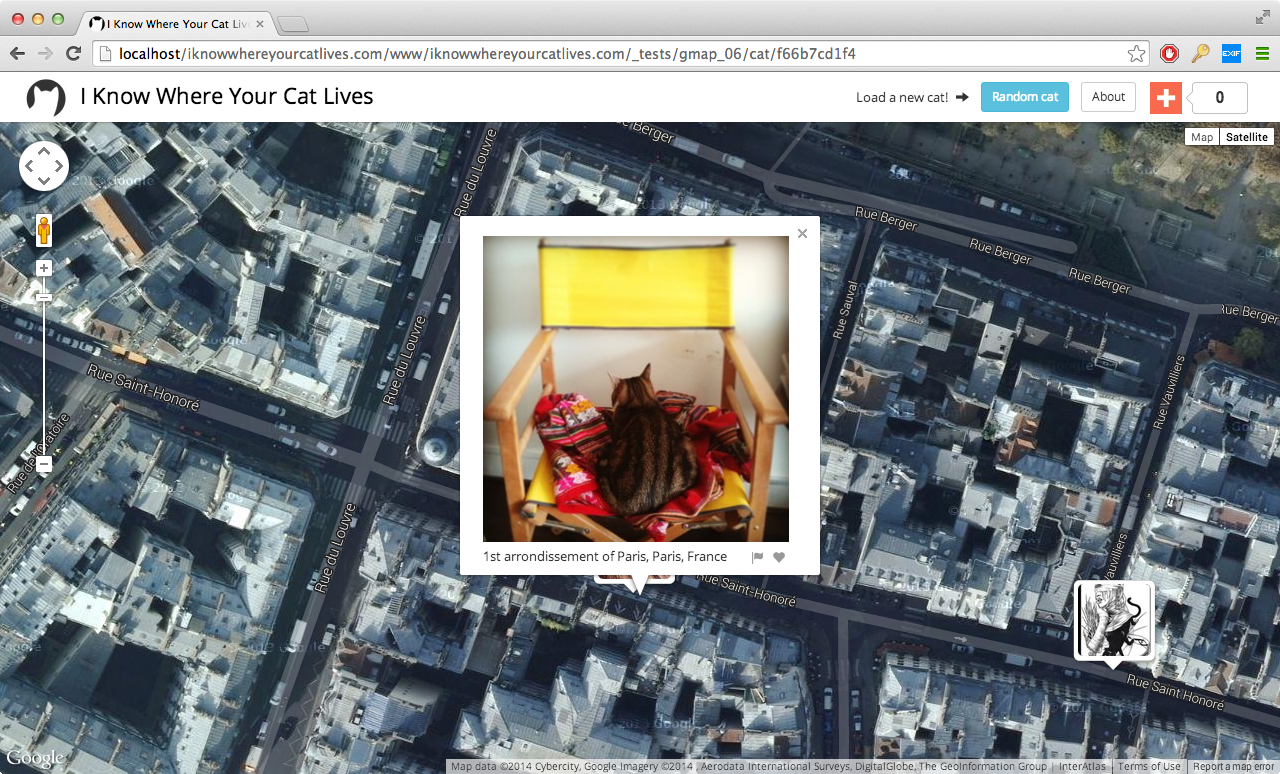
I Know Where Your Cat Lives has received an overwhelmingly positive response from international press. Besides photos of cats on a world map, there are charts, an FAQ and (now) links to press on the website.

I have to admit I specifically picked cat photos as an accessible medium with which to explore the privacy issue. Still, I was astounded at just how much the internet responded. It’s not only cats, the issue was important for discussion, and I appreciated that as well as the thoughtful responses from everyone. Even the puns.


The privacy implications of cat pictures (4:24) MSNBC Interview with Ronan Farrow

Meet The Guy Who’s Putting Your Cat On The Map — To Prove A Point (2:12) Interview with National Public Radio’s All Things Considered

npr_logo

“If you have posted a picture of your cat online, data analyst and artist Owen Mundy, and now, the rest of the world, knows where it lives. And, by that logic, he knows where you live, too. That should probably creep you out a little bit, and that’s really the point.”

Screen Shot 2014-08-06 at 2.53.29 PM

“Using cat pictures — that essential building block of the Internet — and a supercomputer, a Florida State University professor has built a site that shows the locations of the cats (at least at some point in time, given their nature) and, presumably, of their owners.”

Screen Shot 2014-08-06 at 9.41.41 AM

“Attention all 4.9 million users of the #Catstagram hashtag: You’re being watched.”

Screen Shot 2014-08-06 at 2.54.23 PM

“I recognize that a single serving site like this should be easy to quit, but I’ve been refreshing for hours and looking at all the different cats of the world. Near, far, wherever they are, these cats just go on and on and on.”

Screen Shot 2014-08-06 at 9.53.46 AM

“If I put up a “cat” photo on Instagram, I am not just sharing a cat photo on Instagram. I am offering up data about my, and my cat’s, location. “I Know Where Your Cat Lives” is, as a title, meant to be vaguely threatening.”

Screen Shot 2014-08-06 at 9.53.54 AM

“Owen Mundy just ruined the Internet. What were once innocuous photos of grumpy cats, tired cats, and fat cats, have now become adorable symbols of just how little privacy we have online.”

Screen Shot 2014-08-06 at 9.54.06 AM

Some charts

Because, charts.

chart_world

catsworld-citiesworld

chart_eu

chart_AT-DE

Traffic and hosting

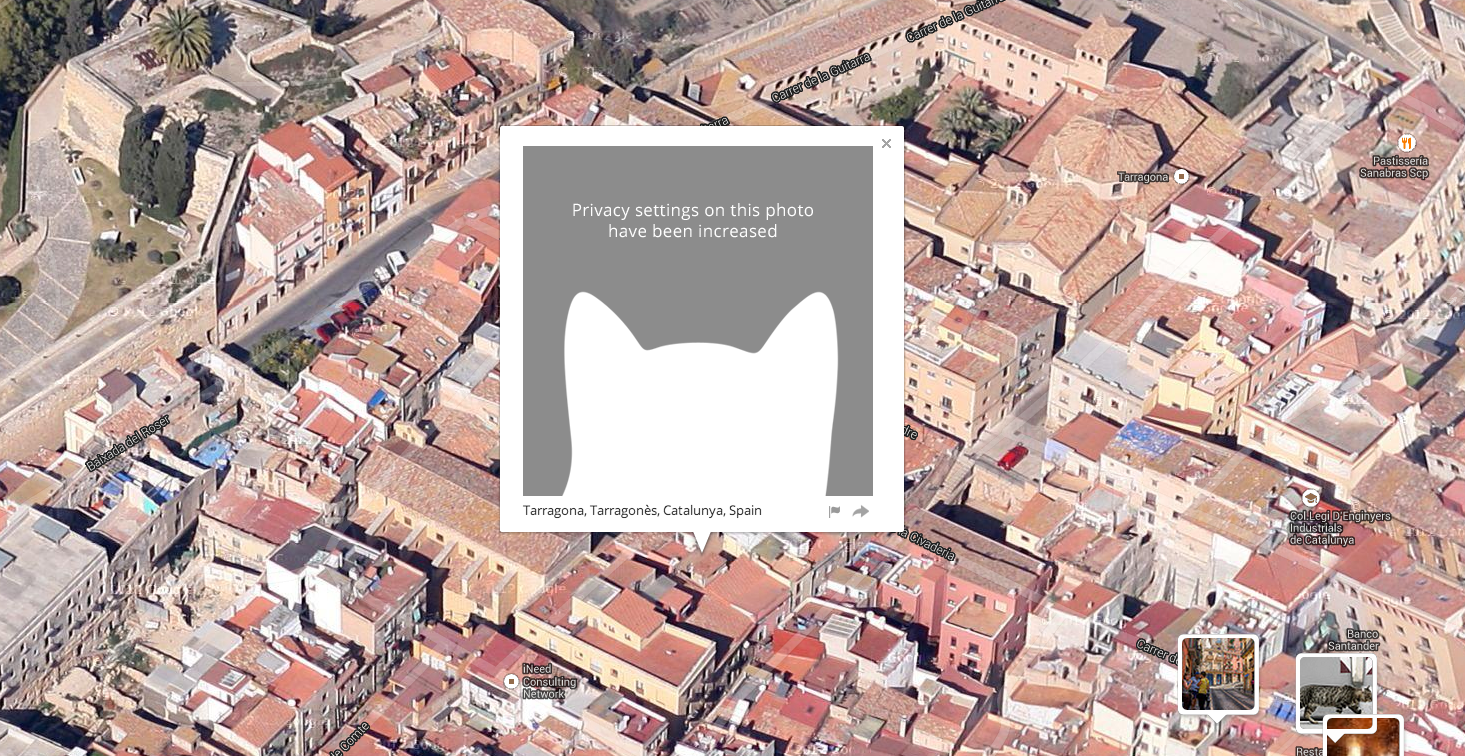
So far 19,169 cats have been removed from the map due to privacy settings on their photographs being increased. I think this is awesome. And, it is also the ironic part of this project in that its success is measured in increased privacy. Meaning, the more people who are convinced to manage their data better, the less cats I will be able to represent on the map!

Truthfully speaking, I don’t think I have to worry about running out of cats, since this is a small portion of the total one million. And, I figured out a clever way to show this progress as it unfolds:

Screen Shot 2014-08-06 at 10.46.31 AM

The bandwidth and computing resources consumed by this project have been crazy. Even with a very fast Amazon EC2 server (high I/O computing-intensive 4XL server with 16 virtual cpus and 30 GB RAM) I watched the CPU hover at 100% for the entire day of The New York Times article. And this is after I put many hours indexing the database columns and making the scripts efficient in other ways. All told my bill for “going viral” was $1,019.73 (the month of July 2014).

Screen Shot 2014-07-31 at 10.01.18 AM

I used a few different logging tools to monitor the status of the server. Here are some basic stats (from awstats installed on the server) from the three weeks since I launched the project. This is for the requests and bandwidth on the EC2 server only. It does not include the actual cat photos, only the website itself (html, css, json, php, etc):

  • 353,734 unique visits
  • 14,141,644 pages (total clicks on the site)
  • 16,786,127 requests (additional files)
  • 8846.24 GB bandwidth (again, only text files)

I also used CloudFlare CDN (thanks for the tip Tim Schwartz!) to cache the site files and cat photos and serve the data from various locations around the world. This helped with the speed and to decrease my costs. Since all requests are routed through their DNS I believe their stats are likely the most reliable. According to CloudFlare, they served:

  • 20,631,228 total requests (3,089,020 of which were served through CloudFlare’s cache)
  • 10.2 TB bandwidth!! (437.3 GB of this data (site files and cat photos were served by CloudFlare)

Screen Shot 2014-08-06 at 11.20.28 AM

The Kickstarter has <3 days left!

And great news, thanks to 123 backers, including a big push from the awesome folks at Ghostery and Domi Ventures, the Kickstarter will be funded! There’s still time however, to help contribute to the number of years I can keep the site live while getting fun rewards from the project like I Know Where Your Cat Lives themed beer koozies and plush fish-shaped catnip-laced cat toys, as well as a limited edition signed I Know Where Your Cat Lives archival ink jet print. The kickstarter closes on Sat, Aug 9 2014 11:49 AM EDT.

Thanks again to everyone who supported the project. It’s been fun.


I Know Where Your Cat Lives launched

I just launched a new ongoing project this week. Here’s the text, a video and some screenshots. I’ll post more about how I made it soon.

Welcome to the today’s internet—you can buy anything, every website is tracking your every move, and anywhere you look you find videos and images of cats. Currently, there are 15 million images tagged with the word “cat” on public image hosting sites, and daily thousands more are uploaded from unlimited positions on the globe.

“I Know Where Your Cat Lives” iknowwhereyourcatlives.com is a data experiment that visualizes a sample of 1 million public pics of cats on a world map, locating them by the latitude and longitude coordinates embedded in their metadata. The cats were accessed via publicly available APIs provided by popular photo sharing websites. The photos were then run through various clustering algorithms using a supercomputer at Florida State University in order to represent the enormity of the data source.

This project explores two uses of the internet: the sociable and humorous appreciation of domesticated felines, and the status quo of personal data usage by startups and international megacorps who are riding the wave of decreased privacy for all. This website doesn’t visualize all of the cats on the net, only the ones that allow you to track where their owners have been.

Folks can also contribute to a kickstarter to help with hosting costs.

Screen Shot 2014-05-14 at 11.01.20 PM

Screen Shot 2014-05-14 at 11.06.09 PM

Screen Shot 2014-05-15 at 10.16.42 AM

Screen Shot 2014-05-23 at 8.48.02 PM

Screen Shot 2014-05-23 at 9.24.59 PM

Screen Shot 2014-06-05 at 10.28.53 AM

Screen Shot 2014-06-05 at 10.30.26 AM

Art and the Internet book published by Black Dog Publishing

Here are some shots from the recently released Art and the Internet (Black Dog Publishing, London) with contributions from Joanne McNeil, Domenico Quaranta, and Nick Lambert. The book is a welcome update to writing on the subject and contains many well known works by artists I’ve admired for years. Nice to be included.

art-internet-_0000_Layer 20

art-internet-_0001_Layer 18
Trust (Evidence Locker) (2004) Jill Magid. Essay by Joanne McNeil.

art-internet-_0002_Layer 17
Simple Net Art Diagram by MTAA (1997). Essay by Domenico Quaranta

art-internet-_0003_Layer 16
Colorflip.com (2008) by Rafaël Rozendaal

art-internet-_0007_Layer 8
Every Icon (1997) by John F Simon Jr

art-internet-_0009_Layer 6
Tommy Chat Just Emailed Me (2006) by Ryan Trecartin

art-internet-_0004_Layer 13
1:1 (1999-2002) by Lisa Jevbratt

art-internet-_0006_Layer 11
They Rule (2001) by Josh On

art-internet-_0010_Layer 4
My Generation (2010) by Eva and Franco Mattes

art-internet-_0005_Layer 12
Artist’s Statement No 45, 730,944: The Perfect Artistic Website (2000) Young-Hae Chang Heavy Industries

art-internet-_0011_Layer 1
I am Unable to Fulfill Your Wish (2012) by Owen Mundy

art-internet-_0012_Layer 0

“Data and Site: Visualizing Indexicality” lecture @ Florida State

Screen-Shot-2014-03-27-at-1.43.23-PM_cropped

I am giving a lecture on my research tomorrow at a Florida State Department of Geography colloquium. I’ll be addressing artistic and cultural works that make use of data visualization and various forms of mapping to critique or engage issues surrounding data privacy, militarism, and surveillance. I will be giving a preview of a new web-based project involving mapping and cats. I will also talk about Representing Place, the collaborative graduate seminar I co-taught with Prof. Phil Steinberg in Geography.

“Data and Site: Visualizing Indexicality”
Owen Mundy, Assistant Professor in Art
Friday April 18, 3:30-4:30pm
DeVoe Moore Conference Center, Bellamy 150-E.

Term vs. Term for Digital Public Library of America hackathon

I made a small app to compare the number of search results for two phrases from the Digital Public Library of America for a hackathon / workshop here at Florida State next week.

http://owenmundy.com/work/term-vs-term

dpla term vs term

Digital Humanities Hackathon II – Digital Public Library of America

Monday, April 21, 2:00-3:30 p.m.
Strozier Library, Scholars Commons Instructional Classroom [MAP]

The Digital Scholars Reading and Discussion Group will simulate its second “hackathon” on April 21, allowing participants to learn more about the back-end structure of the Digital Public Library of America. With its April 2013 launch, the DPLA became the first all-digital library that aggregates metadata from collections across the country, making them available from a single point of access. The DPLA describes itself as a freely available, web-based platform for digitized cultural heritage projects as well as a portal that connects students, teachers, scholars, and the public to library resources occurring on other platforms.

From a critical point of view, the DPLA simultaneously relies on and disrupts the principles of location and containment, making its infrastructure somewhat interesting to observe.

In this session, we will visit the DPLA’s Application Programming Interface (API) codex to observe some of the standards that contributed to its construction. We will consider how APIs function, how and why to use them, and who might access their metadata and for what purposes. For those completely unfamiliar with APIs, this session will serve as a useful introduction, as well as a demonstration of why a digital library might also want to serve as an online portal. For those more familiar with APIs, this session will serve as an opportunity to try on different tasks using the metadata that the DPLA aggregates from collections across the country.

At this particular session, we are pleased to be joined by Owen Mundy from FSU Department of Art and Richard Urban from FSU College of Communication and Information, who have considered different aspects of working with APIs for projects such as the DPLA, including visualization and graphics scripting, and developing collections dashboards.

As before, the session is designed with a low barrier of entry in mind, so participants should not worry if they do not have programming expertise or are still learning the vocabulary associated with open-source projects. We come together to learn together, and all levels of skill are accommodated, as are all attitudes and leanings.

Participants are encouraged to explore the Digital Public Library of America site prior to our meeting and to familiarize themselves with the history of the project. Laptops will be available for checkout, but attendees are encouraged to bring their own.

Exuberant Politics

PS1_0002

March 6-April 8, 2014
Opening Receptions:
Legion Arts – March 6, 5-7 PM
1103 3rd St. SE, Cedar Rapids

Public Space One – March 7, 6-8 PM
120 N. Dubuque St., Iowa City

see websites for gallery hours
www.legionarts.org
www.publicspaceone.com

Exhibiting Artists – Legion Arts

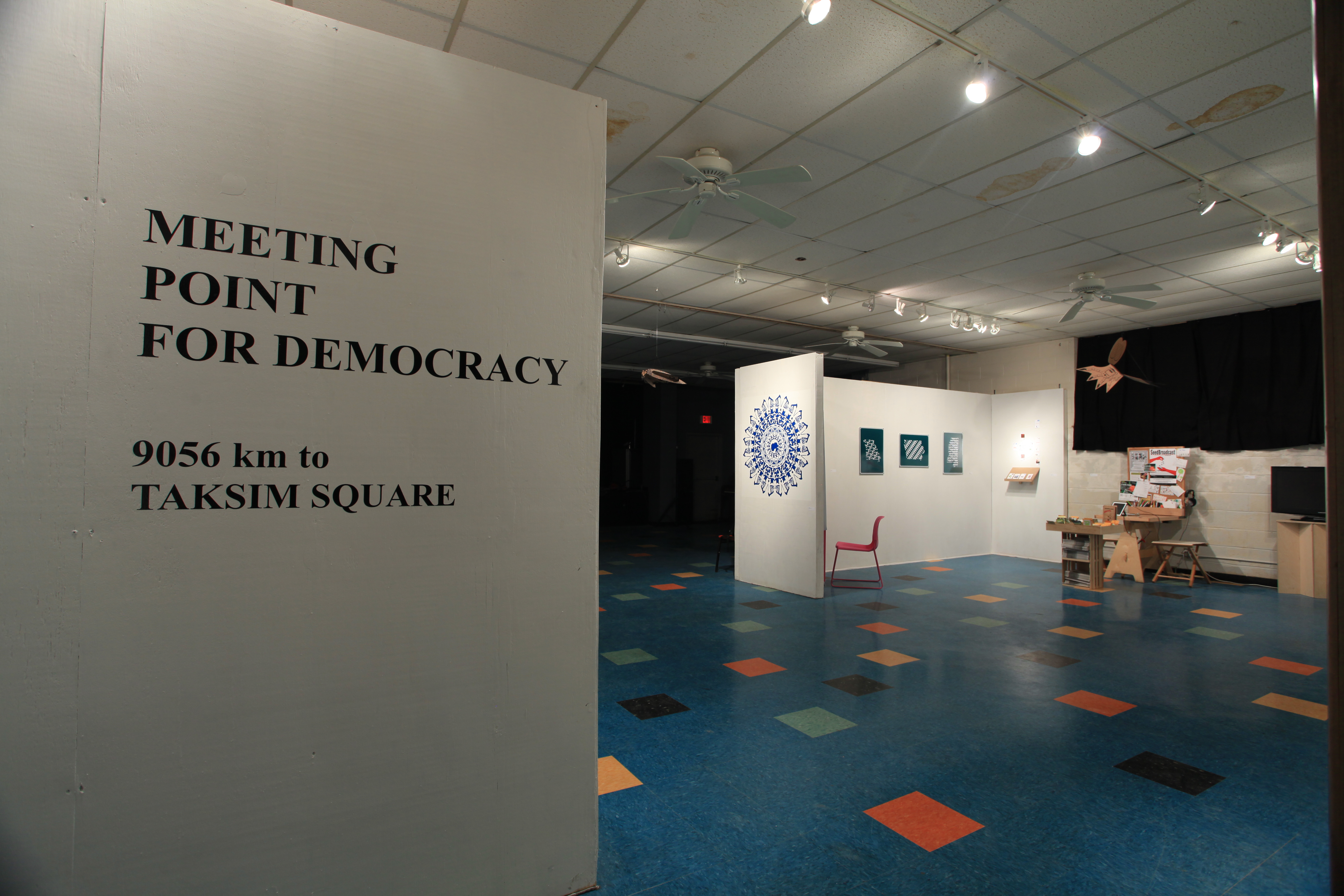
Brandon Bauer (United States), Mark Cooley (United States), Priti Cox (United States), Liz Ensz (United States), David Fodel (United States), Ben Grosser (United States), Miguel Angel Hernandez (Mexico), Mahdyar Jamshidi (Iran), Wago Kreider (United States), Jane Lawson (United Kingdom), Fred Lonidier (United States), Kim Maher (United States), Timea Oravecz (Hungary), Brian Prugh (United States), Ali Reid (United States), Charles Roderick (United States), Alicja Rogalska (United Kingdom), Fabio Santacroce (Italy), SeedBroadcast (United States), Robert Spahr (United States), Joanna Tam (United States), Lieve Van Stappen (Belgium)

Exhibiting Artists – Public Space One

Esther Baker-Tarpaga and Windega Tarpaga (United States), Pedro Bustamente (Germany), Vivian Charlesworth and Alyson Ogasian (United States), Stephen Chen (Germany), Chris Collins (United States), English Disco Lovers (United Kingdom), Liz Ensz (United States), Jeremy Entwistle (United States), Paul Handley (New Zealand), Josh Hoeks (United States), Faith Holland (United States), Sam Holler (United States), Philip Mantione (United States), Owen Mundy (United States), Jessica Pleyel (United States), Blanca Rego (Spain), Vincent Romaniello (United States), Jennie Schankar (United States), Heath Schultz (United States), Levi Sherman (United States), SeedBroadcast (United States), Greg Thompson (United States), Margi Weir (United States)

Plus posters and reading materials by

Richard Bannister, Bluelab, Andy Cairns, House Magic Bureau, Iraq Veterans Against the War, Kazu Livingstone, Anna McIntyre, Feliz Mundo, Tea Popovic, Melissa Potter, Matt Taylor, John Vincent, Food for Free Thought, Gene Elder, Alou Randon, Andy Singer, and Elizabeth Tonnard.

Supported by the College of Liberal Arts & Sciences Perry A. and Helen Judy Bond Fund for Interdisciplinary Interaction, the Studio for Public Digital Arts and Humanities, the School of Art and Art History, the Obermann Center, and the Project on the Rhetoric of Inquiry.

“The Earth Observation Guide” – Post Media Lab notes

I’m back from Lüneberg, Germany and already missing the simplicity of traveling by train as well as the pleasure of fine wurst. However I had an engaging few days at the Post Media Lab’s Taking Care of Things!. The event began with a keynote by Kelly Dobson from RISD, followed by a tour of Stadtarchive the next morning. Then we broke off into groups to address various topics around archives, art, media, and politics.

I worked in the Measure Drones group with colleagues, Kristian Lukic, Moritz Queisner, Boaz Levin, Daniel Herleth, Adam Kaplan, Frédéric Eyl, and Oliver Lerone Schultz (one of the coordinators of Taking Care of Things along with Christina Kral). Together, over the course of two days, we worked together to conceive, research, write, illustrate, and design a booklet called “The Earth Observation Guide.” This is not a history of art about drones, nor does it try to tackle the whole subject. Rather it is more akin to a time capsule that preserves a moment in time before drones are widespread. It acts as a guidebook, recording what is known about their past and present, illustrating shifts and concerns, and addressing how humans might understand their future. Here are some images of the presented work on the third day:

IMG_5074

IMG_140115_PML+HoL+CDC_Taking-Care-of-Things_Stadtarchiv-Lueneburg_0434-XL

IMG_5070

IMG_140115_PML+HoL+CDC_Taking-Care-of-Things_Stadtarchiv-Lueneburg_0596-XL


I also somehow managed to get my mug in the newspaper in Lüneberg. I think it says “American professor launching spy drones in Germany” or some such thing.

IMG_5062

The group examining 16th century drawings of salt mines from the archive.

IMG_5058